




Active Heat Sink Technology to Improve Thermal Performance of Military Systems
Active heat sinks
Thermacore
Lancaster, PA
717-569-6551
www.thermacore.com
The Defense Advanced Research Projects Agency (DARPA) has extended its contract with Thermacore to develop and commercialize active heat sinks that can be used with Micro-technologies for Air-Cooled Exchangers (MACE). The MACE program harnesses active micro-devices that greatly improve heat sink thermal performance and cool military electronic systems used for telecommunications, active sensing and imaging, radar, and other functions. Thermacore is partnering with the University of Minnesota, Lockheed Martin Company, and the Bergquist Torrington Company to develop the technology.
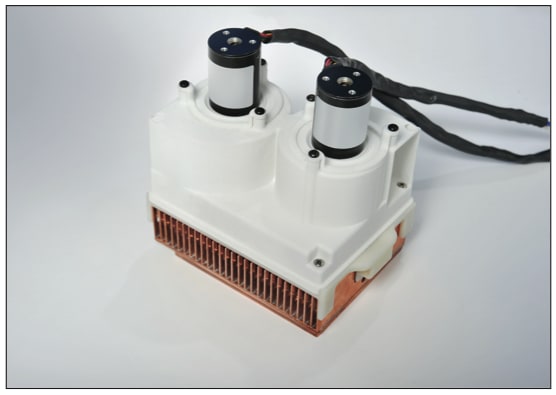
To qualify for the extension, Thermacore created a thermal demonstrator using a combination of existing and developmental heat transfer tools. The requirements included a power/heat input capability of one kilowatt, a volume of 4 × 4 × 4", a mass of 800 grams or less, thermal resistance less than 0.05°C/W, and electrical power consumption of 33W or less. The device’s heat flux was more than double the contract’s requirements, according to Thermacore, and the thermal resistance was 10 percent lower than what was originally proposed.
Thermacore’s work on the MACE project is closely related to another DARPA-commissioned project where the company contributed to the development of a cooling system for military and automotive electronics applications. Specifically, the advanced cooling system handles roughly 10 times the heat generated by conventional computer chips. The technology developed in the MACE program will allow that heat to move more efficiently into the airstream.
More From SAE Media Group
Tech Briefs
Chip Converts Wasted Heat to Usable Energy
Aerospace & Defense Tech Briefs
Considerations for Thermal Management of Printed Wiring Boards
Aerospace & Defense Tech Briefs
Thermal Management Techniques in Avionics Cooling
Automotive Engineering
Getting a Grip on EV Fasteners
Tech Briefs
Composite Panel with Integrated Thermal Control
Aerospace & Defense Tech Briefs
Ruggedization of Electronics for Deployed Military Environments


Battery Technology
An Immersive Solution for Thermally Safer EV Batteries
Medical Design Briefs
Thermal Management Solutions for Medical Electronics
Tech Briefs
5 Ws of the Electronics-Powering Finger Wrap
Aerospace & Defense Tech Briefs
Taming the Thermal Behavior of Solid-State Military Lasers
Automotive Engineering
Defrosting Tech Saves EV Battery Energy
Tech Briefs
Low-Inductance DC Power Bus
Automotive Engineering
Air- or Water-Cooling Resistors for EVs: The Case for H2O
Aerospace & Defense Tech Briefs
Dispensable Gels vs Gap Filler Pads
Aerospace & Defense Tech Briefs
Thermoelectric Cooling
Aerospace & Defense Tech Briefs
Thermal Trends and Improvements for Rugged COTS Cards
Tech Briefs
Solid-State Thermal Transistor
Tech Briefs
Wearable Air Conditioning
Tech Briefs
Electronics Cooling Using Additive Manufacturing
Aerospace & Defense Tech Briefs
Surviving the Challenge of Thermal Design in Aerospace Electronics
Tech Briefs
Q&A: Electricity-Free Cooling
Off-Highway Engineering
Thermal Management for Off-Highway Vehicles
Tech Briefs
Pyroelectric Sandwich Thermal Energy Harvester
Tech Briefs
How Much Do You Know About Thermal Management?


Electronics & Sensors INSIDER
New Cooling Technique Could Make Computer Chips More Powerful

Top Stories
INSIDERManufacturing & Prototyping
 How Airbus is Using w-DED to 3D Print Larger Titanium Airplane Parts
INSIDERManned Systems
 FAA to Replace Aging Network of Ground-Based Radars
NewsTransportation
 CES 2026: Bosch is Ready to Bring AI to Your (Likely ICE-powered) Vehicle
NewsSoftware
 Accelerating Down the Road to Autonomy
EditorialDesign
 DarkSky One Wants to Make the World a Darker Place
INSIDERMaterials
 Can This Self-Healing Composite Make Airplane and Spacecraft Components Last...
Webcasts
Defense
 How Sift's Unified Observability Platform Accelerates Drone Innovation
Automotive
 E/E Architecture Redefined: Building Smarter, Safer, and Scalable...
Power
 Hydrogen Engines Are Heating Up for Heavy Duty
Electronics & Computers
 Advantages of Smart Power Distribution Unit Design for Automotive...
Unmanned Systems
 Quiet, Please: NVH Improvement Opportunities in the Early Design...
