




Bird-Inspired Unmanned Aircraft Show Higher Efficiency and Endurance
RMIT University researchers in Melbourne, Australia, are developing bio-inspired unmanned aircraft capable of soaring like birds, boosting energy efficiency and endurance.
In collaboration with Australia's Defence Science and Technology Organisation (DSTO), the research team is aiming to be the first in the world to demonstrate an autonomous unmanned aircraft that can mimic birds by using updrafts around buildings to stay airborne.
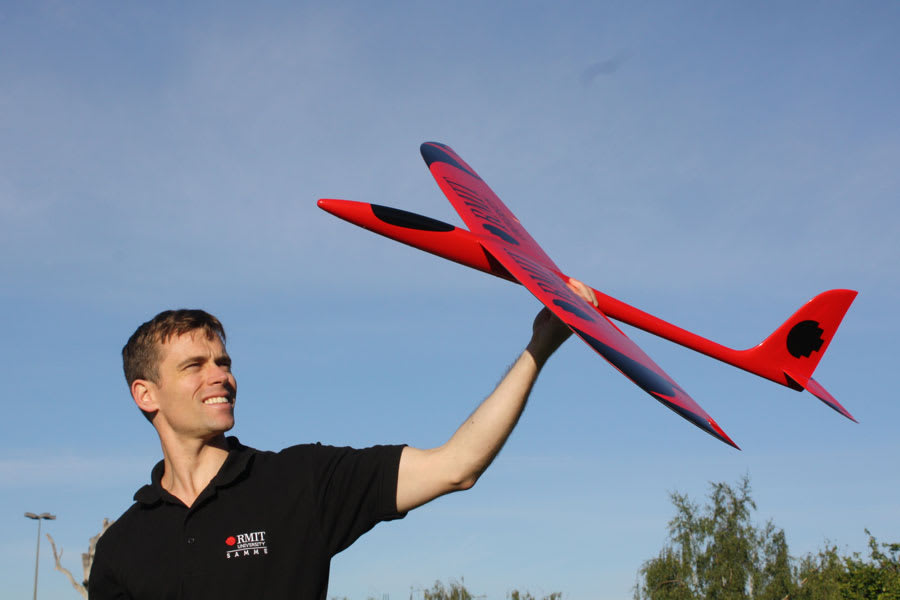
Lead researcher Dr Reece Clothier said soaring birds used positive air flows generated around features such as cliffs or large buildings to maintain lift.
"This research aims to develop the sensing and control systems that will allow a small fixed-wing unmanned aircraft to achieve the same thing," Dr Clothier said.
"Birds make soaring look easy, but when we try to mimic what they know by instinct, we realise just how far advanced nature is in its designs."
The focus is on proving the feasibility of "urban" soaring, combining real-time sensing of wind with complex flow models to locate possible positive airflows around large buildings. Flying a small aircraft in those updrafts could significantly increase its endurance.
Dr Jennifer Palmer, a Senior Research Scientist in the Aerospace Division of DSTO, said the long-term goal was to design an unmanned aircraft that could autonomously predict airflows in its surrounding environment and — by using this information — minimise its energy consumption, maximise its endurance and avoid areas of high turbulence.
"Small aircraft used for communications relay or surveillance and reconnaissance could greatly benefit by having a means of exploiting naturally occurring updrafts and avoiding the deleterious effects of turbulence in urban environments," Dr Palmer said.
"DSTO undertakes research in a number of areas related to autonomous unmanned aircraft, and this is a great opportunity to engage with academia on a project with both scientific challenges and real-world outcomes."
More From SAE Media Group
Aerospace & Defense Tech Briefs
Quantifying Autonomous Soaring on a Surveillance and Communications Relay Mission
Aerospace & Defense Tech Briefs
Uncrewed Solar Aircraft Passes Key Ground Tests
Aerospace INSIDER
Navy Completes 73-Hour Nonstop Flight of Solar-Powered UAS


Aerospace & Defense Tech Briefs
Airbus to Fly Prototype eVTOL This Year
Aerospace & Defense Tech Briefs
Rising Star Awards: Women in Engineering Aerospace Winner - Heather Cummings
Aerospace & Defense Tech Briefs
Assessment of Noncommercial Icing Prediction Capabilities for Army Applications
Motion Design INSIDER
Tailless Jet Flies Free with Novel Control Technique
Tech Briefs
Novel Control Method in Tailless Aircraft
Aerospace & Defense Tech Briefs
PHASA-35 Stratospheric Flight
Aerospace & Defense Tech Briefs
MQ-25 Vehicle Management Computer Upgrade
Aerospace & Defense Tech Briefs
MUSHER Demonstrates Manned-Unmanned Aircraft Teaming Applications
Aerospace & Defense Tech Briefs
Small UAV Satcom System
Tech Briefs
Algorithms Improve Quadrotor Drone Performance
Motion Design INSIDER
AI-Powered Vision System Helps Drones Navigate Safely
Aerospace & Defense Tech Briefs
Effectiveness of Inter-Vehicle Communications and On-Board Processing for Close Unmanned Autonomous Vehicle Flight Formations
NASA Spinoff
From Shark Searches to Space Tours
Aerospace INSIDER
GA-ASI Announces Gray Eagle 25M for Multi-Domain Operations
Aerospace & Defense Tech Briefs
Remotely Piloted Air Systems
Aerospace INSIDER
Bombardier to Start Building New Army HADES Prototype Spy Plane
Aerospace INSIDER
Engineers Assess Flow Quality in Wind Tunnel Test Facility
Aerospace & Defense Tech Briefs
The New Airbus Wingman Aircraft
Tech Briefs
AIRVUE: Prelude to Self-Flying Aircraft
NASA Spinoff
Flying (Not Quite) Blind
Aerospace & Defense Tech Briefs
1 Megawatt Turbogenerator
Aerospace & Defense Tech Briefs
Air Force eVTOL Research and Development Programs Make Remote Pilot Progress
Tech Briefs
Aircraft Vertical Takeoff and Landing
Aerospace & Defense Tech Briefs
AI Algorithms Fly Valkyrie XQ-58A
Top Stories
INSIDERManufacturing & Prototyping
 How Airbus is Using w-DED to 3D Print Larger Titanium Airplane Parts
INSIDERManned Systems
 FAA to Replace Aging Network of Ground-Based Radars
NewsTransportation
 CES 2026: Bosch is Ready to Bring AI to Your (Likely ICE-powered) Vehicle
NewsSoftware
 Accelerating Down the Road to Autonomy
EditorialDesign
 DarkSky One Wants to Make the World a Darker Place
INSIDERMaterials
 Can This Self-Healing Composite Make Airplane and Spacecraft Components Last...
Webcasts
Defense
 How Sift's Unified Observability Platform Accelerates Drone Innovation
Automotive
 E/E Architecture Redefined: Building Smarter, Safer, and Scalable...
Power
 Hydrogen Engines Are Heating Up for Heavy Duty
Electronics & Computers
 Advantages of Smart Power Distribution Unit Design for Automotive...
Unmanned Systems
 Quiet, Please: NVH Improvement Opportunities in the Early Design...
