




Flying Robot Would Monitor Environmental Health
With a contract from the U.S. Army, the University of Nevada, Reno is partnering with NevadaNano to develop a robotic flying vehicle that can be used for environmental health and safety monitoring of large areas. The goal is development of a flying robot with integrated chemical sensing, inter-unit communication, and the potential for self-powering. It will be able to "swarm" with other similar units to monitor, collect, and analyze samples while in flight and relay data immediately.
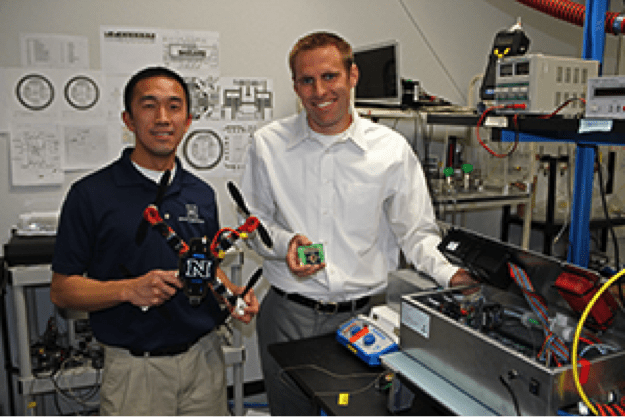
The flying robotic platforms may evolve to a system to carry a number of payloads, beginning with this autonomous environmental detection system, for a wide variety of applications. The sensor system, with a sensor chip about 1 x 1 mm, currently installed in a housing about the size of a shoebox, is being reduced in size and will eventually be about the size of a deck of cards, with the sensing system integrated into the construction of the flying robot.
The final platform will detect environmental threats in vapor form using interchangeable, onboard sensors. Utilizing the real-time data collected and analyzed by these sensors, the unit will be capable of swarming with other units during surveillance of a given area to, for example, localize and profile a contaminant source, such as toxic industrial chemicals and materials, semi-volatile and volatile organic compounds (pesticides, ammonia, and explosives), and chemical or biological agents.
More From SAE Media Group
Aerospace Manufacturing and Machining INSIDER
Supernova to 3D Print Military Grade Energetic Materials
Aerospace & Defense Tech Briefs
Fiber Computer Allows Apparel to Run Apps and Understand the Wearer
Aerospace & Defense Tech Briefs
DEVCOM CBC Innovates and Integrates through Autonomous Technologies
Aerospace & Defense Tech Briefs
Machine Learning Unlocks Secrets to Advanced Alloys
Aerospace INSIDER
FAA to Replace Aging Network of Ground-Based Radars
Photonics & Imaging Technology INSIDER
High-Speed Infrared Reveals Safer Hypergolic Propellant
Aerospace & Defense Tech Briefs
The Future of Automated Guided Vehicles for Aerospace and Defense
Aerospace & Defense Tech Briefs
Context-Aware Visual Search Using a Pan-Tilt-Zoom Camera


Aerospace INSIDER
Bombardier to Start Building New Army HADES Prototype Spy Plane
Tech Briefs
Combating COVID-19 with Clean Air Tech
Aerospace & Defense Tech Briefs
Data Collection Using the MetalMapper in Dynamic Data Acquisition and Cued Modes
Aerospace & Defense Tech Briefs
Chemical Hazard Sensor
NASA Spinoff
Clean Air Tech for Spacecraft Helps Fight Pandemic

Aerospace & Defense Tech Briefs
Unlocking the Potential of 3D-Printed Polymers in Aerospace and Defense


Tech Briefs
Products of Tomorrow
Tech Briefs
Solid-State Carbon Dioxide Sensor

Tech Briefs
Sensor Film for Aerospace

Aerospace INSIDER
Navy Completes 73-Hour Nonstop Flight of Solar-Powered UAS

Aerospace & Defense Tech Briefs
New AFRL Chamber Enhances Equipment Performance in Extreme Environments
Aerospace & Defense Tech Briefs
Low Cost Air Traffic Control for Drones
Aerospace & Defense Tech Briefs
Human-Focused Research Aims to Enhance UAS Effectiveness, Readiness
Aerospace INSIDER
Aitech’s New Palm-Sized Satellite Enables Space-Based AI Processing
Top Stories
INSIDERManufacturing & Prototyping
 How Airbus is Using w-DED to 3D Print Larger Titanium Airplane Parts
INSIDERManned Systems
 FAA to Replace Aging Network of Ground-Based Radars
NewsTransportation
 CES 2026: Bosch is Ready to Bring AI to Your (Likely ICE-powered) Vehicle
NewsSoftware
 Accelerating Down the Road to Autonomy
EditorialDesign
 DarkSky One Wants to Make the World a Darker Place
INSIDERMaterials
 Can This Self-Healing Composite Make Airplane and Spacecraft Components Last...
Webcasts
Defense
 How Sift's Unified Observability Platform Accelerates Drone Innovation
Automotive
 E/E Architecture Redefined: Building Smarter, Safer, and Scalable...
Power
 Hydrogen Engines Are Heating Up for Heavy Duty
Electronics & Computers
 Advantages of Smart Power Distribution Unit Design for Automotive...
Unmanned Systems
 Quiet, Please: NVH Improvement Opportunities in the Early Design...
