




Realistic Simulation Makes Army Helmets Safer
Helmet Design Simulation
MIT Man-Vehicle Laboratory
Cambridge, MA
617-253-7758
mvl.mit.edu
As materials, ergonomic design, and ballistics protection have evolved, the U.S. Army helmet has improved in form and function, from the M1 of WWII, to the 29-layer Kevlar PASGT (Personnel Armor System for Ground Troops), to finally the lighter Kevlar/Twaron ACH (Advanced Combat Helmet) design of today (Figure 1). Helmet liners have progressed too, from compressed paper fibers, plastic, and rayon in the early days to more sophisticated suspension-webbing systems with chin straps constructed from stronger synthetics.

Since the 1970s, there has been no shortage of ideas about how to construct helmet liner systems. Countless designs have emerged using air- and fluid-filled chambers. But the designs have primarily been sports-related, and the protection systems focused on protecting against impact (striking an object) rather than blast (from a shock wave).
There’s also been no shortage of hypotheses about what materials would be most effective at blast attenuation. Mechanical properties are the major contributor to the way shock waves behave at material interfaces; acoustic impedance mismatches determine what portion of a wave is reflected and transmitted. Layered composites, cellular materials, expanded polystyrene, vinyl nitrate foams, and glycerin have all been suggested as candidates, while material properties such as porosity, density, and heat capacity have been proposed as factors contributing to blast mitigation.
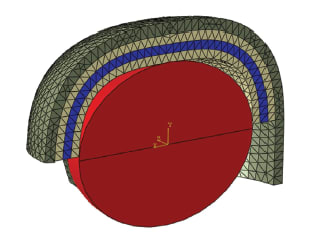
“The FEA software needed to handle the nonlinear complexity of the contact between the helmet, head, and air,” says graduate student Andrew Vechart, who worked with fellow researcher Rahul Goel in Young’s laboratory. “It also had to be good at simulating the physics of the blast wave moving through air.” Other design challenges included comfort, fit, and feel. The team chose Abaqus from SIMULIA, the Dassault Systèmes brand for realistic simulation, for its ability to meet these requirements, as well as the fact that it is frequently referenced in research literature for its blast modeling and analysis capabilities.
“Simulating a blast event provides important, realistic data without the risk of involving test subjects,” says Vechart. “It also eliminates the need for special facilities and permissions required to handle explosives.”
In order to evaluate the effectiveness of different filler materials during a blast event, the team first analyzed a simplified liner model — a flat sandwich-plate manufactured from high-energy-absorbing vinyl nitrile foam. A cavity in the plate was used to hold the different fillers including: fluids (water and glycerin) and solids such as foam, glass beads, and aerogel. Results from these tests were compared against the benchmark case of a solid piece of foam with no cavity. The team used the CONWEP air blast capability in Abaqus to reduce computation times by eliminating consideration of the blast media (air) from the analysis. They then used the Coupled Eulerian-Lagrangian (CEL) feature in Abaqus to analyze the realistic behavior of fluid filler materials.
Next, the team created a simplified helmet-liner model and coupled it with a surrogate head model, also simplified (Figure 2). The team again used a CEL simulation, which effectively replicated the relatively complex fluid-structure interaction (FSI) of the air blast — high blast levels, short time spans, compressibility effects, and some nonlinearity. The team used a Windows XP, 64 bit, 8 GB RAM system running on an Intel Core 2 Duo 3 GHz processor. Solutions were computed up to two milliseconds after detonation with peak transmitted pressure being of primary interest.
To validate simulation results against physical experiments, collaborators at Purdue University’s Zucrow Laboratory used a shock tube to create a controlled explosion equivalent to the one used in the simulation and an approximation of a typical IED explosion (50 pounds of TNT at a distance of 20 feet). The simulated blast had peak overpressures strong enough to cause TBI (50 psi) but not strong enough to be fatal (at 100 psi there is a one percent chance of fatality).
For the solid foam liner, there was reasonable agreement between simulation and test results for peak loading pressures and rise time as the shock wave impacted the liner, as well as for transmitted pressure on the back-side of the model. The analyses indicated that glass beads, water, and glycerin had the lowest peak pressures and demonstrated the best characteristics for blast attenuation.
For Free Info Click Here
More From SAE Media Group
Aerospace & Defense Tech Briefs
Ballistic Helmets
Aerospace & Defense Tech Briefs
Inter-Laboratory Combat Helmet Blunt Impact Test Method Comparison
Defense INSIDER
Multifunctional Nanofiber Protects Against Explosions
Tech Briefs
Pearl-Like Coating Enhances Lightweight Armor
Aerospace & Defense Tech Briefs
A Supercomputer for Aerospace and Defense Systems Modeling and Simulation
Aerospace & Defense Tech Briefs
Sensing Applied Load and Damage Effects in Composites with Nondestructive Techniques


Aerospace & Defense Tech Briefs
Reduced Order Modeling for Rapid Simulation of Blast Events of a Military Ground Vehicle and its Occupants
Aerospace & Defense Tech Briefs
Designing With Plastics for Military Equipment

Aerospace & Defense Tech Briefs
The World’s Largest Real Time EW Test Range
Defense INSIDER
3D Printing Parts for Ships, Submarines and Underwater Vehicles
Aerospace & Defense Tech Briefs
3D Printing Parts for Ships, Submarines and Underwater Vehicles
Aerospace & Defense Tech Briefs
Designing Transportable, High-Performance AI Systems for the Rugged Edge
Tech Briefs
2023 Create the Future Design Contest
Aerospace & Defense Tech Briefs
Robotic Rotational Molding Creates New Opportunities for Military and Aerospace Applications
Aerospace Manufacturing and Machining INSIDER
Can This Self-Healing Composite Make Airplane and Spacecraft Components Last for Centuries?
Tech Briefs
Material Combination Strengthens Body Armor
Aerospace & Defense Tech Briefs
Cold Spray Technology
Tech Briefs
Why the RenAM 500Q?


Aerospace & Defense Tech Briefs
Turn Growing Complexity into Competitive Advantage Through Digitalization -- Focus of AeroTech Keynote Thursday
Off-Highway Engineering
Predicting Mobility in MILITARY OPERATIONAL SCENARIOS
Defense INSIDER
US and Japanese Scientists Conduct Joint Composites Study
Aerospace & Defense Tech Briefs
3D Printing Metal Parts on a Ship
Top Stories
INSIDERManufacturing & Prototyping
 How Airbus is Using w-DED to 3D Print Larger Titanium Airplane Parts
INSIDERManned Systems
 FAA to Replace Aging Network of Ground-Based Radars
NewsTransportation
 CES 2026: Bosch is Ready to Bring AI to Your (Likely ICE-powered) Vehicle
NewsSoftware
 Accelerating Down the Road to Autonomy
EditorialDesign
 DarkSky One Wants to Make the World a Darker Place
INSIDERMaterials
 Can This Self-Healing Composite Make Airplane and Spacecraft Components Last...
Webcasts
Defense
 How Sift's Unified Observability Platform Accelerates Drone Innovation
Automotive
 E/E Architecture Redefined: Building Smarter, Safer, and Scalable...
Power
 Hydrogen Engines Are Heating Up for Heavy Duty
Electronics & Computers
 Advantages of Smart Power Distribution Unit Design for Automotive...
Unmanned Systems
 Quiet, Please: NVH Improvement Opportunities in the Early Design...
