




Autonomous Vehicle Engineering - January 2021
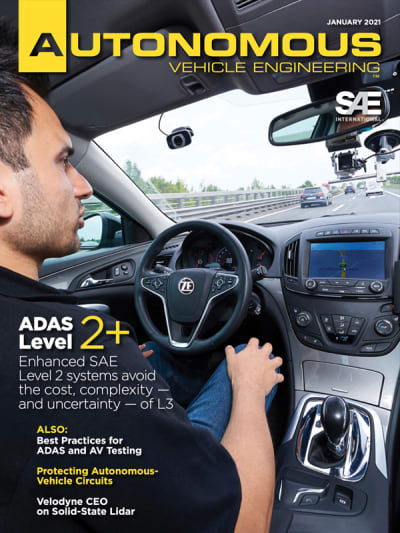
Inside this issue
Overview
The latest issue of Autonomous Vehicle Engineering delves into significant advancements and discussions surrounding autonomous vehicle technology, particularly focusing on safety, communication technologies, and the evolving landscape of automated driving systems.
Key Highlights:
-
Vehicle Safety Communications Landscape: A pivotal article discusses the Federal Communications Commission (FCC) ruling from November 2020, which reallocated a portion of the 5.9-GHz "Safety Spectrum" previously reserved for vehicle communications. The ruling favors cellular vehicle-to-everything (C-V2X) technology over the Wi-Fi-based Dedicated Short-Range Communications (DSRC). This decision has sparked debate among industry experts, with concerns about potential interference from newly permitted radio signals affecting the reliability of the Safety Spectrum. The article emphasizes that the automotive industry has not sufficiently demonstrated the safety benefits of DSRC, leading to the FCC's decision to limit the spectrum available for automotive safety communications.
-
Level 2+ Automated Driving Systems: The issue explores the burgeoning area of Level 2+ automated driving systems, which, while not officially recognized in the SAE J3016 levels, are becoming increasingly popular in the industry. These systems aim to enhance driver assistance features without the complexities associated with Level 3 automation. Suppliers like ZF are actively testing new developments, including adaptive merging and advanced automated emergency braking (AEB) systems. The focus is on ensuring driver attention and safety while providing high-value features that can be integrated into existing vehicles.
Testing Best Practices for ADAS and AVs: A veteran tester shares insights on acquiring quality test and validation data for Advanced Driver Assistance Systems (ADAS) and autonomous vehicles (AVs). The article outlines ten best practices that can help streamline the testing process, ensuring that data collected is reliable and useful for further development. This guidance is crucial as the industry moves towards more sophisticated automated systems that require rigorous validation to ensure safety and performance.
-
Innovations in Lidar Technology: The issue also highlights Velodyne's new Velarray H800 Lidar system, designed for ADAS applications and scalable automated production. This technology represents a significant step forward in sensor capabilities, enabling more accurate perception for autonomous vehicles. The integration of advanced Lidar systems is essential for enhancing the safety and reliability of AVs, as they provide critical data for navigation and obstacle detection.
-
Impact of COVID-19 on Mobility: An editorial discusses the impact of the COVID-19 pandemic on the mobility-as-a-service (MaaS) business model, which has faced challenges due to public hesitance towards shared mobility options. However, the pandemic has also opened new opportunities for automated delivery vehicles, suggesting a shift in focus towards last-mile delivery solutions. This evolution reflects changing consumer behaviors and the need for innovative approaches in the mobility sector.
-
Industry Collaboration and Future Directions: The magazine emphasizes the importance of collaboration among industry stakeholders, including automakers, technology providers, and regulatory bodies. Events like the Digital Summit provide platforms for discussing changing regulations related to safety, emissions, and energy conservation, allowing participants to influence future vehicle development. The issue encourages ongoing dialogue to address the challenges and opportunities presented by emerging technologies in the automotive landscape.
-
Conclusion: Overall, this issue of Autonomous Vehicle Engineering provides a comprehensive overview of the current state of autonomous vehicle technology, highlighting critical developments in communication systems, safety features, and testing methodologies. As the industry continues to evolve, the insights shared in this publication will be invaluable for professionals seeking to navigate the complexities of autonomous vehicle engineering and development.
In summary, the magazine serves as a vital resource for understanding the latest trends, challenges, and innovations in the field of autonomous vehicles, fostering a deeper appreciation for the technology that is shaping the future of transportation.
Articles
Top Stories
INSIDERAerospace
 How Airbus is Using w-DED to 3D Print Larger Titanium Airplane Parts
NewsAutomotive
 Microvision Aquires Luminar, Plans Relationship Restoration, Multi-industry Push
INSIDERManufacturing & Prototyping
 A Next Generation Helmet System for Navy Pilots
INSIDERDefense
 New Raytheon and Lockheed Martin Agreements Expand Missile Defense Production
ArticlesAR/AI
 Accelerating Down the Road to Autonomy
Road ReadyDesign

Webcasts
Automotive
 Advantages of Smart Power Distribution Unit Design for Automotive...
Unmanned Systems
 Quiet, Please: NVH Improvement Opportunities in the Early Design...
Defense
 Cooling a New Generation of Aerospace and Defense Embedded...
Power
 Battery Abuse Testing: Pushing to Failure
Power
 A FREE Two-Day Event Dedicated to Connected Mobility
