




Aerospace & Defense Technology - August 2021
Inside this issue
Overview
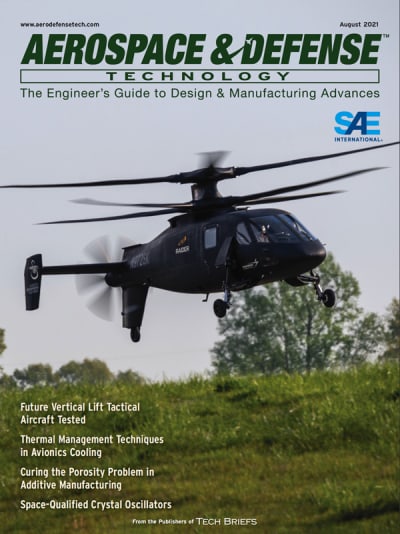
The August 2021 issue of Aerospace & Defense Technology presents a comprehensive exploration of current advancements and challenges in the aerospace and defense sectors. This edition features a variety of articles that delve into innovative technologies, engineering solutions, and industry trends that are shaping the future of aviation and defense.
Future Vertical Lift Tactical Aircraft
One of the key highlights of this issue is the focus on Future Vertical Lift (FVL) tactical aircraft. The article discusses the ongoing development of next-generation rotorcraft designed to enhance operational capabilities for military forces. These aircraft aim to provide improved speed, range, and versatility compared to existing models. The FVL program is a critical initiative for the U.S. Army and other branches of the military, as it seeks to address the evolving demands of modern warfare, including the need for rapid troop deployment and support in diverse environments.
Thermal Management Techniques in Avionics Cooling
Another significant topic covered is the thermal management techniques employed in avionics cooling systems. As avionics systems become more sophisticated and compact, managing heat dissipation has become increasingly challenging. The article outlines various strategies, including advanced materials and innovative cooling designs, that are being implemented to ensure optimal performance and reliability of electronic components in aircraft. Effective thermal management is crucial for maintaining the functionality of avionics systems, especially in high-performance military aircraft where operational conditions can be extreme.
Curing the Porosity Problem in Additive Manufacturing
The issue also addresses the challenges associated with additive manufacturing, particularly the problem of porosity in 3D-printed components. Porosity can significantly affect the mechanical properties and overall integrity of parts used in aerospace applications. The article explores various methods being researched and developed to mitigate porosity, including process optimization, material selection, and post-processing techniques. By overcoming these challenges, manufacturers can enhance the reliability and performance of additive-manufactured components, paving the way for broader adoption of this technology in the aerospace industry.
Space-Qualified Crystal Oscillators
In the realm of space technology, the magazine features an article on space-qualified crystal oscillators. These components are essential for maintaining accurate timing and frequency control in satellite systems and other space applications. The article discusses the rigorous testing and qualification processes that these oscillators must undergo to ensure their reliability in the harsh conditions of space. As satellite technology continues to advance, the demand for high-performance crystal oscillators that can withstand extreme temperatures and radiation levels is becoming increasingly critical.
Industry Insights and Trends
Beyond specific technologies, the issue provides insights into broader industry trends, including the impact of emerging technologies such as artificial intelligence and machine learning on aerospace and defense. These technologies are being integrated into various systems to enhance decision-making, improve operational efficiency, and enable predictive maintenance. The magazine emphasizes the importance of staying ahead of technological advancements to maintain a competitive edge in the rapidly evolving aerospace landscape.
Conclusion
Overall, the August 2021 issue of Aerospace & Defense Technology serves as a valuable resource for professionals in the industry, offering a blend of technical insights, innovative solutions, and forward-looking perspectives. As the aerospace and defense sectors continue to evolve, staying informed about the latest developments and challenges is essential for engineers, manufacturers, and decision-makers alike. This issue not only highlights the current state of technology but also sets the stage for future advancements that will shape the next generation of aerospace and defense capabilities.
Features
-
Application Briefs
-
Articles
4 Thermal Management Techniques in Avionics Cooling
8 Curing the Porosity Problem in Additive Manufacturing
12 Space-Qualified Crystal Oscillators
20 Reimagining Automated Test During a Pandemic
24 EW: New Challenges, Technologies, and Requirements
30 Software Enables New-Age, Flexible Test Solution for Analog and Digital Radios
Tech Briefs
-
Aerospace
32 Formal Process Modeling to Improve Human-Decision-Making During Test and Evaluation Range Control
Products
-
62 New Products
Top Stories
INSIDERDefense
 New Raytheon and Lockheed Martin Agreements Expand Missile Defense Production
NewsAutomotive
 Ford Announces 48-Volt Architecture for Future Electric Truck
INSIDERManufacturing & Prototyping
 Active Strake System Cuts Cruise Drag, Boosts Flight Efficiency
ArticlesTransportation
 Accelerating Down the Road to Autonomy
INSIDERMaterials
 How Airbus is Using w-DED to 3D Print Larger Titanium Airplane Parts
Road ReadyTransportation

Webcasts
Electronics & Computers
 Cooling a New Generation of Aerospace and Defense Embedded...
Power
 Battery Abuse Testing: Pushing to Failure
Connectivity
 A FREE Two-Day Event Dedicated to Connected Mobility
Automotive
 Quiet, Please: NVH Improvement Opportunities in the Early Design Cycle
Transportation
 Advantages of Smart Power Distribution Unit Design for Automotive &...
Aerospace
 Sesame Solar's Nanogrid Tech Promises Major Gains in Drone Endurance