




Wheel Force Transducer
This transducer could ensure better testing of off-road vehicles.
Aconcept wheel force transducer has been developed that can measure the forces and moments between a tire and a road on a High Mobility Multi-purpose Wheeled Vehicle (HMMWV or Humvee) driven under off-road conditions. The proposed wheel force transducer is an important step in correcting the gap in current tire testing and modeling knowledge to ensure that future off-road vehicle models and simulation efforts are conducted with confidence. In order to obtain tire characteristics over off-road terrain, cost-effective field test equipment was required.
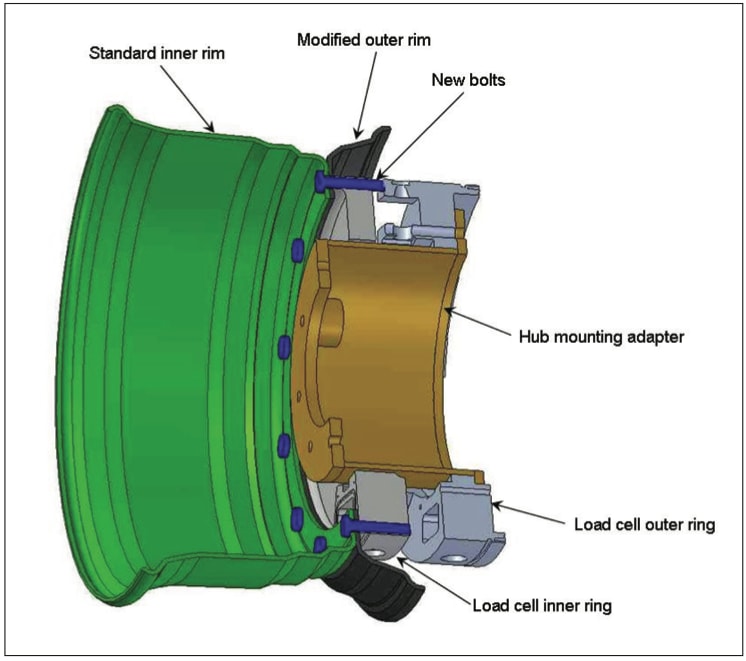
The wheel force transducer had to replace part of the rim so that the rim was connected to the hub via the force transducer. To achieve this, the standard rim had to be modified. Modification involved cutting out the center portion of the outer part of the original rim to the same diameter as the unmodified inner rim. The load cell inner ring was mounted to the modified rim using 12 bolts. On the unmodified rim, these 12 bolts were responsible for holding together the two parts of the split rim. These bolts were part of the inner rim. In this application, the bolts were replaced and screwed in from the inside of the rim into the load cell inner ring. The nuts on the outside were not used, as the load cell inner ring served this purpose.
The load cell outer ring was mounted to the hub using the hub mounting adapter, which connected the load cell outer ring to the vehicle’s hub with the existing eight hub bolts and nuts. The hub mounting adapter was also bolted to the load cell outer ring. The load cell inner ring and outer ring were connected to each other via six individual tension-compression load cells. The load cells were mounted such that the three tire forces and three tire moments could be calculated from the six tension-compression forces measured with the individual load cells and the geometry.
The possibility exists to mount the wheel force transducer to other rim sizes and designs. The exact possibilities depend on the geometry of the different rims, but basically entail designing and manufacturing adapters to connect the load cell inner ring to the rim, and the load cell outer ring to the hub. This can also be turned around so that the load cell inner ring is mounted to the hub, and the load cell outer ring is mounted to the rim.
This work was done by P.S. Els of the University of Pretoria, South Africa, for the US Army International Technology Center-Atlantic. ARL-0124
This Brief includes a Technical Support Package (TSP).
Wheel Force Transducer Research and Development
(reference ARL-0124) is currently available for download from the TSP library.
Don't have an account?
More From SAE Media Group
Motion Design
Self-Contained Wheel Unit
Motion Design
Making Automotive Assembly Lines Safer
Motion Design INSIDER
Self-Contained Wheel Units Cut Vehicle Costs
Aerospace & Defense Tech Briefs
SAE International Extends Call for Abstracts, Seeks Submissions for AeroTech Conference
Motion Design
Plastic Bearings Redefine the Wheelchair
Motion Design
Soft Mate Lifting Device
Automotive Engineering
Hyundai’s Uni Wheel Creates Space for EV Powertrains

Aerospace & Defense Tech Briefs
Industry Invited to Participate in AeroTech Aerospace and Defense Technical Program
Tech Briefs
Cord Tension Measurement Device
Autonomous Vehicle Engineering
German University Installing Advanced Simulator to Study Autonomous-Vehicle Handover
Medical Design Briefs
Mechatronic Integration for Precision Medical Device Linear Motion
Tech Briefs
All-Terrain Wheelchair
Aerospace & Defense Tech Briefs
Miniature Wheel-Leg Mobile Robots

Automotive Engineering
A Darker Side of the Chip-Shortage Story
Tech Briefs
Chemically Driven Wheels “Morph” Into Gears

Tech Briefs
Tension Element Vibration Damping
Motion Design
Gear Bearings
Automotive Engineering
Slate and SK Executives on Bringing the Inexpensive EV to Market
Motion Design
Get a Handle on Grippers
Motion Design
Multi-Axis Motion Controller Accelerates Gear Testing
Tech Briefs
UCF’s Hypersonic Technology Advances
Motion Design
Torque Limiters 101: Benefits, Types, and Comparisons
Automotive Engineering
Schaeffler Heads Back to CES with New Acquisition, Capabilities
Tech Briefs
Products of Tomorrow
Overview
The document titled "Wheel Force Transducer Research and Development" is a first interim report authored by Prof. P.S. Els from the University of Pretoria, covering the period from September 16, 2010, to December 16, 2010. It details the development of a prototype wheel force transducer designed to measure the forces and moments between a tire and the road while a vehicle, specifically a High Mobility Multipurpose Wheeled Vehicle (HMMWV), is driven under off-road conditions.
The primary objective of this research is to create cost-effective field test equipment that can accurately capture tire characteristics in real-world off-road scenarios. The report outlines four main objectives: developing a six-component wheel force transducer, creating mathematical models for the transducer, validating and calibrating the device, and manufacturing a set of four wheel load cells for vehicle installation.
The document emphasizes the importance of obtaining accurate tire characteristics for off-road terrain, which poses significant challenges for traditional laboratory testing methods. The proposed wheel force transducer is a crucial step in addressing gaps in current tire testing and modeling knowledge, ultimately enhancing the reliability of future off-road vehicle models and simulations.
Key design requirements for the transducer include a static vertical wheel load of 1600 kg, a maximum vertical load capacity of 4800 kg, and specifications for rim size and flange dimensions. The report also discusses the need to mount the transducer externally on the standard military HMMWV split rim due to space constraints imposed by suspension components.
The research is supported by the U.S. Army International Technology Center-Atlantic (USAITC-A), highlighting its significance in military applications. The report serves as a foundational document for ongoing research efforts aimed at improving tire performance and vehicle dynamics in challenging terrains.
In summary, this interim report outlines the initial stages of developing a wheel force transducer that will facilitate better understanding and modeling of tire behavior in off-road conditions, thereby contributing to advancements in vehicle testing and performance evaluation.
Top Stories
INSIDERManufacturing & Prototyping
 How Airbus is Using w-DED to 3D Print Larger Titanium Airplane Parts
INSIDERManned Systems
 FAA to Replace Aging Network of Ground-Based Radars
NewsTransportation
 CES 2026: Bosch is Ready to Bring AI to Your (Likely ICE-powered) Vehicle
NewsSoftware
 Accelerating Down the Road to Autonomy
EditorialDesign
 DarkSky One Wants to Make the World a Darker Place
INSIDERMaterials
 Can This Self-Healing Composite Make Airplane and Spacecraft Components Last...
Webcasts
Defense
 How Sift's Unified Observability Platform Accelerates Drone Innovation
Automotive
 E/E Architecture Redefined: Building Smarter, Safer, and Scalable...
Power
 Hydrogen Engines Are Heating Up for Heavy Duty
Electronics & Computers
 Advantages of Smart Power Distribution Unit Design for Automotive...
Unmanned Systems
 Quiet, Please: NVH Improvement Opportunities in the Early Design...
