




Development of Soldier Conformable Antennas Using Conducting Polymers
Fiber antennas can be directly incorporated into fabrics.
Soldiers performing dismounted operations in the field use radios that have antennas with a distinct visible signature and can become easy targets. These antennas also tend to snag on other equipment or vegetation, creating a hazard and a distraction to any ongoing operation. Therefore, it has become necessary to develop an antenna that can conform to soldiers and be virtually indistinguishable from a soldier’s body armor.
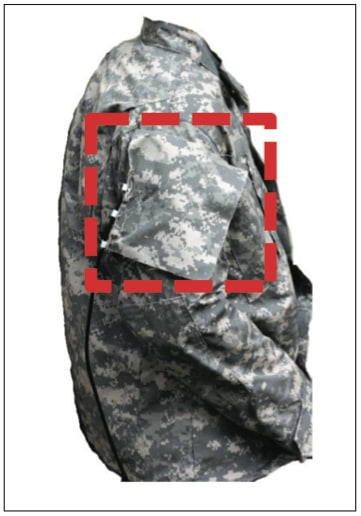
This innovation uses conducting polymer materials to create patch antennas that can easily conform to a soldier’s body and can match the performance of existing antennas. Antennas based on these materials have reached high enough electrical conductivities such that they have been developed for radio frequency identification (RFID) applications. These materials can be developed as flexible, conformable, and even transparent alternatives to traditional metal-based approaches.
Conducting polymers are electrically conducting materials that have high electrical conductivities (~105 S/m) and are extremely lightweight and flexible. Wires synthesized from these materials have a wide range of applications that can include smart textiles, neural probes, polymer-based actuators, sensors, and antennas. The fabrication technique involves an additive printing technique that can print numerous patterns, but with limited inherent conductivity (less than 600 S/m). There is also interest in generating highly electrically conductive polymer fibers that can be directly incorporated into clothing to function as an antenna, but a printing technique has to be developed for this process.
Polypyrrole films cannot be synthesized as long wires using traditional electrospinning or wet spinning techniques. The electrochemical deposition process involved in the fabrication of polypyrrole traditionally cannot create fibers; however, the thin films generated from this process have high conductivities. A new approach has been developed to manufacture wires of polypyrrole up to 10 m long having varying cross-sections. The pyrrole monomer was vacuum-distilled before use. Polypyrrole was electrodeposited on a glassy carbon cylindrical substrate at - 40 °C at a constant current density of 1.0 A/m2 for 8 hours. The deposition solution used was 0.05 M pyrrole in 0.05 M tetraethyl ammonium hexaflourophosphate in propylene carbonate. The cylindrical glassy carbon substrate is 85 mm tall and 75 mm in diameter. A thin layer of polypyrrole forms on the surface of the electrode approximately 10-20 μm thick.
The electrode is then mounted on a custom-built instrument that slices the wires. The instrument consists of 4 axes (1 rotary and 3 linear axes) with the electrode mounted on the rotary axis. One of the linear axes consists of a sharp blade that slides along with a rotating crucible. The blade slices the film by running over the crucible in a helical pattern. The blade is simultaneously oscillated along its length such that a fresh cutting edge is continuously presented at the point of contact with the crucible. This instrument has enabled the production of PPy microwires with widths as small as a few micrometers and lengths ranging from tens of millimeters to a few meters. It may also be used to slice microwires from films made of other types of conducting polymers.
These fibers can range from a few microns to tens of millimeters in width and thickness. The large conductivities and large strengths make these materials ideal candidates for direct incorporation into fabrics.
The design focuses on an easily removable patch design. This enables the user to easily attach and detach the antenna from their radios while at the same time avoiding the problems associated with repeated cycles of washing. It also provides a low-profile, lightweight, highly flexible design that can easily conform to any active surface. The base design consists of three layers: a top camouflage layer made of any type of flexible fabric, an intermediate feed/ radiator layer, and a bottom isolation/ attachment layer. The feed/radiator layer is uniplanar and can consist of a meander line monopole or a wideband radiator such as a bow-tie slot radiator that can be optimized for the particular application under consideration. The bottom layer isolates the middle layer from the body and contains attachments such as a hook-and-loop mechanism that can be used to attach the antenna to a uniform (see figure).
The overall device has dimensions of 200 mm × 200 mm and 1 mm in thickness, along with a very low bend radius. The connector cable in the current embodiment of the prototype is directly attached to the patch itself but it is not necessary for this to be the case. A connector can be directly connected to the patch and the device can be directly connected to the relevant radio.
The patch design was tested to access its viability as an antenna. The measurements were taken with a network analyzer and the radiation patterns were taken in a tapered anechoic chamber free from any outside interference. The chamber was calibrated to a known isotropic radiator. The test antenna was secured in a stable position with the electric field oriented vertically. The gains of the antennas were calculated at different frequencies. At 200 MHz the gain is about 0 dBi, at 250 MHz the gain is -1 dBi, and at 500 MHz the gain is 8.2 dBi. The lower gain is due to the low conductivity of the conducting polymer as compared to copper. A noticeable amount of directionality is visible in each tested frequency. Using automated sewing techniques, better and more precise geometries can be created that can make these antennas have a better return loss.
This work was done by Priam Pillai, Eli Paster, Lauren Montemayor, Chris Benson, and Ian W. Hunter of MIT. MIT-0003
This Brief includes a Technical Support Package (TSP).
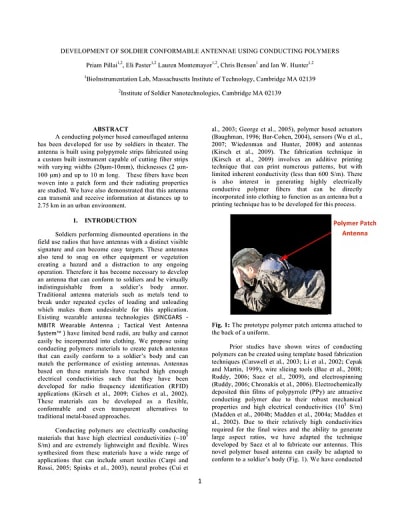
Development of Soldier Conformable Antennae Using Conducting Polymers
(reference MIT-0003) is currently available for download from the TSP library.
Don't have an account?
More From SAE Media Group
Tech Briefs
Automated Fabric Circuit and Antenna Fabrication
Medical Design Briefs
Inkjet Printing Shows Promise for Making E-Textiles
Tech Briefs
Conductive Carbon Fiber Polymer Composite
Tech Briefs
Hyper-Distributed RFID Antenna (HYDRA) System
Aerospace & Defense Tech Briefs
Raytheon Invests in Advanced, Autonomous Manufacturing Technologies for Radar Development, Testing


Tech Briefs
Agile RFID Antenna System
Tech Briefs
Inkjet Printing of Metamaterials
Tech Briefs
3D Printing Stronger Carbon Nanotubes
Tech Briefs
Precision CNT Cutting Mechanism
Aerospace & Defense Tech Briefs
Fabricating Transparent and Stretchable Supercapacitors Based on Wrinkled Graphene Electrodes
Automotive Engineering
Keeping Your Silicon Cool
Medical Manufacturing and Fabrication
Testing & Quality Control for Nanomanufacturing
Tech Briefs
Passive Smart Container
Aerospace & Defense Tech Briefs
Researchers Use Ancient Japanese Art Method to Create Tunable Antennas
Tech Briefs
A Novel Way to Convert Heat to Electricity
Tech Briefs
Organic Material for Printed Electronics


Aerospace & Defense Tech Briefs
Modeling and Experimenting with 2D Materials for CMOS Type Devices and Digital Integrated Circuits
Tech Briefs
Method Enables Conductive Gels to Stick When Wet
Power Electronics INSIDER
Scalable Supercapacitor Technology Made from Graphene
Aerospace & Defense Tech Briefs
Shape-Shifting Antenna Poised to Transform Communications
Overview
The document discusses the development of a novel conducting polymer-based camouflaged antenna designed for military use, specifically for soldiers in the field. Traditional antennas used by soldiers are often bulky, visible, and can snag on equipment or vegetation, making them potential targets and hazards during operations. The proposed solution addresses these issues by creating a flexible, lightweight antenna that can conform to a soldier's body armor, making it virtually indistinguishable from their uniform.
The antenna is constructed using polypyrrole strips, which are fabricated with a custom-built instrument capable of cutting fiber strips in varying widths (20μm to 10mm) and thicknesses (2μm to 100μm), with lengths of up to 10 meters. These strips are woven into a patch form, allowing for easy integration into clothing. The design focuses on a low-profile, removable patch that can be attached and detached from radios, thus avoiding the degradation associated with repeated washing and heating cycles of traditional wearable devices.
The antenna's design consists of three layers: a top camouflage layer made from flexible fabric, an intermediate feed/radiator layer, and a bottom isolation/attachment layer. The feed/radiator layer can be optimized for various applications, utilizing designs such as a meander line monopole or a bow-tie slot radiator. This configuration not only enhances the antenna's performance but also ensures comfort and usability for soldiers.
The document highlights the antenna's capability to transmit and receive information over distances of up to 2.75 kilometers in urban environments, demonstrating its effectiveness in real-world scenarios. The use of conducting polymers offers advantages over traditional metal-based antennas, including flexibility, conformability, and the potential for transparency, which are crucial for maintaining stealth in military operations.
Overall, this research represents a significant advancement in wearable antenna technology, providing soldiers with a more effective communication tool that enhances their operational capabilities while minimizing risks associated with traditional antennas. The work is conducted by researchers from the BioInstrumentation Lab and the Institute of Soldier Nanotechnologies at the Massachusetts Institute of Technology, and it was presented at the 27th Army Science Conference in 2010.
Top Stories
INSIDERDefense
 New Raytheon and Lockheed Martin Agreements Expand Missile Defense Production
NewsAutomotive
 Ford Announces 48-Volt Architecture for Future Electric Truck
INSIDERManufacturing & Prototyping
 Active Strake System Cuts Cruise Drag, Boosts Flight Efficiency
ArticlesTransportation
 Accelerating Down the Road to Autonomy
INSIDERMaterials
 How Airbus is Using w-DED to 3D Print Larger Titanium Airplane Parts
Road ReadyTransportation

Webcasts
Electronics & Computers
 Cooling a New Generation of Aerospace and Defense Embedded...
Power
 Battery Abuse Testing: Pushing to Failure
Connectivity
 A FREE Two-Day Event Dedicated to Connected Mobility
Automotive
 Quiet, Please: NVH Improvement Opportunities in the Early Design Cycle
Transportation
 Advantages of Smart Power Distribution Unit Design for Automotive &...
Aerospace
 Sesame Solar's Nanogrid Tech Promises Major Gains in Drone Endurance