




Analysis of Voltage and Current Signal Processing in a Li-ion Battery Management System
Performance of Li-ion batteries can be improved using a system that manages their charge and discharge.
A Battery Management System (BMS) manages Li-ion batteries in a storage system for pulsed power weapons aboard Naval vessels. The system charges the batteries with a buck converter according to the Constant Current Constant Voltage method. The BMS uses analog equipment to measure signals and then digitally converts signals for transmittal to a Field Programmable Gate Array (FPGA).
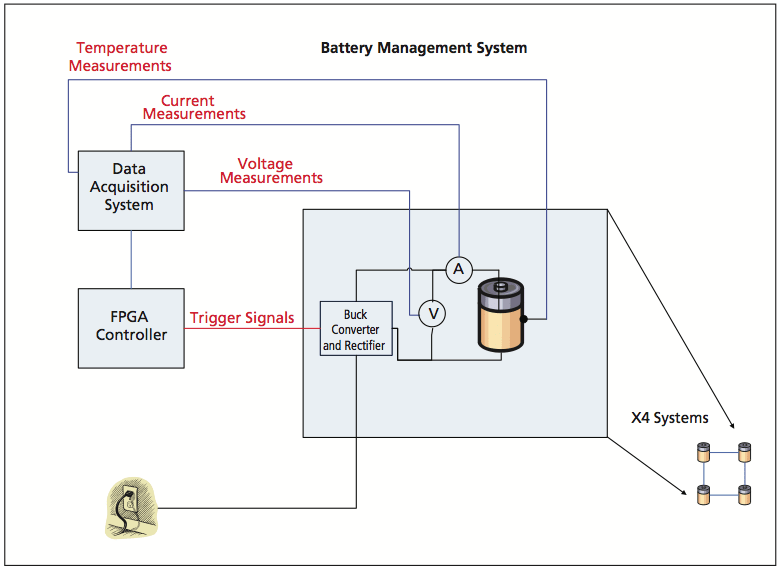
At its core, the BMS is made of four FPGA-controlled buck converters. There is one converter for each battery. Additionally, each converter contains sensors and a control system to allow for digital control of the buck converter by the FPGA. The FPGA varies the buck converter’s duty cycle to control the battery current.
The BMS is a complex system with many components that work together to accomplish its goal to manage Li-ion batteries. In order to control the charge delivered to Li-ion batteries, the cell current and voltage must be closely monitored. These two sensors are critical components of the BMS operation.
The BMS system consists of a transformer rectifier, a buck converter, an FPGA controller, a data acquisition system, and Li-ion batteries. The components that handle the current signal are a Hall Effect Sensor, a buffer/amplifier, an Analog-to-Digital Converter (ADC), and the FPGA. The components that handle the voltage signal are the voltage-to-frequency converter, an optocoupler for galvanic isolation, a SIMULINK® model for processing the output from the voltage-to-frequency converter, and the FPGA.
For the current signal, two sets of data were collected for analysis; one set with the buck converter operating at 30 kHz, and the other set at 8 kHz. For each frequency, testing included measurements at 20%, 50%, and 80% duty cycles. The digital waveforms are significantly distorted in shape from the analog input. Despite this distortion, the DC component of the signal is only slightly disturbed. The proportional integrator controller of the buck converter corrects the waveform distortion. The controller integrates the signal twice before processing. This smoothes out the signals and extracts the intact DC value of the signals. As the DC component of current is what charges the battery, this processing is appropriate. Therefore, even though the digital conversion introduces significant error, the FPGA does not see the error and uses only the correct DC values for processing.
The voltage signal processing method is less complicated, as the signal is converted digitally when the voltage-to-frequency converter measures it. The converter’s output is a digital square wave with frequency proportional to the voltage. The BMS uses three components to acquire and process the current for use in the FPGA: the LEM sensor, the buffer/amplifier (operational amplifier, or OPAMP), and the ADC.
The voltage output of the buck converter has a much simpler path to the FPGA. The voltage-to-frequency converter measures and digitally converts the voltage signal to a digital square wave with frequency proportional to the measured voltage. The FPGA then converts this digital waveform to a scalar value. The control aspect of the FPGA uses this scalar value to control the operation of the BMS.
The BMS uses a buck converter to deliver power to the Li-ion batteries for charging. The buck converter offers several advantages over other topologies including simplicity, ability to handle a wide range of voltages and currents, and high efficiency. The buck converter used in the BMS uses a MOSFET switch operating at 30 kHz controlled by the FPGA. The FPGA varies the duty cycle of the MOSFET switch to control the output current and the battery voltage. The charging current is constant until the battery voltage reaches an almost-full charge level. After the voltage reaches this level, the battery is trickle charged while regulating the voltage so as not to exceed the maximum battery voltage.
The testing results showed that, when properly calibrated, the BMS properly measures and transmits voltage data to the FPGA for processing and control. The current signal undergoes significant waveform distortion during the digital conversion. The DC component remains intact. The buck converter’s PI controller properly deals with this distortion by slowly responding to rapid changes in current. This allows the controller to respond only to the correct DC component of the current signal.
This work was done by Jerome Sean McConnon of the Naval Postgraduate School. NRL-0047
This Brief includes a Technical Support Package (TSP).

Analysis of Voltage and Current Signal Processing in a Li-ion Battery Management System
(reference NRL-0047) is currently available for download from the TSP library.
Don't have an account?
More From SAE Media Group
Embedded Technology
Wireless Electronic Patches Improve Medical Data and Patient Mobility
Tech Briefs
X-Band, 17-Watt Solid-State Power Amplifier
Embedded Technology
Understanding the Unique Requirements of Portable Data Acquisition Systems
Tech Briefs
High-Voltage, Asymmetric-Waveform Generator

Aerospace & Defense Tech Briefs
Optimizing IoMT Device Battery Life With Emulation and Profiling Software
Electronics Tech Briefs
Fast Transient-Voltage Recorder

Sensor Technology
Smart Batteries Include Force and Pressure Sensing
Aerospace & Defense Tech Briefs
Monitoring and Charging System for a High-Power Battery
Aerospace & Defense Tech Briefs
New Products


Tech Briefs
164-GHz MMIC HEMT Frequency Doubler
Tech Briefs
Impedance-Based Cable Tester

Battery Technology
Charge Control Methods for Supercapacitors
Sensor Technology
Near-Zero-Power Temperature Sensor
Tech Briefs
Full-Circle Resolver-to-Linear-Analog Converter

Aerospace & Defense Tech Briefs
Benefits and Challenges of Direct-RF Sampling for Avionic Platforms
Embedded Technology
Sensor Interface Design Demystified

Tech Briefs
Ultra-Efficient Ka-Band MMIC Power Amplifier

Battery Technology
Stretchable Micro-Supercapacitors Self-Power Wearable Devices
Aerospace & Defense Tech Briefs
How High-Reliability Capacitors Support Electrical Power in Military Vehicles
Overview
The document is a thesis authored by Jerome Sean McConnon at the Naval Postgraduate School in September 2010, focusing on the analysis of voltage and current signal processing in a Lithium-ion Battery Management System (BMS). The primary objective of the research is to enhance the management of Li-ion batteries used in pulsed power weapon systems on naval vessels, which require reliable and efficient energy storage solutions.
The thesis begins by outlining the importance of Li-ion batteries in modern military applications, particularly in systems that demand high energy density and rapid discharge capabilities. It discusses the challenges associated with battery management, including the need for precise monitoring of voltage and current to ensure safety, efficiency, and longevity of the battery systems.
McConnon explores various charging methods suitable for Li-ion batteries, emphasizing the significance of proper charging protocols to prevent overcharging and overheating, which can lead to battery failure or safety hazards. The document details the methodologies employed for measuring voltage and current signals, highlighting the importance of accurate data acquisition in the BMS.
The thesis also delves into digital signal processing techniques that can be applied to the data collected from the battery system. By utilizing advanced algorithms, the BMS can analyze the performance of the battery in real-time, allowing for better decision-making regarding charging cycles and energy distribution. This is particularly crucial in military applications where reliability and performance are paramount.
Furthermore, the research includes a discussion on the integration of the BMS with other systems on naval vessels, ensuring that the battery management is compatible with existing technologies and operational requirements. The findings suggest that an effective BMS can significantly enhance the operational capabilities of naval weapon systems by providing a stable and efficient power source.
In conclusion, McConnon's thesis presents a comprehensive study on the critical aspects of Li-ion battery management in naval applications. It emphasizes the need for advanced monitoring and processing techniques to optimize battery performance, ensuring that naval forces can rely on their energy systems during critical operations. The research contributes valuable insights into the development of more effective BMS solutions for military applications, paving the way for future advancements in battery technology.
Top Stories
INSIDERManufacturing & Prototyping
 How Airbus is Using w-DED to 3D Print Larger Titanium Airplane Parts
INSIDERManned Systems
 FAA to Replace Aging Network of Ground-Based Radars
NewsTransportation
 CES 2026: Bosch is Ready to Bring AI to Your (Likely ICE-powered) Vehicle
NewsSoftware
 Accelerating Down the Road to Autonomy
EditorialDesign
 DarkSky One Wants to Make the World a Darker Place
INSIDERMaterials
 Can This Self-Healing Composite Make Airplane and Spacecraft Components Last...
Webcasts
Defense
 How Sift's Unified Observability Platform Accelerates Drone Innovation
Automotive
 E/E Architecture Redefined: Building Smarter, Safer, and Scalable...
Power
 Hydrogen Engines Are Heating Up for Heavy Duty
Electronics & Computers
 Advantages of Smart Power Distribution Unit Design for Automotive...
Unmanned Systems
 Quiet, Please: NVH Improvement Opportunities in the Early Design...
