




High Critical Current in Metal Organic Derived YBCO Films
These films have potential in electric propulsion systems, directed-energy weapons, and commercial motors and generators.
High-temperature superconducting (HTS) YBCO wire is a versatile technology for a number of military and commercial applications. However, anticipated military applications such as energy-dense electric propulsion systems (including motor and adjustable speed motor drives), directed-energy weapons (including the gyrotron magnet and power supply), and commercial applications such as motors, generators, transformers, and power transmission lines require improvement in the performance of such wires before these applications are broadly realized.
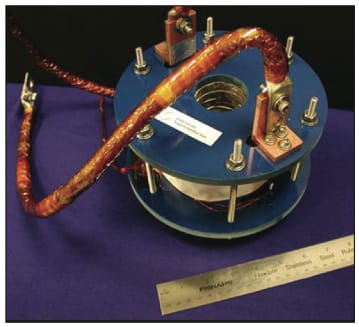
The project focused on developing a robust, multi-coat process and increasing the thickness of the single-coat process; characterization and optimization of the nucleation and growth stages of both the single- and multi-coat films; and transferring the thick-film coating-decomposition-reaction process to a long-length roll-to-roll manufacturing process.
A critical current of 560 A/cm-w was achieved in a 2-μm MOD film (660 A/cm-w was demonstrated in a 2-μm MOD film in a separately supported effort.). The maximum thickness of the single-coat MOD film was increased by 50% to 1.2 μm. The thick-film multi-coat and single-coat coating/decomposition processes were successfully demonstrated in a roll-to-roll manufacturing line. A thick-film conversion process for a 1.4-μm film was successfully demonstrated in a pilot roll-to-roll YBCO manufacturing furnace. Multiple 100-meter lengths of wire, with an Ic exceeding 300 A/cm-w, were fabricated in a pilot manufacturing line.
Key processing parameters were successfully developed and optimized for obtaining high critical currents in thick MOD-based YBCO films. The thick-film process also was successfully demonstrated in a roll-to-roll pilot manufacturing line. The 344 wires achieved end-to-end critical currents exceeding 300 A/cm-w (77K, self-field).
This work was done by Xiaoping Li of American Superconductor Corp. for the Air Force Office of Scientific Research. For more information, download the Technical Support Package (free white paper) at www.defensetechbriefs.com/tsp under the Materials category. AFRL-0180
This Brief includes a Technical Support Package (TSP).
High Critical Current in Metal Organic Derived YBCO Films
(reference AFRL-0180) is currently available for download from the TSP library.
Don't have an account?
More From SAE Media Group

Aerospace & Defense Tech Briefs
New Diamond Super-Material Enhances Aircraft Survivability

Aerospace & Defense Tech Briefs
More Bang for the Buck: A New Design and Manufacturing Method for Deep Penetrating Bomb Cases

Tech Briefs
A Novel Way to Convert Heat to Electricity
Aerospace & Defense Tech Briefs
Biodegradable MEMS Based on Cellulose Paper
Tech Briefs
Superlattice for Sustainable Quantum Electronics
Medical Manufacturing and Machining
Hybrid Technique Aims to Produce Stronger, Corrosion-Resistant Nickel
Medical Design Briefs
New Thermofluidic Improves Lab-On-a-Chip Applications

Tech Briefs
Videos of the Month
Tech Briefs
Liquid Metal Lattice

Aerospace & Defense Tech Briefs
Expanding Possibilities for Superconducting Qubits With Niobium
Tech Briefs
Superconductivity in a Nickel Oxide Material


Aerospace & Defense Tech Briefs
Solving Signal Interference Challenges in Aerospace and Defense Electronics
Medical Design Briefs
Nontoxic, Flexible Energy Converters Could Power Wearable Devices

Tech Briefs
Fine-Tuning Alloys for High-Temperature Use

Tech Briefs
Products of Tomorrow
Tech Briefs
Sustainable 3D-Printed Magnets
Overview
The final report titled "High Critical Current in Metal Organic Derived YBCO Films," prepared by American Superconductor Corporation under Contract FA9550-07-C-0034, outlines the achievements of a Phase II Small Business Technology Transfer (STTR) project focused on optimizing the Metal Organic Deposition (MOD) process for producing high critical current YBCO (Yttrium Barium Copper Oxide) films. These films are essential for the development of Second Generation (2G) YBCO coated conductor wires, which have significant applications in power transmission and magnetic systems.
The project successfully extended the thickness of YBCO films to over 2 micrometers (μm) using a multi-coat process. A notable achievement was the attainment of a critical current of 560 A/cm-width at 77K in a 2μm thick, rare earth-doped YBCO film. This advancement demonstrates the potential for high-performance superconducting materials in practical applications. The report highlights the successful transfer of the thick film, multi-coat process to American Superconductor’s wide-web manufacturing line, enabling the production of 2G wires with 1.4 μm thick, rare earth-doped YBCO films in lengths up to 100 meters.
Additionally, the project developed a modified decomposition process for Metal Organic-based YBCO precursors, which increased the maximum single-coat thickness to over 1.2 μm. This innovation led to a critical current approaching 450 A/cm-width in short-length 1.2 μm single-coat YBCO films. The report also notes that processing thicker high-temperature superconductor (HTS) layers necessitated longer reaction times, which is an important consideration for scaling up production.
Overall, the findings of this project contribute significantly to the field of superconductivity, particularly in enhancing the performance and manufacturability of YBCO films. The successful optimization of the MOD process and the ability to produce longer lengths of high-quality coated conductors represent a substantial step forward in the development of advanced superconducting materials for various technological applications. The report is intended for the Air Force Research Laboratory and is approved for public release, indicating its relevance to broader scientific and engineering communities.
Top Stories
NewsRF & Microwave Electronics
 Microvision Aquires Luminar, Plans Relationship Restoration, Multi-industry Push
INSIDERAerospace
 A Next Generation Helmet System for Navy Pilots
INSIDERDesign
 New Raytheon and Lockheed Martin Agreements Expand Missile Defense Production
INSIDERMaterials
 How Airbus is Using w-DED to 3D Print Larger Titanium Airplane Parts
NewsPower
 Ford Announces 48-Volt Architecture for Future Electric Truck
ArticlesAR/AI

Webcasts
Electronics & Computers
 Cooling a New Generation of Aerospace and Defense Embedded...
Automotive
 Battery Abuse Testing: Pushing to Failure
Power
 A FREE Two-Day Event Dedicated to Connected Mobility
Unmanned Systems
 Quiet, Please: NVH Improvement Opportunities in the Early Design Cycle
Automotive
 Advantages of Smart Power Distribution Unit Design for Automotive &...
Energy
 Sesame Solar's Nanogrid Tech Promises Major Gains in Drone Endurance