




Biodegradable MEMS Based on Cellulose Paper
This piezoelectric paper is flexible, biodegradable, and ultra-lightweight for industry, military, and space applications.
Electro-Active Paper(EAPap) has been recognized as a new smart material that can be used for sensors, actuators, biomimetic robots, and smart wallpapers. EAPap is made with cellulose paper by coating thin electrodes on both sides of it. This paper can produce a bending or longitudinal strain in the presence of an electric field. Also, it can produce an induced charge under the external stress. This EAPap material has many advantages in terms of large displacement output, low actuation voltage, low power consumption, dryness, flexibility, sensing capability, and biodegradable characteristics.

In developing biodegradable MEMS fabrication with cellulose EAPap, there are several sub-technologies: micro-patterning on cellulose paper, fabrication of microelectronics, and microstructure fabrication with cellulose paper. The MTP process has been studied to improve the quality of micro-transferred pattern. Studies included adhesion control between gold and cellulose paper, and contact alignment for pattern transfer. Several adhesive layers were tried to improve the adhesion between gold and cellulose papers. Also, the contact aligner machine was revised so as to precisely control the contact pressure and contact depth. This contact control capability allows high yield ratio on the MTP process. To demonstrate its success, dipole rectenna patterns were made.
As a microelectronic device, Schottky diodes were fabricated. Instead of using semiconductor materials such as GaAs or GaNb, nanoparticles were mixed in a resin polymer such as PEDOT, and their processability on cellulose paper was studied. MTP was used to make a pattern of semiconductor element on cellulose EAPap.
Cellulose paper fabrication was successfully established. To make microstructures with cellulose paper, micromolding can be a solution. Cellulose solution can be poured onto a micromold and cured. After that, however, washing and drying processes should be followed, which may affect the quality of the micro-molding.
The paper contained cellulose nanofibers, composed of cellulose crystalline and cellulose chains. The cellulose chains could be ordered by electrical poling and stretching. The diameters of the cellulose nanofibers were gradually reduced by increasing the stretching ratio. Dense crystalline in nanofibers of diameter 50-100 nm and ordering of cellulose chains resulted. Preliminary measurements revealed existence of direct piezoelectricity and converse piezoelectricity.
This work was done by Jaehwan Kim of South Korea’s Inha University for the Asian Office of Aerospace Research and Development. For more information, download the Technical Support Package (free white paper) at www.defensetechbriefs.com/tsp under the Materials category. AFRL-0160
This Brief includes a Technical Support Package (TSP).
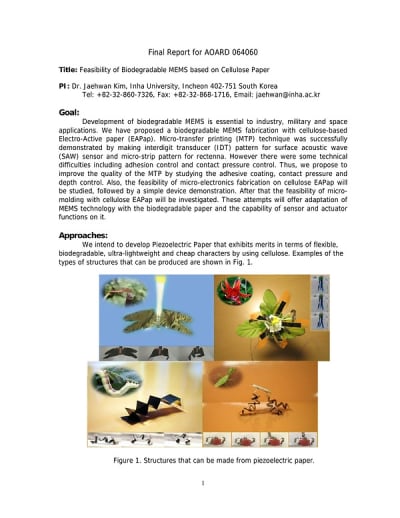
Biodegradable MEMS Based on Cellulose Paper
(reference AFRL-0160) is currently available for download from the TSP library.
Don't have an account?
More From SAE Media Group

Electronics & Sensors INSIDER
Careful Heating Unlocks Unprecedented Sensitivity to Pressure in Semiconductor Materials


Medical Design Briefs
Lens Offers Tunable Focus
Medical Design Briefs
Tiny Biosupercapacitor Provides Energy for Biomedical Applications

Medical Design Briefs
Hybrid Material Enables Next-Gen E-Skin
Medical Design Briefs
Piezoelectric Material Printing
Electronics & Sensors INSIDER
Piezoelectric Polymers
Tech Briefs
3D Printing of Wearable Devices
Tech Briefs
Nanoscale Pillars Act as Memory Foam
Medical Manufacturing and Machining
Process Developed to 3D Print Piezoelectric Materials
Tech Briefs
Macro-Fiber Composite (MFC) Actuator
Tech Briefs
5 Ws of 3D-Printing Piezoelectric Materials
Aerospace & Defense Tech Briefs
MEMS-Based Accelerometer to Measure Microgravity for In-Orbit Manufacturing
Medical Manufacturing and Machining
Hybrid Technique Aims to Produce Stronger, Corrosion-Resistant Nickel
Aerospace & Defense Tech Briefs
Nanosensor Arrays for Detecting Breast-Cancer Compounds
Tech Briefs
Small and Dexterous Cockroach-Inspired Robot
Tech Briefs
Twisted Moiré Photonic Crystals
Tech Briefs
Flexible Piezoelectric Actuators
Tech Briefs
Self-Protected, Low-Temperature Nanosolder
Electronics & Sensors INSIDER
Medical Robotic Hand? Rubbery Semiconductor Makes It Possible
Tech Briefs
Products of Tomorrow
Electronics & Sensors INSIDER
Sensors that Operate at High Temperatures and in Extreme Environments
Motion Design INSIDER
‘Metabots’ Shapeshift from Flat Sheets into Hundreds of Structures

Tech Briefs
Self-Sensing Electric Artificial Muscles
Overview
The document is a final report for AOARD 064060, titled "Feasibility of Biodegradable MEMS based on Cellulose Paper," authored by Dr. Jaehwan Kim from Inha University, South Korea. The report outlines the development of biodegradable micro-electromechanical systems (MEMS) utilizing cellulose-based Electro-Active Paper (EAPap). The primary goal is to create eco-friendly MEMS that can be applied in various industries, including military and space applications.
EAPap is a novel smart material made from cellulose paper, coated with thin electrodes on both sides. It exhibits unique properties, such as the ability to produce bending or longitudinal strain in response to an electric field and generate an induced charge under external stress. The advantages of EAPap include large displacement output, low actuation voltage, low power consumption, flexibility, sensing capability, and biodegradability.
The report discusses the challenges associated with fabricating biodegradable MEMS using EAPap, particularly the difficulties in applying conventional lithography and etching techniques due to the material's flexibility and rough surface. The hydrophilic nature of cellulose paper also complicates wet etching processes. To address these challenges, the report proposes the use of micro-transfer printing (MTP) techniques, which have shown promise in creating interdigit transducer (IDT) patterns for surface acoustic wave (SAW) sensors and micro-strip patterns for rectennas.
Despite some technical difficulties, such as adhesion control and contact pressure management, the report emphasizes the potential for improving MTP quality through further research on adhesive coatings and depth control. Additionally, the feasibility of micro-electronics fabrication on cellulose EAPap is explored, along with plans for micro-molding techniques.
Future plans outlined in the report include enhancing the piezoelectric properties of cellulose paper, developing a paper speaker, and creating a structural health monitoring patch based on SAW technology. These initiatives aim to demonstrate the versatility of piezoelectric paper in various applications, showcasing its potential as a sustainable alternative in the field of MEMS.
Overall, the report highlights the innovative approach to integrating biodegradable materials into MEMS technology, paving the way for environmentally friendly solutions in electronics and sensor applications.
Top Stories
NewsRF & Microwave Electronics
 Microvision Aquires Luminar, Plans Relationship Restoration, Multi-industry Push
INSIDERAerospace
 A Next Generation Helmet System for Navy Pilots
INSIDERDesign
 New Raytheon and Lockheed Martin Agreements Expand Missile Defense Production
INSIDERMaterials
 How Airbus is Using w-DED to 3D Print Larger Titanium Airplane Parts
NewsPower
 Ford Announces 48-Volt Architecture for Future Electric Truck
ArticlesAR/AI

Webcasts
Electronics & Computers
 Cooling a New Generation of Aerospace and Defense Embedded...
Automotive
 Battery Abuse Testing: Pushing to Failure
Power
 A FREE Two-Day Event Dedicated to Connected Mobility
Unmanned Systems
 Quiet, Please: NVH Improvement Opportunities in the Early Design Cycle
Automotive
 Advantages of Smart Power Distribution Unit Design for Automotive &...
Energy
 Sesame Solar's Nanogrid Tech Promises Major Gains in Drone Endurance