




Nanosensor Arrays for Detecting Breast-Cancer Compounds
Multiple biomarkers would be detected rapidly in small samples.
Arrays of nanosensors for detecting biomolecules associated with breast cancer are undergoing development. It has been proposed to construct the arrays as silicon-based large-scale integrated circuits, each array containing possibly thousands of nanosensors, for rapid, simultaneous detection of molecules of many different species of interest. Some or all of the nanosensors in a given array could be based on a detection principle involving changes in electrical conduction in biofunctionalized nanowires. Alternatively, some or all of the nanosensors in a given array could be based on a detection principle involving changes in the vibrational resonance frequencies of nanocantilevers. By exploiting the experience of the semiconductor and microelectromechanical systems (MEMS) industries, it should be possible to mass-produce such nanosensor arrays at low cost. The development work thus far has included computational simulations of the operation of nanosensors based on the aforementioned detection principles, and fabrication and testing of individual nanosensors and small nanosensor arrays.
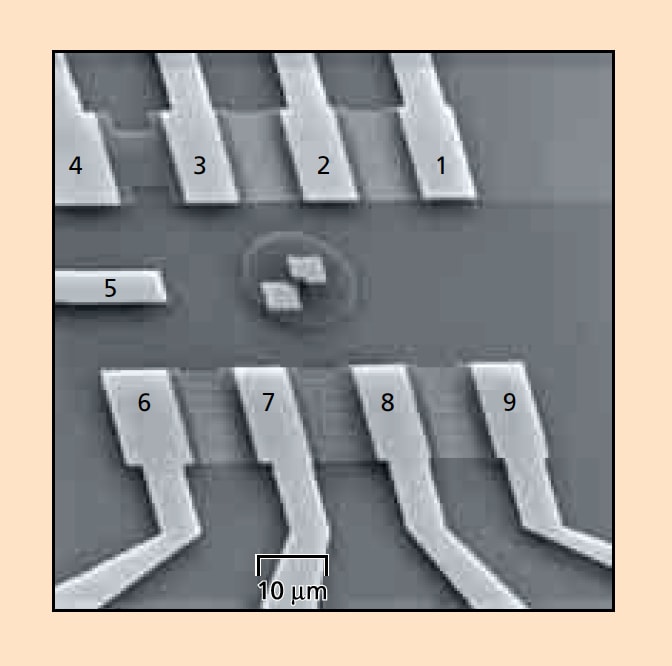
The most recently reported development efforts have been focused on electrical-conductance-based nanosensors. A sensor of this type comprises one or more boron-doped silicon nanowires supported between gold electrodes on an electrically insulating layer of silicon oxide. Such a sensor or an array of such sensors is fabricated on a silicon-on-insulator substrate by electron-beam lithography, micromachining, and other processes that are well established in the semiconductor and MEMS industries. The doping is effected by ion implantation and the doping concentration is chosen to obtain the desired starting electrical resistivity. In some cases, electrical-conductance-type nanosensors have been fabricated with gate electrodes placed nearby to demonstrate that these nanosensors could be operated in a manner analogous to that of field-effect transistors (FETs), with all the advantages of amplification, reproducibility, and sensitivity afforded by FETs.
After fabrication of a nanowire-type sensor array as described thus far, all parts except the nanowires are masked with poly(methyl methacrylate) by an established process involving coating and electron-beam lithography. Then the nanowires are functionalized in a process that typically includes exposure to a solution containing the desired sensitizing substance or its precursor. In the case of the experimental nanosensor array shown in the figure, the solution consisted of aminopropyltriethoxysilane in methanol.
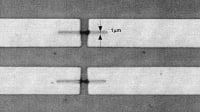
In addition to electrodes with nanowires between them, the experimental array shown in the figure includes a reference or gate electrode used to demonstrate operation utilizing the field effect. In the experiments, the nanosensors were used to measure the pH (the logarithm of the reciprocal of the hydrogen- ion concentration). The gate electrode was used to locally set the potential of a sample of a solution of buffer and protein to which the array was exposed. The estimated sample volume sensed was about 1 femtoliter.
In general, the effect of changing pH can be mimicked by changing the gate voltage. This fact can be exploited to increase sensitivity and control by adjusting the gate voltage to change the local hydrogen-ion concentration past the nominal chosen pK value (the negative logarithm of an equilibrium constant) of a selected bimolecular group. In effect, the local pH in a few femtoliters of solvent near a nanosensor can be controlled by adjusting the gate voltage to adjust the ion concentration. By thus changing the local hydrogen-ion concentration past the nominal chosen pK value, one could control the ability of the group to bind or not bind. Hence, through control of gate voltages, one could effect selective coating of nanowires with specific antibodies or peptides. It is planned to investigate such selective coating using cancer biomarker substances specific to breast cancer.
This work was done by Shyamsunder Erramilli of Boston University for the Army Research Laboratory. ARL-0007
This Brief includes a Technical Support Package (TSP).
Nanosensor Arrays for Detecting Breast-Cancer Compounds
(reference ARL-0007) is currently available for download from the TSP library.
Don't have an account?
More From SAE Media Group
Medical Design Briefs
Piezoelectric Material Printing
Medical Design Briefs
Tiny Biosupercapacitor Provides Energy for Biomedical Applications
Medical Design Briefs
Skin Sensors Monitor Health
Medical Design Briefs
Electron Beam Writer Enables Microfabrication
Tech Briefs
5 Ws of Electronic Stickers
Sensor Technology
Silicon Nose: Small Sensor ‘Smells’ Incipient Seizures
Medical Design Briefs
MEMS Technology Powers Sterilization Cycle Counter for Medical Applications

Medical Design Briefs
Silicon Synthesized for Use with Medical Devices
Electronics & Sensors INSIDER
Medical Robotic Hand? Rubbery Semiconductor Makes It Possible

Medical Design Briefs
Researchers Develop Microchips That Detect and Diagnose Diseases
Medical Design Briefs
Electrospinning Advantages for Wearable Technology
Medical Design Briefs
Self-Aligning Wires for Nanoelectronics
Aerospace & Defense Tech Briefs
Biodegradable MEMS Based on Cellulose Paper
Medical Design Briefs
Printing Flexible Circuits on Curved Surfaces
Aerospace & Defense Tech Briefs
Modular Biosensor Patch
Medical Design Briefs
Kirigami Inspires New Method for Wearable Sensors
Sensing Technology
Processing and Packaging MEMS to Maximize Functionality

Medical Design Briefs
Piezoelectrics Stretch Potential with Flexible Sticking
Medical Design Briefs
Highly Conductive Sensors for Wearables
Medical Manufacturing and Machining
Hybrid Technique Aims to Produce Stronger, Corrosion-Resistant Nickel
Medical Design Briefs
Researchers Develop New X-Ray Detector

Medical Design Briefs
Lens Offers Tunable Focus
Overview
The document is an annual report detailing the research conducted on the development of nanomechanical sensors aimed at detecting breast cancer biomarkers. Led by Principal Investigator Dr. Shyamsunder Erramilli at Boston University, the report covers the period from May 15, 2005, to May 14, 2006, and was prepared for the U.S. Army Medical Research and Materiel Command.
The introduction outlines the project's objectives, which include designing a nanomechanical cantilever-based sensor for biomolecular recognition. The research aims to enhance the reproducibility and reliability of individual nanosensors, ultimately leading to the creation of a nanosensor array. This array is expected to facilitate cheaper and faster detection methods for biomolecular markers associated with breast cancer.
Key advancements reported include the discovery of a gating phenomenon that could significantly improve sensor performance. The report also discusses the fabrication of different sensor structures, highlighting the ability to control geometries at the nanoscale. This precision allows for the comparison of these sensors to conventional gene chip optical arrays, indicating a potential leap in the technology used for biomarker detection.
The report emphasizes the importance of these nanomechanical sensors in the context of breast cancer research, as they could provide critical insights into biomolecular interactions and disease progression. The findings suggest that the developed sensors may lead to more effective diagnostic tools, which could ultimately improve patient outcomes.
In addition to the technical details, the report includes sections on key research accomplishments, reportable outcomes, and conclusions drawn from the research findings. It underscores the potential impact of this work on the field of cancer diagnostics and the broader implications for medical research.
Overall, the document serves as a comprehensive overview of the progress made in developing advanced nanomechanical sensors for breast cancer biomarkers, showcasing the innovative approaches being explored to enhance early detection and treatment strategies in oncology. The research is positioned as a significant contribution to the ongoing efforts in improving cancer diagnostics and patient care.
Top Stories
NewsSensors/Data Acquisition
 Microvision Aquires Luminar, Plans Relationship Restoration, Multi-industry Push
INSIDERRF & Microwave Electronics
 A Next Generation Helmet System for Navy Pilots
INSIDERWeapons Systems
 New Raytheon and Lockheed Martin Agreements Expand Missile Defense Production
NewsAutomotive
 Ford Announces 48-Volt Architecture for Future Electric Truck
INSIDERAerospace
 Active Strake System Cuts Cruise Drag, Boosts Flight Efficiency
ArticlesTransportation

Webcasts
Aerospace
 Cooling a New Generation of Aerospace and Defense Embedded...
Energy
 Battery Abuse Testing: Pushing to Failure
Power
 A FREE Two-Day Event Dedicated to Connected Mobility
Automotive
 Quiet, Please: NVH Improvement Opportunities in the Early Design Cycle
Electronics & Computers
 Advantages of Smart Power Distribution Unit Design for Automotive &...
Unmanned Systems
 Sesame Solar's Nanogrid Tech Promises Major Gains in Drone Endurance