




Novel Active Transient Cooling Systems
Magnetic refrigeration systems offer good potential to reduce global energy consumption and use of ozone-depleting compounds, greenhouse gases, and hazardous chemicals.
Energy-efficient cooling technology is extremely important in today’s society, considering the need for energy conservation and the urgent need to mitigate global warming. Near-room-temperature magnetic refrigeration is an emerging cooling technology that has several advantages compared to conventional gas-compression technology. It utilizes the magnetocaloric effect (MCE) in which heating and cooling of a magnetocaloric material (MCM) is induced by a varying external magnetic field. The magnetocaloric effect (the temperature change of a magnetic material due to the application of an external magnetic field) is the cornerstone of magnetic cooling.
MCE is the vital element of near-room-temperature magnetic cooling, which is poised for commercialization in the future. In addition, MCE is intrinsic to every magnetic solid and is of fundamental importance; it is related to diverse topics such as spin dynamics and physical properties such as thermal conductivity.

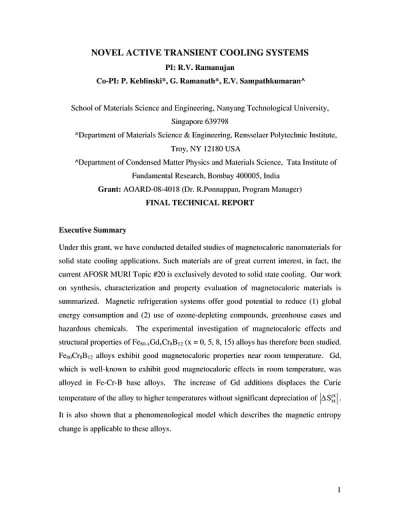
Fe80-xGdxCr8B12 alloys exhibit good magnetocaloric properties near room temperature. Gd, which is well-known to exhibit good magnetocaloric effects in room temperature, was alloyed in Fe-Cr-B base alloys. The increase of Gd additions displaces the Curie temperature of the alloy to higher temperatures. Because of this, the experimental investigation of magnetocaloric effects and structural properties of Fe80-xGdxCr8B12 (x = 0, 5, 8, 15) alloys has been studied.
Gd addition decreases the peak entropy change slightly and displaces TC to higher temperatures. The RC values of Fe80-xGdxCr8B12 alloys compare favorably to those in GMCE materials, and the alloys are much cheaper than
the rare-earth-based MCM. The universal curve models are applicable to the studied alloys. The exponent, n, controlling the field dependence of the magnetic entropy change enables easier MCE extrapolations of the alloys at different magnetic fields.
This work was done by Raju Ramanujan of Nanyang Technological University, Singapore, for the Asian Office of Aerospace Research and Development. For more information, download the Technical Support Package (free white paper) at www.defensetechbriefs.com/tsp under the Physical Sciences category. AFRL-0168
This Brief includes a Technical Support Package (TSP).
Novel Active Transient Cooling Systems
(reference AFRL-0168) is currently available for download from the TSP library.
Don't have an account?
More From SAE Media Group

Tech Briefs
Vacuum Camera Cooler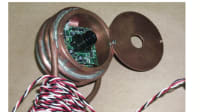
Tech Briefs
Maglev Facility for Simulating Variable Gravity

Tech Briefs
Steady-State Thermal Test Methodology


Tech Briefs
Fault-Tolerant Heat Exchanger


Electronics & Sensors INSIDER
New Cooling Technique Could Make Computer Chips More Powerful

Motion Control Tech Briefs
Electrohydrodynamic Conduction Pumps

Aerospace & Defense Tech Briefs
Beyond Boundaries: Elevating Aerospace Design with Fluorosilicones

Tech Briefs
Liquid Shell Insulation

Electronics & Sensors INSIDER
New Atom-Based Thermometer Measures Temperature More Accurately
Power Electronics INSIDER
Continuously Tunable Thermal Regulators for Batteries and Electronic Devices
Tech Briefs
Microscale Regenerative Heat Exchanger
Photonics & Imaging Technology
New Frequency Comb Can Identify Molecules in 20-Nanosecond Snapshots
Aerospace & Defense Tech Briefs
A New Look at Ignition: Refining Our Understanding of Combustion Dynamics in Gun Chambers



Tech Briefs
Cryogenic Moisture Apparatus
Overview
The document is a final technical report on a research project titled "Novel Active Transient Cooling Systems," led by Principal Investigator R.V. Ramanujan and co-investigators from various institutions. The project, funded by the Asian Office of Aerospace Research & Development (AOARD), focuses on the study of magnetocaloric nanomaterials for solid-state cooling applications, which are increasingly important for energy efficiency and environmental sustainability.
The report emphasizes the significance of energy-efficient cooling technologies in addressing global energy consumption and mitigating climate change. It introduces magnetic refrigeration as an emerging technology that utilizes the magnetocaloric effect (MCE), where the temperature of a magnetic material changes in response to an external magnetic field. This method offers several advantages over traditional gas-compression refrigeration, including higher efficiency, lower operating costs, and the elimination of ozone-depleting substances.
The research specifically investigates the synthesis, characterization, and property evaluation of Fe80-xGdxCr8B12 alloys, where Gadolinium (Gd) is alloyed with iron, chromium, and boron. The study finds that these alloys exhibit favorable magnetocaloric properties near room temperature, with Gd enhancing the materials' performance by increasing the Curie temperature without significantly degrading the magnetic entropy change. The report also discusses a phenomenological model that effectively describes the magnetic entropy change in these alloys.
The document outlines the historical context of magnetic refrigeration, tracing its origins back to the late 19th century and highlighting key advancements, including the demonstration of cooling at low temperatures and the development of giant magnetocaloric effects (GMCE) in specific materials. The report notes that while magnetic refrigeration has shown promise, its widespread adoption has been limited by the availability of suitable materials that exhibit large MCE at low magnetic fields.
In conclusion, the report underscores the potential of magnetocaloric materials in revolutionizing cooling technologies, contributing to energy conservation, and reducing reliance on harmful refrigerants. The findings from this research could pave the way for more sustainable cooling solutions in various applications, aligning with global efforts to combat climate change and promote energy efficiency.
Top Stories
INSIDERRF & Microwave Electronics
 FAA to Replace Aging Network of Ground-Based Radars
PodcastsDefense
 A New Additive Manufacturing Accelerator for the U.S. Navy in Guam
NewsSoftware
 Rewriting the Engineer’s Playbook: What OEMs Must Do to Spin the AI Flywheel
Road ReadyPower
 2026 Toyota RAV4 Review: All Hybrid, All the Time
INSIDERDefense
 F-22 Pilot Controls Drone With Tablet
INSIDERRF & Microwave Electronics
 L3Harris Starts Low Rate Production Of New F-16 Viper Shield
Webcasts
Energy
 Hydrogen Engines Are Heating Up for Heavy Duty
Energy
 SAE Automotive Podcast: Solid-State Batteries
Power
 SAE Automotive Engineering Podcast: Additive Manufacturing
Aerospace
 A New Approach to Manufacturing Machine Connectivity for the Air Force
Software
 Optimizing Production Processes with the Virtual Twin
