




Development of an Electrochemical Biosensor for Organophosphate Chemicals
These sensors detect compounds used in pesticides and chemical warfare agents.
Detection of organophosphate (OP) compounds has attracted much attention in terms of safeguarding human health, owing to their frequent use as pesticides in agriculture and their potential use as chemical warfare agents. Among a variety of biological methods based on the biocatalytic activity of organophosphorus hydrolase (OPH), amperometric, potentiometric, and optical biosensing devices have been developed for detecting OPs. Electrochemical biosensors in particular have been widely investigated to monitor various pesticides including OP compounds such as paraoxon, parathion, sarin, and soman via an enzyme-catalyzed hydrolysis reaction by OPH due to their fast speed, high efficiency, low cost, and small sample size.
Considering the requirements for the detection of OPs, carbon nanotubes (CNTs) have been considered as potential electrode materials of electrochemical biosensors due to their high accessible surface area, electronic conductivity, stability, and capacity to immobilize enzymes. Bucky gels (BGs) consisting of ionic liquids (ILs) and CNTs have served as advanced electrode materials of electrochemical biosensor devices. They offer good bio-compatibility, ease of preparation, and chemical and environmental stability. There have been very few reports regarding the underlying relationship of the electrochemical properties of CNT/IL-composite electrodes according to the types of ILs for developing biosensors. Furthermore, no work has been reported on the application of CNT/IL electrodes to detect OP compounds.
OPH immobilized on CNT/IL electrodes were prepared by using three different intrinsic kinds of ILs as binders: 1-butyl-3-methylimidazolium tetrafluoroborate ([bmim][BF4]), 1-butyl-3-methylimidazolium hexafluorophosphate ([bmim][PF6]), and 1-buytl-3-methylimidazolium bis(trifluoromethl-sulfonyl)imide ([bmim][TF2N]). CNTs/ ILs lead to dramatic electrochemical enhancements with respect to response time, stability, and sensitivity of composite electrodes. In addition, the electro-chemical and biocatalytic properties of three-composite electrodes were strongly influenced by different types of ILs used, as verified by cyclic voltammetry and chronoamperometry. These results were attributed to the conformational changes of the microenvironment between the OPH and the composite electrodes within three different types of ILs. In particular, the biocatalytic signals of three OPH/CNT/IL-modified electrodes increased linearly to the concentration of paraoxon in a wide range. These findings provide a deep understanding of the role of each IL on the modified electrodes, enabling enhanced electrochemical properties for biosensors.
Modification of MWNTs by ILs resulted in high dispersion of CNT bundles and the formation of a 3D network structure, good compatibility with OPH, and accelerated electron transfer reaction at the interface. Electrochemical properties and sensor performances of composite electrodes depend on the types of ILs. In particular, electron transfer rate of the three modified electrodes increased after the immobilization of OPH on the modified electrode surface in the following order: OPH/MPGE < OPH/MBGE < OPH/MTGE. Among three-composite electrodes, MPGE provided the best sensitivity, 4.37 μA μM-1, and a fast response time of ~10 s for detecting OP. Composite electrodes could be applied to various electro-chemical biosensors, based on their fast, stable, and sensitive properties.
This work was done by Sang Yup Lee of the Korea Advanced Institute of Science and Technology for the Asian Office of Aerospace Research and Development. For more information, download the Technical Support Package (free white paper) at www.defensetechbriefs.com/tsp under the Physical Sciences category. AFRL-0167
This Brief includes a Technical Support Package (TSP).
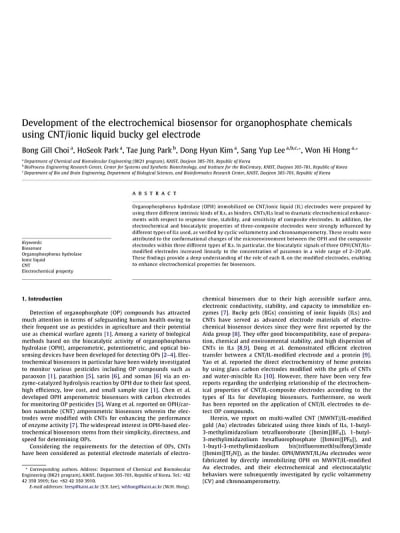
Development of an Electrochemical Biosensor for Organophosphate Chemicals
(reference AFRL-0167) is currently available for download from the TSP library.
Don't have an account?
More From SAE Media Group
Battery & Electrification Technology
Next-Generation Binder for Lithium-ion Batteries
Tech Briefs
Carbon-Nanotube-Based Chemical Gas Sensor
Battery & Electrification Technology
Designing Safer, Higher-Performance Lithium Batteries
Power Electronics INSIDER
Carbon Nanotubes Store Energy

Tech Briefs
Creating 2D All-Organic Perovskites
Battery & Electrification Technology
Enhancing the Performance of All-Solid-State Batteries
Tech Briefs
VaCNT Makes Up a Promising Membrane Material
Battery & Electrification Technology
Developing Safer Batteries with Solid-State Polymer Electrolytes

Aerospace & Defense Tech Briefs
Mechanical Aspects of Structural Composite Batteries
Tech Briefs
Better Microelectronics from Coal
Electronics & Sensors INSIDER
A Simple Way to Get Complex Semiconductors to Assemble Themselves
Electronics & Sensors INSIDER
Powerful Family of Two-Dimensional Materials

Battery & Electrification Technology
Cheaper and Safer Battery Storage
Motion Design INSIDER
Superlubricity Coating for Nearly Friction-Free Surfaces
Tech Briefs
Nanowire Electron Scattering Spectroscopy
Electronics & Sensors INSIDER
Graphene-Based Electronics
Electronics & Sensors INSIDER
Atomic Chains in Nanotubes Push the Electronics Frontier
Tech Briefs
Small CO₂ Sensors Operate at Lower Temperature
Tech Briefs
University of Pennsylvania School of Engineering

Tech Briefs
Capturing Water from Thin Air
Power Electronics INSIDER
Substrate Engineering to Improve Power Electronics
Motion Design INSIDER
Self-Folding Origami Machines Powered by Chemical Reaction
Aerospace & Defense Tech Briefs
Structural Composite Batteries
Tech Briefs
Low-Current Cathodic Protection of Metal
Overview
The document discusses the development of an electrochemical biosensor for detecting organophosphate (OP) chemicals, which are commonly used as pesticides and have potential applications in chemical warfare. The research focuses on the use of carbon nanotube (CNT) and ionic liquid (IL) composite electrodes to enhance the performance of the biosensor.
Organophosphorus hydrolase (OPH), an enzyme that catalyzes the hydrolysis of organophosphate compounds, is immobilized on these CNT/IL electrodes. The study highlights the significant improvements in electrochemical properties, such as response time, stability, and sensitivity, achieved by using different types of ionic liquids as binders. The researchers conducted experiments using cyclic voltammetry and chronoamperometry to evaluate the electrochemical and biocatalytic properties of the modified electrodes.
The findings indicate that the choice of ionic liquid has a profound impact on the performance of the biosensor. The biocatalytic signals from the OPH/CNT/IL-modified electrodes showed a linear increase in response to varying concentrations of paraoxon, a model organophosphate compound, within a range of 2–20 µM. This linear relationship suggests that the biosensor can effectively quantify the presence of organophosphate residues.
The document emphasizes the advantages of using CNTs in biosensor design, including their high surface area, electronic conductivity, and stability, which facilitate enzyme immobilization and enhance electron transfer. The combination of CNTs and ILs results in a composite material that offers good biocompatibility and environmental stability, making it suitable for practical applications in monitoring pesticide residues.
Overall, the research provides valuable insights into the role of ionic liquids in improving the electrochemical properties of biosensors, paving the way for the development of efficient and reliable detection methods for organophosphate compounds. The study contributes to the growing field of biosensors aimed at safeguarding human health and the environment by enabling rapid and accurate monitoring of hazardous chemicals.
Top Stories
INSIDERManufacturing & Prototyping
 How Airbus is Using w-DED to 3D Print Larger Titanium Airplane Parts
NewsAutomotive
 Microvision Aquires Luminar, Plans Relationship Restoration, Multi-industry Push
INSIDERAerospace
 A Next Generation Helmet System for Navy Pilots
INSIDERDesign
 New Raytheon and Lockheed Martin Agreements Expand Missile Defense Production
ArticlesAR/AI
 CES 2026: Bosch is Ready to Bring AI to Your (Likely ICE-powered) Vehicle
Road ReadyDesign

Webcasts
Semiconductors & ICs
 Advantages of Smart Power Distribution Unit Design for Automotive...
Unmanned Systems
 Quiet, Please: NVH Improvement Opportunities in the Early Design...
Electronics & Computers
 Cooling a New Generation of Aerospace and Defense Embedded...
Power
 Battery Abuse Testing: Pushing to Failure
AR/AI
 A FREE Two-Day Event Dedicated to Connected Mobility
