




Novel Wavelength Standards in the Near Infrared
These techniques may lead to improvements in portable optical frequency references.
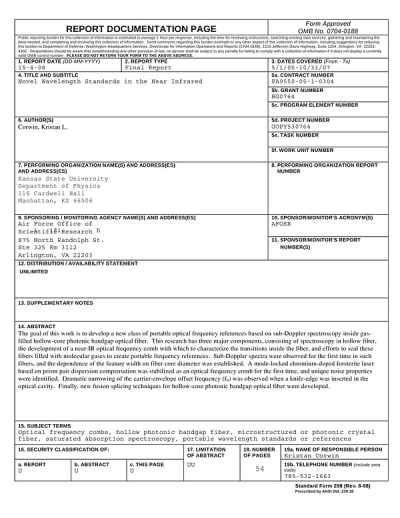
The goal of this work was to develop a new class of portable optical frequency references based on sub-Doppler spectroscopy inside gas-filled, hollow-core photonic bandgap (PBG) optical fiber. The change in line width with core size, and narrower transitions inside a new “kagome” structured optical fiber, were demonstrated. A simplified and more compact method for observing saturated absorption spectroscopy in half-sealed photonic bandgap fibers, called the “reflected pump technique,” was realized. Two systems, each consisting of a narrow-line fiber laser locked to the P(13) transition in acetylene, were constructed. By comparing those two systems, it was possible to obtain stability data on the fiber-filled references.
A mode-locked Cr:forsterite laser was developed and stabilized to a GPS-disciplined Rb clock with which to characterize the gas-filled, hollow-fiber optical frequency references. It was found that these lasers offer noisier “f0” beats than Ti:sapphire lasers, but a method was found to dramatically reduce the f0 beat width. A study was initiated into the source of the noise and the exact explanation for the narrowing. In the meantime, absolute frequency measurements of the fiber laser locked to the hollow fiber references are in progress.
A generally useful technique was developed for splicing the photonic bandgap fibers to solid-core fibers using an arc fusion splicer, which makes PBG fibers easier to use in the laboratory. Toward making a completely sealed photonic bandgap fiber cell, PBG was spliced to solid-core fibers inside a vacuum system using a CO2 laser. Efforts to reproduce this in an acetylene vapor proved unsuccessful, most likely due to the thermal properties of acetylene.
This work was done by Kristan L. Corwin of Kansas State University for the Air Force Research Laboratory. For more information, download the Technical Support Package (free white paper) at www.defensetechbriefs.com/tsp under the Photonics category. AFRL-0132
This Brief includes a Technical Support Package (TSP).
Novel Wavelength Standards in the Near Infrared
(reference AFRL-0132) is currently available for download from the TSP library.
Don't have an account?
More From SAE Media Group
Aerospace & Defense Tech Briefs
Terahertz Fiber-Optic Lasers for Detection of Explosives
Tech Briefs
Compact Laser Source Detects Pollution
Photonics & Imaging Technology
Creating High-Precision Glass for NIR Lasers
Photonics & Imaging Technology
A Laser That Could Reshape the Landscape of Integrated Photonics
Aerospace & Defense Tech Briefs
Stimulated Brillouin Scattering (SBS) Suppression and Long Delivery Fibers at the Multikilowatt Level with Chirped Seed Lasers
Tech Briefs
Free-Space Fiber Optic Laser Rod
Aerospace & Defense Tech Briefs
Advances Toward Affordable High-Energy Laser Modules
Aerospace & Defense Tech Briefs
Development of Photoacoustic Sensing Platforms
Photonics & Imaging Technology
Hollow-Core Fiber Lamp for Mercury Ion Clocks and Micro-Plasma Studies
Aerospace & Defense Tech Briefs
Towards Greater Sensitivity: A Brief FTIR and Infrared-Based Cavity Ring Down Spectroscopy Comparative Study
Photonics & Imaging Technology
Pratt & Whitney, Virginia Tech Pioneer Laser-Optical Approach for Turbofan Engine Thrust Measurement
Photonics & Imaging Technology INSIDER
A Compact, Mid-Infrared Pulse Generator
Photonics & Imaging Technology
Using Magnets to Toggle Nanolasers Leads to Better Photonics
Photonics & Imaging Technology
SPIE Photonics West 2022 Preview

Tech Briefs
Embedded Fiber Optic Sensors (EFOS)

Photonics Tech Briefs
White-Light Whispering-Gallery-Mode Optical Resonators

Aerospace & Defense Tech Briefs
High-Power Broadband Multispectral Source on a Hybrid Silicon Chip
Aerospace & Defense Tech Briefs
On the Pulsed Laser Ablation of Metals and Semiconductors
Photonics Tech Briefs
Microsphere and Microcavity Optical-Absorption Sensors
Photonics & Imaging Technology
Essential Principles for Designing and Specifying Laser Optics
Photonics & Imaging Technology
Moving Precision Communication, Metrology, Quantum Applications from Lab to Chip
Photonics & Imaging Technology
A First-Of-Its-Kind Integrated Optical Isolator
Photonics & Imaging Technology
Microresonators Offer Simpler Approach to Sensing With Light Pulses
Photonics Tech Briefs
Tunable Ultraviolet Light Source for Combustion Experiments
Aerospace & Defense Tech Briefs
Computational Photonics in Laser Communications Through Clouds
Aerospace & Defense Tech Briefs
Ultrafast Optics: Vector Cavity Lasers — Physics and Technology
Overview
The document is a final report titled "Novel Wavelength Standards in the Near IR," authored by Dr. Kristan L. Corwin from Kansas State University, covering the research period from May 1, 2005, to October 31, 2007. The primary objective of the research was to develop a new class of portable optical frequency references utilizing sub-Doppler spectroscopy within gas-filled hollow-core photonic bandgap (PBG) optical fibers.
The report outlines three major components of the research:
-
Spectroscopy in Hollow Fiber: The study successfully observed sub-Doppler spectra for the first time in hollow-core fibers. It established a relationship between the feature width of the spectra and the diameter of the fiber core, which is crucial for optimizing the performance of these optical systems.
-
Development of a Near-IR Optical Frequency Comb: A mode-locked chromium-doped forsterite laser was stabilized as an optical frequency comb for the first time, employing prism pair dispersion compensation. This advancement allowed for the characterization of molecular transitions within the hollow fibers, revealing unique noise properties that enhance the precision of measurements.
-
Sealing Fibers with Molecular Gases: The research included efforts to seal the hollow-core fibers filled with molecular gases, aiming to create portable frequency references. This aspect is significant for practical applications, as it addresses the challenges of maintaining the integrity and performance of the optical fibers in various environments.
The report also discusses the broader context of frequency metrology, highlighting advancements in portable standards created by the National Institute of Standards and Technology (NIST) and other international institutions. These standards have moderate uncertainties and are essential for commercial applications. The document emphasizes the advantages of using hollow-core PBG fibers, which allow for high-intensity light confinement with low loss, making them superior to traditional capillary fibers.
Overall, the research contributes to the field of optical frequency references by demonstrating the feasibility of using hollow-core PBG fibers for high-accuracy infrared spectroscopy. The findings have implications for the development of portable optical devices, enhancing the precision and accessibility of wavelength standards in the near-infrared region. The report concludes with a recognition of the transformative impact of frequency comb technology and hollow fiber technology on the science of frequency metrology.
Top Stories
INSIDERDesign
 How Airbus is Using w-DED to 3D Print Larger Titanium Airplane Parts
NewsSensors/Data Acquisition
 Microvision Aquires Luminar, Plans Relationship Restoration, Multi-industry Push
INSIDERManned Systems
 A Next Generation Helmet System for Navy Pilots
NewsAR/AI
 Accelerating Down the Road to Autonomy
INSIDERDefense
 New Raytheon and Lockheed Martin Agreements Expand Missile Defense Production
ArticlesAR/AI
 CES 2026: Bosch is Ready to Bring AI to Your (Likely ICE-powered) Vehicle
Webcasts
Semiconductors & ICs
 Advantages of Smart Power Distribution Unit Design for Automotive...
Unmanned Systems
 Quiet, Please: NVH Improvement Opportunities in the Early Design...
Electronics & Computers
 Cooling a New Generation of Aerospace and Defense Embedded...
Automotive
 Battery Abuse Testing: Pushing to Failure
Transportation
 A FREE Two-Day Event Dedicated to Connected Mobility
