




Advances Toward Affordable High-Energy Laser Modules
There are numerous potential military, industrial, and scientific applications.
A multidisciplinary research project entitled “Affordable High-Energy Lasers” has made numerous contributions to the development of several types of advanced laser modules, including not only lasers but also coupling optics and integral laser/ coupling-optic combinations. There are numerous potential applications for such modules, including weaponry, lidar, high-data-rate optical communications, interferometry, spectroscopy, remote sensing, and processing of materials. The devices developed in this project include novel fiber lasers, novel vertical-external-cavity surface emitting lasers (VECSELs), and a radially emitting photonic-bandgap (PBG) polymer fiber laser. Somewhat more specifically, the contributions are summarized as follows:
Fiber Lasers
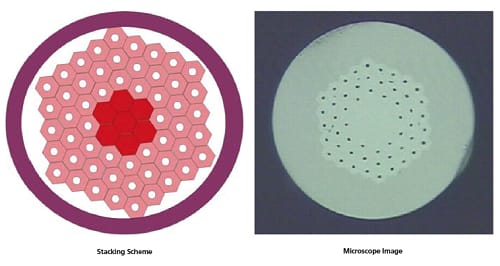
The fiber laser developed in this project include compact (chip-scale) devices based on phosphate glass optical fibers heavily doped with Er and Yb ions. These fiber lasers function as high- power (as much as several watts continuous), low-noise, single-wavelength (1.55-μm), single-mode oscillators and are expected to be useful as building blocks of laser systems that can be scaled up to power levels of multiple kilowatts. The project included integration of fabrication, testing, and optimization of all materials, components, and techniques necessary for manufacturing fiber laser modules. This integration effort yielded advances in highly doped specialty glasses, fiber preforms, fiber-drawing techniques, fiber Bragg gratings, fiber facet coatings, and fusion splicing of fiber components. A novel stack-and-draw technique was used to produce microstructured single- and multiple-core optical fibers (see figure). Other accomplishments involving laser modules made from these fibers include generation of ultra-short (durations of the order of picoseconds) pulses and distortion-free amplification of these pulses to peak power levels of tens of kilowatts.
VECSELs
An overriding theme of the project was the development and use of sophisticated theoretical and computational simulation capabilities to drive the design and testing of the various novel devices. The effect of this theme was greatest in the VECSEL subproject, in which a first-principles quantum-based approach was followed in designing the successions of epitaxial semiconductor layers to obtain quantum-well structures needed for lasing, effectively accelerating the optimization of VECSEL suboptical-cavity structures by obviating what would otherwise be a costly, time-consuming iterative process of fabrication, testing, and design modification. The VECSEL subproject yielded high-power, high-brightness, tunable VECSELs that, like the aforementioned fiber lasers, can be utilized as building blocks of scalable multi-kilowatt laser systems. Like the fiber-laser subproject, the VECSEL subproject included integration of fabrication, testing, and optimization of all components. Special attention was given to designing semiconductor quantum wells to afford gain, designing distributed Bragg reflectors, designing microcavity resonators, designing external optical cavities, fabricating VECSEL chips, low-reflection coating of the chips, and dissipation of heat from the chips.
Radially Emitting PBG Polymer Fiber Laser
This fiber laser consists of a core containing a gain medium (an organic dye) surrounded by a concentric multilayer PBG resonator structure, that, in turn, is surrounded by a cladding layer. All fiber lasers developed prior to the conception of this fiber laser emit radiation only along their fiber axes. In this fiber laser, interactions of a linearly polarized axial pump beam with the PBG resonator and the gain medium cause radiation to be emitted radially outward and to be azimuthally isotropic. Low-threshold lasing was demonstrated at nine different wavelengths in the visible and near-infrared spectrum. Concomitantly, dispersion characteristics of two-dimensional dielectric PBG structures were calculated.
This work was done by Jerome V. Moloney, Axel Schülzgen, Nasser Peyghambarian, Pavel Polynkin, Masud Mansuripur, and Mahmoud Fallahi of the University of Arizona, and Yoel Fink and Chiping Chen of Massachusetts Institute of Technology for the Air Force Research Laboratory.
AFRL-0064
This Brief includes a Technical Support Package (TSP).

Advances Toward Affordable High- Energy Laser Modules
(reference AFRL-0064) is currently available for download from the TSP library.
Don't have an account?
More From SAE Media Group
Photonics & Imaging Technology
A Laser That Could Reshape the Landscape of Integrated Photonics
Medical Design Briefs
Optical Fiber Performance in High-Power Applications

Air Force Research Laboratory Technology Horizons
Surface-Emitting Laser Arrays Bring Light to the Top
Photonics Tech Briefs
Fiber Laser Amplifiers with Broad Applications
Aerospace & Defense Tech Briefs
Rare-Earth-Doped Soft Glass Optical Fibers for Coherent Wavelength Sources Above 2 Microns
Photonics & Imaging Technology
Creating High-Precision Glass for NIR Lasers
Photonics & Imaging Technology
Essential Principles for Designing and Specifying Laser Optics
Photonics & Imaging Technology
2.2-Micron, Uncooled, InGaAs Photodiodes and Balanced Photoreceivers up to 25-GHz Bandwidth
Photonics & Imaging Technology
High-Power Fiber Lasers
Photonics Tech Briefs
Tunable, Single-Frequency, Fiber Fabry-Perot VCSELs
Medical Design Briefs
Scientists Create Continuously Emitting Microlasers With Nanoparticle-Coated Beads
Photonics & Imaging Technology
How to Innovate and Overcome the Challenges of Blue Laser Beam Shaping
Photonics & Imaging Technology
SPIE Photonics West 2016 Preview
Aerospace & Defense Tech Briefs
Computational Photonics in Laser Communications Through Clouds
Aerospace & Defense Tech Briefs
Terahertz Fiber-Optic Lasers for Detection of Explosives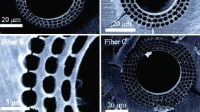
Photonics & Imaging Technology
Ultrafast Beam-Steering Breakthrough at Sandia Labs
Aerospace & Defense Tech Briefs
High-Power Broadband Multispectral Source on a Hybrid Silicon Chip
Photonics & Imaging Technology
Optical Signal Amplifying Technique
Photonics & Imaging Technology
Using Magnets to Toggle Nanolasers Leads to Better Photonics
Photonics Tech Briefs
Using Hollow Core Plastic Bragg Fiber to Deliver Ultrashort Pulse Laser Beams
Photonics & Imaging Technology
Ultrafast Laser Micromachining

Photonics & Imaging Technology
A First-Of-Its-Kind Integrated Optical Isolator
Tech Briefs
Free-Space Fiber Optic Laser Rod
Aerospace & Defense Tech Briefs
Ultrafast Optics: Vector Cavity Lasers — Physics and Technology
Photonics & Imaging Technology
SPIE Photonics West 2022 Preview
Photonics Tech Briefs
DPSS Micromachining Puts Shine on Industrial Molds

Photonics & Imaging Technology
SPIE Photonics West 2017 Preview
Overview
The document is a final report detailing a multi-disciplinary research project focused on the development of advanced laser technologies, specifically high-power, low-noise single wavelength oscillators using highly-doped Er/Yb phosphate-doped glass fibers. Conducted from July 1, 2002, to June 30, 2007, and led by Principal Investigator Jerome V. Moloney at the University of Arizona, the project aimed to create affordable high-energy laser modules.
Key achievements of the project include the establishment of three world record powers in low-noise, single frequency laser oscillators operating at the eyesafe wavelength of 1.55μm. The research involved a vertically integrated approach, encompassing the fabrication, testing, and optimization of all components necessary for manufacturing fiber laser units. This included the development of specialty glasses, fiber preforms, fiber drawing techniques, fiber Bragg gratings, fiber facet coatings, and fusion splicing of fiber components.
A novel stack and draw technique was introduced, enabling the production of both single and multi-core geometries, which included index guides and micro-structured fibers. The project also explored ultra-short pulse generation in these phosphate fibers, achieving world record peak intensities and opening avenues for novel applications. Collaborations with MIT led to the development of a new class of surface-emitting fiber lasers based on one-dimensional photonic bandgap confinement.
Additionally, the project designed a high-power, high-brightness semiconductor vertical-external-cavity surface-emitting laser emitting around 980nm, utilizing a novel epitaxial quantum design approach. Power scaling methods were demonstrated, including spectral beam combining and cascaded intra-cavity semiconductor chips, as well as visible light generation through intra-cavity second harmonic generation.
The report highlights the extensive dissemination of research findings, with over 70 articles published in peer-reviewed journals, showcasing the project's impact on the field of laser technology. The document serves as a comprehensive overview of the innovative designs and coupling schemes developed during the project, emphasizing their potential applications in various sectors, including defense and telecommunications. Overall, the research represents a significant advancement in the capabilities and affordability of high-energy laser systems.
Top Stories
NewsRF & Microwave Electronics
 Microvision Aquires Luminar, Plans Relationship Restoration, Multi-industry Push
INSIDERAerospace
 A Next Generation Helmet System for Navy Pilots
INSIDERDesign
 New Raytheon and Lockheed Martin Agreements Expand Missile Defense Production
INSIDERMaterials
 How Airbus is Using w-DED to 3D Print Larger Titanium Airplane Parts
NewsPower
 Ford Announces 48-Volt Architecture for Future Electric Truck
ArticlesAR/AI

Webcasts
Electronics & Computers
 Cooling a New Generation of Aerospace and Defense Embedded...
Automotive
 Battery Abuse Testing: Pushing to Failure
Power
 A FREE Two-Day Event Dedicated to Connected Mobility
Unmanned Systems
 Quiet, Please: NVH Improvement Opportunities in the Early Design Cycle
Automotive
 Advantages of Smart Power Distribution Unit Design for Automotive &...
Energy
 Sesame Solar's Nanogrid Tech Promises Major Gains in Drone Endurance