




Cooperative Single-Antenna Node Networks
Through cooperation, the average power used in a network can be significantly reduced.
Future tactical networks will be complex, with severe constraints on energy and bandwidth, operating in dynamic and unpredictable environments. By exploiting the broadcast nature of the wireless medium and spatially dispersed nodes, some of these advantages can be realized through cooperation among single-antenna nodes in a network.
In cooperative systems, a group of nodes can transmit together as a virtual antenna array to obtain diversity gains. Cooperation techniques can significantly improve the performance of wireless networks with increased transmission range, improved energy and bandwidth efficiency, and more reliable and longer lasting network connectivity. Some of these techniques are:
Decentralized Relay-Selection and Transmission
For any given number of columns in the underlying space-time block coding (STBC) matrix, the optimized discrete randomized schemes can achieve almost the same performance as the continuous randomized scheme, as long as the number of potential relays is much larger than the number of columns.
Power-Efficient Relay Selection
In this strategy, only a small amount of local information is required to optimize the relay selection at each hop, which could be applied to either two-hop or multihop decode-and-forward (DF) networks.
Power Allocation
Two ad-hoc, yet efficient, power-allocation strategies were developed for decentralized distributed STBC. The first strategy requires some control information and is near-optimal; the second strategy requires no control signaling, but is sub-optimal.
Network Lifetime
One source and one selected relay cooperate to transmit source messages to the destination. When a Best-Select strategy is used, the forwarding relay is selected as the node with the best instantaneous or mean channel gain to the destination. To maximize the network lifetime while incurring the minimum overhead, an efficient relay-selection strategy using only the mean channel state information (CSI) and the residual energy information could be used.
Network Coding for Cooperation with Multiple Source-Destination Pairs
Using mean-CSI-based, Best-Select cooperation, the selected best relay performs network coding on the correctly decoded information from all the sources by transmitting a random linear combination of the columns in an underlying full-rate, full-diversity, perfect STBC.
Hop-by-Hop Routing Using Mean Channel Gains
A novel optimization metric was proposed to select the best relay on a per-hop basis by only utilizing the local mean channel gain of the current hop.
Cooperative Routing
An optimal routing strategy was proposed to minimize the end-to-end outage, which requires the instantaneous CSI of all the links and serves as a performance bound. TV-hop routing, where a joint optimization is performed every N hops, can achieve a good complexity-performance tradeoff.
Fairness and Cooperation
Fairness can actually bring significant throughput gains by using a price-aware cooperation protocol, where the residual energy information of each node is exploited to shape the relay set.
Future tactical networks will be deployed in highly dynamic environments, with severe constraints on energy and bandwidth. The concept of cooperative networking will have the most impact precisely in these applications. Through cooperation, the average power used in the network (per node) can be significantly reduced, and the reliability and connectivity can be dramatically increased.
This work was done by Leonard J. Cimini of the University of Delaware for the Air Force Research Laboratory. AFRL-0130
This Brief includes a Technical Support Package (TSP).

Cooperative Single-Antenna Node Networks
(reference AFRL-0130) is currently available for download from the TSP library.
Don't have an account?
More From SAE Media Group
Tech Briefs
New Wireless System for Greater 5G Access
Aerospace & Defense Tech Briefs
Low-Power Distributed Jammer Network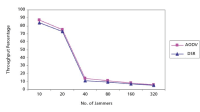
Aerospace & Defense Tech Briefs
Energy-Scalable Protocols for Battery Operated Micro Sensor Networks
Tech Briefs
How Much Do You Know About 6G?
Tech Briefs
Readers Select 2023 Products of the Year
Aerospace & Defense Tech Briefs
How Will TSN Ethernet Impact the Future of Embedded Computing?

Autonomous Vehicle Engineering
Keeping Pace with In-Vehicle Data Speed
Off-Highway Engineering
Data Connectivity in Heavy-Duty Vehicle Environments
Tech Briefs
Robust Serial Communications
Embedded Technology
Choosing Among ZigBee RF Power Options for Your Wireless Application
Power Management INSIDER
Network-on-a-Chip Could Reduce Data-Farm Energy Use

Battery Technology
Cloud-Connected, Battery-Based IoT Devices Last Years Longer

Aerospace & Defense Tech Briefs
Satellite System
Tech Briefs
Readers Select 2024 Products of the Year
Aerospace & Defense Tech Briefs
Advanced Satellite Communications Research

Tech Briefs
Conformal, Lightweight, Aerogel-Based Antenna
Photonics & Imaging Technology INSIDER
NVIDIA Includes Ethernet Photonics in New Six-Chip AI Rubin Platform
Aerospace & Defense Tech Briefs
Understanding the “Black Art” of RF and Microwave Switching
Tech Briefs
Wireless, Wearable Transmitter
Aerospace & Defense Tech Briefs
New, Portable Antenna Could Help Restore Communication After Disasters
Medical Design Briefs
Renamic Neo Offers Complete Wireless Connectivity to Implants
Aerospace & Defense Tech Briefs
Qualification of Multi-Channel Direction Finding Radar Receivers in The Lab
Aerospace & Defense Tech Briefs
Optoelectronic Analog Signal Transmission Takes Center Stage Amidst Aerospace and Defense Innovation

Electronics & Sensors INSIDER
Miniature, High-Performance, Low-Cost 5G Transceiver Design
Overview
The document titled "Cooperative Networks" is a final performance report detailing research conducted under AFOSR Grant FA9550-06-1-0077 from February 2006 to November 2008, led by Principal Investigator Leonard J. Cimini, Jr. The research focuses on developing cooperative strategies for tactical networks that operate under severe constraints of energy and bandwidth in dynamic and unpredictable environments.
The introduction emphasizes the complexity of future tactical networks, which will benefit from the use of multiple antennas and cooperation among single-antenna nodes. By leveraging the broadcast nature of wireless communication, these networks can achieve diversity gains, leading to increased transmission range, improved energy efficiency, and enhanced reliability. However, the report acknowledges that centralized control in large networks may be infeasible due to excessive communication overhead among cooperating nodes.
The primary objective of the research was to devise decentralized cooperative strategies that minimize the need for centralized control and inter-node communication. The report outlines the development of various techniques for relay selection, combining, power allocation, and routing, all based on locally obtained information. Two power-allocation strategies were proposed: one near-optimal requiring some control information and another sub-optimal that operates without control signaling.
The findings indicate that cooperation can significantly reduce the average power used per node in the network while dramatically increasing reliability and connectivity. The report also discusses the use of Orthogonal Frequency Division Multiplexing (OFDM) to facilitate cooperation in multihop networks, further enhancing the effectiveness of the proposed strategies.
The research is still in its early stages, but the results are expected to have a substantial impact on the deployment of tactical networks in dynamic environments. The document concludes with a hope for future collaboration with other researchers to transition these findings into practical applications.
Overall, the report provides a comprehensive overview of the challenges and solutions in cooperative networking, highlighting the potential for improved performance in wireless communication systems through innovative decentralized strategies.
Top Stories
NewsRF & Microwave Electronics
 Microvision Aquires Luminar, Plans Relationship Restoration, Multi-industry Push
INSIDERAerospace
 A Next Generation Helmet System for Navy Pilots
INSIDERDesign
 New Raytheon and Lockheed Martin Agreements Expand Missile Defense Production
INSIDERMaterials
 How Airbus is Using w-DED to 3D Print Larger Titanium Airplane Parts
NewsPower
 Ford Announces 48-Volt Architecture for Future Electric Truck
ArticlesAR/AI

Webcasts
Electronics & Computers
 Cooling a New Generation of Aerospace and Defense Embedded...
Automotive
 Battery Abuse Testing: Pushing to Failure
Power
 A FREE Two-Day Event Dedicated to Connected Mobility
Unmanned Systems
 Quiet, Please: NVH Improvement Opportunities in the Early Design Cycle
Automotive
 Advantages of Smart Power Distribution Unit Design for Automotive &...
Energy
 Sesame Solar's Nanogrid Tech Promises Major Gains in Drone Endurance