




Energy-Scalable Protocols for Battery Operated Micro Sensor Networks
Sensor network protocols designed with low-power techniques can prolong the lifetimes of wireless sensor systems.
Networks of microsensors can greatly improve environment monitoring for many civil and military applications. Multiple sensors provide fault tolerance and can provide valuable inferences about the physical world to the end user. In order to prolong the lifetimes of wireless sensors, all aspects of a sensor system should be energy efficient. To maximize battery lifetimes of distributed wireless sensors, network protocols and data fusion algorithms should be designed with low-power techniques. Network protocols minimize energy by using localized communication and control and by exploiting computation/communication tradeoffs. A sensor network system that uses a localized clustering protocol and beamforming data fusion was developed to enable energy-efficient collaboration.
Beamforming is one method of combining data from multiple sensors in order to satisfy a given performance criteria. The advantage of beamforming is that the desired signal is enhanced while the uncorrelated noise is reduced, which in turn improves detection and classification of the source. An extension of beamforming also allows for source localization and tracking. However, beamforming algorithms are computationally complex, often involving matrix operations, and this large amount of computation results in large power dissipation. Thus, there are tradeoffs between performance and power dissipation that should be considered when implementing beamforming algorithms for sensor networks.
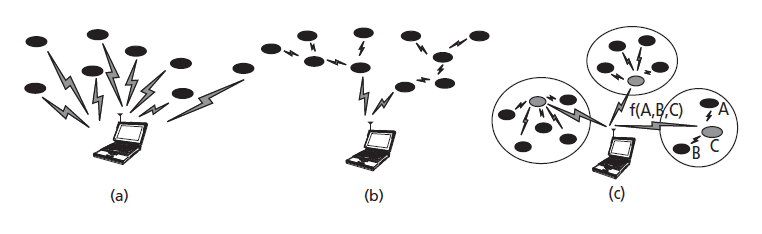
Often, sensor networks are used to monitor remote areas or disaster situations. In both these scenarios, the end user cannot be located near the sensors. Thus, direct communication between the sensors and the end user (see figure (a)) is extremely energy-intensive. In addition, direct communication may not be feasible for large-scale sensor networks. If, for example, frequency-division is used (e.g., each sensor obtains a certain bandwidth in which to transmit data), the amount of information that can be sent from each sensor to the end user becomes negligible as the number of sensors increases, because each sensor’s bandwidth is reduced down to zero.
Since data from neighboring sensors will often be highly correlated, it is possible to aggregate the data locally using an algorithm such as beamforming and then send the aggregate signal to the end user to save energy. There is a large advantage to using local data aggregation (beamforming), rather than direct communication. A clustering algorithm utilizes the energy savings from data aggregation to greatly reduce the energy dissipation in a sensor system. In the algorithm, the sensors self-organize into local clusters. Each cluster has a cluster head sensor that receives data from all other sensors in the cluster, performs data fusion (e.g., beamforming), and transmits the aggregate data to the end user. This greatly reduces the amount of data that is sent to the end user and thus achieves a global energy minimization. Furthermore, the clusters can be organized hierarchically such that the cluster heads transmit the aggregate data to “super-cluster-head” nodes, rather than directly to the end user so as to further reduce energy dissipation.
In addition to minimizing energy dissipation, the clustering algorithm has several other advantages over traditional routing protocols. The clusters are self-organizing and use localized coordiation and control, which not only enables scalability of the network (as no reorganization of the network is required when nodes are added to the system), but also enhances the fault tolerance of the system. This protocol can easily handle trade-offs in computation and communication. If computation is expensive compared to communication costs, the network can have the cluster head transmit all data directly to the base station. On the other hand, if computation is cheap compared to communication costs, the cluster head can perform signal processing functions to compress the data from all the sensors in the cluster and transmit the compressed (aggregated) data to the end user.
This work was done by Alice Wang, Wendi Rabiner Heinzelman, and Anantha P. Chandrakasan of Massachusetts Institute of Technology for the Army Research Laboratory. ARL-0135
This Brief includes a Technical Support Package (TSP).
Energy-Scalable Protocols for Battery-Operated MicroSensor Networks
(reference ARL-0135) is currently available for download from the TSP library.
Don't have an account?
More From SAE Media Group

Aerospace & Defense Tech Briefs
Low-Power Distributed Jammer Network

Tech Briefs
Wearable Strain Sensor Using Light Transmittance
Electronics & Sensors INSIDER
Low-Cost Radio System Could Help Trace Disease Spread
Tech Briefs
EADIN Lite Communication Network


Off-Highway Engineering
Data Connectivity in Heavy-Duty Vehicle Environments


Tech Briefs
Wireless, Wearable Transmitter
Medical Design Briefs
Wearable Brain-Machine Interface Turns Intentions into Actions


Embedded Technology INSIDER
New Wearable Technology Can Sense Appliance Use

Medical Design Briefs
Licking a Tootsie Roll® Sensor to Monitor Health
Tech Briefs
Wearable, All-in-One Health Monitor
Tech Briefs
RFID-Based System Enables Internet of Things
Sensor Technology
Wirelessly Power Multiple Wearable Devices Using a Single Source
Tech Briefs
How Well Do You Know E-Skin?
Photonics & Imaging Technology
Using CoaXPress-over-Fiber for High-Speed Machine Vision
Electronics & Sensors INSIDER
A Lighter, Smarter Magnetoreceptive Electronic Skin
Tech Briefs
Distributed Diagnostics and Prognostics
Aerospace & Defense Tech Briefs
In-Network Processing on Low-Cost IoT Nodes for Maritime Surveillance

Medical Design Briefs
Sensor Enables Smart Diapers, Other Health Monitors
Overview
The document titled "Energy-Scalable Protocols for Battery-Operated MicroSensor Networks" by Alice Wang, Wendi Rabiner Heinzelman, and Anantha P. Chandrakasan from the Massachusetts Institute of Technology discusses strategies to enhance the battery life of distributed wireless sensor networks. The authors emphasize the importance of designing network protocols and data fusion algorithms that prioritize low power consumption to maximize the operational lifespan of these sensors.
The paper introduces a localized clustering protocol that minimizes energy usage by optimizing communication and control within the network. It highlights the trade-offs between computation and communication costs, suggesting that when computation is less expensive, cluster-heads can perform data aggregation through signal processing techniques, such as beamforming. This approach reduces data redundancy and enhances the signal-to-noise ratio (SNR), ultimately leading to more efficient communication.
The authors detail the implementation of two beamforming algorithms: the Maximum Power and the Least Mean Squares (LMS) algorithms. Experimental results indicate that the LMS algorithm is significantly more energy-efficient, requiring less than one-fifth the energy of the Maximum Power algorithm while only incurring a minor 3 dB loss in performance. The document also discusses additional techniques to further reduce energy consumption, including the use of variable-length filters, variable voltage supplies, and adjustable adaptation times.
The research underscores the potential applications of wireless sensor networks in various fields, including environmental monitoring, boundary surveillance, target detection, and patient monitoring. By leveraging multiple sensors, the system can provide fault tolerance and valuable insights into physical phenomena, enhancing the overall effectiveness of monitoring tasks.
In conclusion, the document presents a comprehensive overview of energy-efficient strategies for battery-operated micro-sensor networks, focusing on the integration of localized clustering and beamforming algorithms. The findings contribute to the development of sustainable sensor systems that can adapt to diminishing energy resources, thereby extending their operational lifetimes and improving their utility in real-world applications. The research is part of a collaborative effort supported by the U.S. Army Research Laboratory, aiming to advance the field of low-power sensor networks.
Top Stories
INSIDERDefense
 New Raytheon and Lockheed Martin Agreements Expand Missile Defense Production
NewsAutomotive
 Ford Announces 48-Volt Architecture for Future Electric Truck
INSIDERManufacturing & Prototyping
 Active Strake System Cuts Cruise Drag, Boosts Flight Efficiency
ArticlesTransportation
 Accelerating Down the Road to Autonomy
INSIDERMaterials
 How Airbus is Using w-DED to 3D Print Larger Titanium Airplane Parts
Road ReadyTransportation

Webcasts
Electronics & Computers
 Cooling a New Generation of Aerospace and Defense Embedded...
Power
 Battery Abuse Testing: Pushing to Failure
Connectivity
 A FREE Two-Day Event Dedicated to Connected Mobility
Automotive
 Quiet, Please: NVH Improvement Opportunities in the Early Design Cycle
Transportation
 Advantages of Smart Power Distribution Unit Design for Automotive &...
Aerospace
 Sesame Solar's Nanogrid Tech Promises Major Gains in Drone Endurance