




Manufacturing Cylindrical Parts Using Deep Draw Technology
Deep-drawn components are used in breathing apparatus, missiles, and pyrotechnic containers.
In applications where product performance is mission critical, commercial, military, and aerospace companies require technology to manufacture deep- drawn cylindrical product components. Conventional production alternatives such as impact, spinning, and supplemental annealing processes often do not deliver reliable results for certain applications.
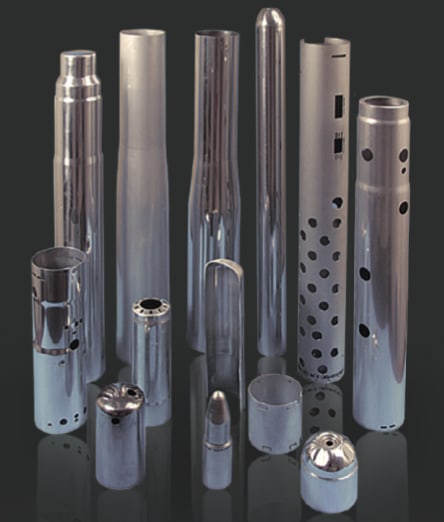
The deep draw process is actually a reverse draw. On the primary draw, material is pulled or drawn through a ring, forming a cup-shaped cylinder with uniform wall thickness. The cylinder is simultaneously turned inside out, or reversed, thus combining two draws in one operation and saving steps and time. Ironing is also performed during the deep draw process, which allows sections of the material to be ironed down to different wall thicknesses.
Once the part is drawn or shaped, the forming process begins. The necking and expanding processes allow for the creation of multiple diameters in a single part. Diameters can either be expanded or reduced (necked) to create forms that more exactly match the product specifications. The process results in seamless, one-piece parts with multiple wall thickness and diameters created through minimal operations. The multiple wall thicknesses give strength where it’s needed while reducing the amount of material used in other areas of the product, eliminating the waste of raw materials and reducing the overall weight and cost of the product. The multiple diameters also simplify the assembly and positioning of internal parts and O-rings.
Deep draw technology results in refined, highly calibrated products with tolerances in the thousandths, and the accuracy is repeatable via high-volume, high-speed manufacturing. Because the process allows for multiple wall thickness and diameters in a single part, there is no need to weld or otherwise connect separate product components to achieve the appropriate product shape and dimensions. Thus, vulnerable interfaces in the final product are eliminated, resulting in a product that performs more reliably in the field.
Deep draw technology relies on a controlled movement process. Typically, when metal is shaped and formed, the material grains are scattered and the integrity of the material structure is compromised. However, the controlled movement process uses optimum speed to enhance the efficiency of the process while maximizing material grain alignment in the final product.
The deep draw process also results in a better finish than specified by most product designers. With deep draw, the finish is typically 63 micro-inches or less, lending a smooth, mirror-like luster to the final part. This finish allows for the direct application of sealing aspects such as O-rings and gaskets during final product assembly, further eliminating secondary operations and providing a leak-proof seal for harsh field conditions.
Deep draw technology primarily utilizes aluminum of different alloys; however, the process also works well with copper, brass, mild (cold rolled) steel, precious metals, and ductile metal. While steel may make sense for some applications, the use of aluminum in the deep draw process provides significant advantages in the final product. Aluminum is softer and more malleable, making it easier to iron the material down and create multiple wall thickness and diameters. Aluminum provides a uniform grain structure and strong, yet ductile product, compared to the less-uniform quality and brittleness of impact-produced parts. As a result, aluminum deep-drawn products absorb vibration better, which is critical with sensitive electronics and other technology.
Applications include missile skins; high-pressure liners for self-contained breathing apparatus used in firefighting and mine safety units; and high-pressure CNG liners for use with buses, vans, and light trucks.
This work was done by Buckeye Shapeform, Columbus, OH. For more information, Click Here .
More From SAE Media Group
Aerospace & Defense Tech Briefs
Evaluation of Additively Manufactured Ultrahard Steels
Automotive Engineering
Lightweight Steel on a (Cold) Roll

Automotive Engineering
Tesla’s Cybertruck Is Audaciously Austenitic
Tech Briefs
Using 3D Printing to Strengthen Jet Engines
Medical Design Briefs
What Medical Device OEMs Should Know About Outsourced MIM
Automotive Engineering
British HFQ Process May Enhance Aluminum’s High-Volume Future
Tech Briefs
Manufacturing Process for Aluminum Alloys
Off-Highway Engineering
MELD Exploits Plastic Deformation of Metals with Non-Melt Additive Manufacturing

Aerospace & Defense Tech Briefs
Equispheres Accelerates Additive Manufacturing Innovation with $5M from Lockheed Martin
Aerospace & Defense Tech Briefs
High-Strength Aluminum Powder Developed for Additive Manufacturing in Aerospace, Automotive
Off-Highway Engineering
Bosch Invested in Large-Scale Metal 3D Printing

Tech Briefs
Attaching Thermocouples by Peening or Crimping
Aerospace & Defense Tech Briefs
Pulse Plasma Nitriding for Aerospace Applications
Tech Briefs
Copper Strengthens 3D-Printed Titanium
Tech Briefs
Shear Assisted Processing and Extrusion
Tech Briefs
Nickel Titanium Alloy Ball Bearings
Aerospace & Defense Tech Briefs
Finding the Perfect Aluminum for Additive Manufacturing
Aerospace & Defense Tech Briefs
More Bang for the Buck: A New Design and Manufacturing Method for Deep Penetrating Bomb Cases
Tech Briefs
Aluminum Electroplating Using Bromide Salts

Tech Briefs
How Metal 3D Printing is Redefining Part Design
Tech Briefs
Method 3D-Prints Marine-Grade Stainless Steel
Aerospace & Defense Tech Briefs
Testing Military-Grade Adhesive in Extreme Loading Conditions

Tech Briefs
Contaminant-Free Steel
Top Stories
NewsSensors/Data Acquisition
 Microvision Aquires Luminar, Plans Relationship Restoration, Multi-industry Push
INSIDERRF & Microwave Electronics
 A Next Generation Helmet System for Navy Pilots
INSIDERWeapons Systems
 New Raytheon and Lockheed Martin Agreements Expand Missile Defense Production
NewsAutomotive
 Ford Announces 48-Volt Architecture for Future Electric Truck
INSIDERAerospace
 Active Strake System Cuts Cruise Drag, Boosts Flight Efficiency
ArticlesTransportation

Webcasts
Aerospace
 Cooling a New Generation of Aerospace and Defense Embedded...
Energy
 Battery Abuse Testing: Pushing to Failure
Power
 A FREE Two-Day Event Dedicated to Connected Mobility
Automotive
 Quiet, Please: NVH Improvement Opportunities in the Early Design Cycle
Electronics & Computers
 Advantages of Smart Power Distribution Unit Design for Automotive &...
Unmanned Systems
 Sesame Solar's Nanogrid Tech Promises Major Gains in Drone Endurance