




Turntide Cuts Time to Market for Electric Construction Equipment
A new axial flux EDU is validated and tested upfront to remove months of component-level testing for electric and hybrid system manufacturers, says Turntide expert.
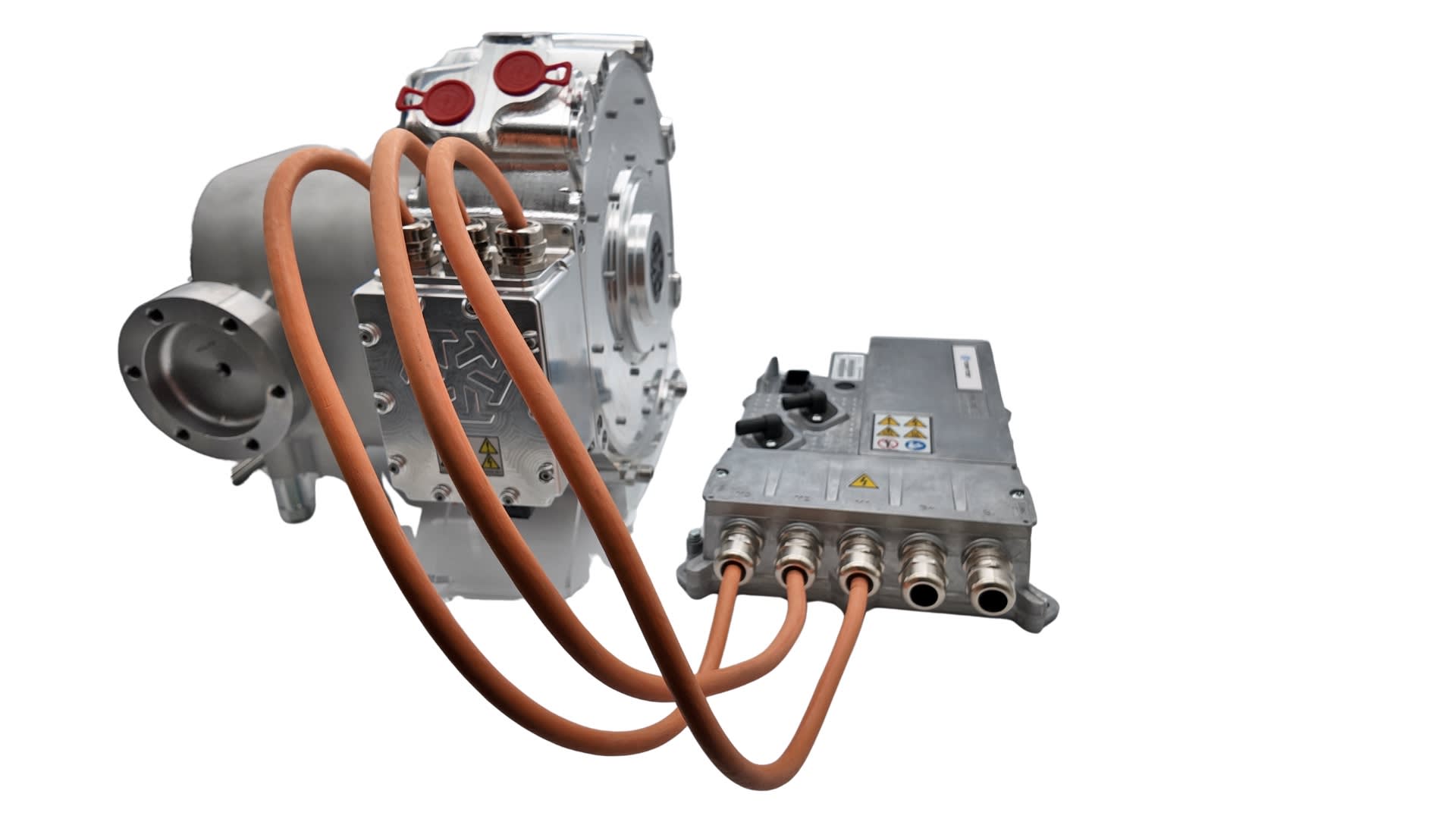
Turntide Technologies is unveiling a new axial flux electric drive unit (EDU) at CONEXPO 2026 in Las Vegas that reportedly enables electric and hybrid system manufacturers to remove months of component-level testing from the development process, decreasing time to market. Applications for the new axial flux EDU include construction equipment and other off-highway and commercial vehicles.
Many manufacturers are moving away from sourcing separate components in favor of more integrated electric propulsion systems such as EDUs, according to Matrishvan Raval, product lead for axial flux motors at Turntide Technologies. Turntide’s fully validated EDU platform can significantly reduce the burden of validating individual motors, inverters, and gearboxes, he said.
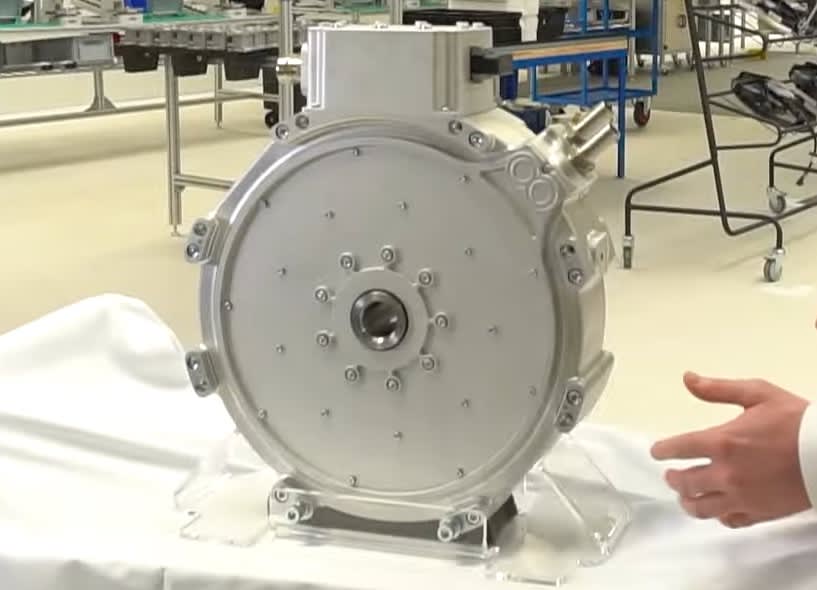
Compared to a radial flux motor, the axial flux EDU is said to deliver 53% higher torque density in a package that is 58% smaller and 37% lighter. With “stackable” axial flux motor technology, power can range from 50 to 240 kW nominal and 175 to 660 kW peak.
The axial flux EDU was developed in about eight months from concept to delivery, according to Raval. “For comparison, first prototypes for similar platforms often take 12 to 18 months, largely because of integration complexity,” he said. “The accelerated timeline was enabled by the existing maturity of the internal motor components and a simplified gearbox approach made possible by the high-torque characteristics of the axial flux motor. The high torque at low speeds allowed for a simpler gearing ratio and design while still meeting end-wheel torque requirements.”
The EDU was designed and developed in the United Kingdom, and final manufacturing, assembly and testing are conducted in Gateshead, UK. Raval shared more details with SAE Media on the development and field-testing of the new axial flux EDU for off-highway applications.
Any specific engineering challenges that needed to be addressed during the development of the new unit?

Three primary engineering challenges were addressed. Every vehicle drivetrain has unique NVH dynamics. Significant effort went into tuning the inverter controls, motor response and gearbox dynamics to match the vehicle geometry and drivetrain behavior. A scientific, algorithm-based tuning methodology within the inverter software enabled rapid and precise calibration. In addition, our axial flux motor inherently has lower cogging torque, which naturally reduces NVH.
The team also optimized the motor configuration (stator coil turn count matched to meet inverter current output) to ensure that the drivetrain operates within a broad, high-efficiency island on the torque-speed curve. [Third], duty-cycle and drivetrain-cycle analyses were conducted to optimize gearbox design and ensure long operational lifetime. The system was validated for durability under real-world operating conditions.
Can you describe the architecture of the axial flux EDU?
The architecture is a semi-integrated EDU. The motor and gearbox are integrated into a single physical unit. The inverter is wire-connected but a separate, flexibly located component, allowing for optimal placement within the vehicle depending on packaging, thermal or reliability considerations.
The platform also supports flexibility in power architecture, including 400-V and 800-V systems. Additionally, multiple motor variants with different torque and speed characteristics can be fitted into the EDU platform, enabling rightsizing for different applications.
Are you seeing a shift toward customers requesting fully integrated electric drives?
There is a broader trend toward higher levels of integration – so-called “X-in-one” systems combining motor, inverter, gearbox, VCU, DC-DC converters, onboard chargers and power conditioning – in high-volume passenger automotive markets. The benefit of having one manufacturer supply all the components for electrification simplifies many aspects of design and engineering, and this is the primary reason for the shift. However, all components [coming] from one supplier requires orders of high volume to make the powertrain cost effective.
However, in the off-highway and construction sector, production volumes are significantly lower. Electrified platforms in this space are typically produced in the hundreds or low thousands, not tens or hundreds of thousands as in passenger vehicles. Highly bespoke, fully integrated X-in-one systems are often not economically viable for lower-volume off-highway applications. A lower level of integration is typically more appropriate.
Turntide’s semi-integrated, three-in-one motor/inverter/gearbox architecture, with the inverter flexibly located, provides the right balance of integration, flexibility and economic viability for low- to medium-volume markets that want to decrease their time to market.
What is unique about this new axial flux EDU compared to other electric drive architectures for construction/off-highway machines?
There are three key differentiators for the axial flux EDU compared to other architectures. Construction and off-highway machines operate at lower speed profiles than on-highway passenger vehicles but demand very high torque under rugged duty cycles. Axial flux motors inherently deliver high torque at low speeds, making them well suited to these applications.
Off-highway applications also experience severe vibration and load conditions. The EDU components are designed to meet elevated NVH demands while maintaining high lifetime and reliability. In addition, the amount of moving equipment needed in off-highway applications is high, and the space is limited. The compact nature of an axial flux EDU and the flexible architecture help with packaging requirements and enables high torque throughput within a small footprint.
Any differences in system setup for a hybrid construction machine vs. fully electric vehicles?
The application case for hybrid and fully electric are similar. The axial flux EDU platform is a great fit for both. However, because of the smaller footprint, its compact size allows it to drop into a hybrid system with an engine much easier than a radial flux EDU. Also, in hybrid diesel-electric construction machines, speed matching between the diesel engine and electric motor is critical. Diesel engines typically operate between 0 rpm to 3,700 rpm/4,000 rpm, which is lower than many conventional radial-flux motor operating ranges.
Turntide has developed high-torque, low-speed axial flux motor variants (430S and 430D series) that are speed-matched to diesel engine operating ranges. This enables direct flywheel integration, eliminates complex intermediary gearbox interfaces, and simplifies hybrid integration.
Are axial flux EDUs already in operation on hybrid and/or electric off-highway machines? Any real-world examples and performance figures?
Axial flux motors and systems are already field-proven in off-highway applications, including traction systems such as mining trucks, agricultural equipment, wheel loaders, dump trucks, street sweepers and more.
The new axial flux EDU has been field-tested in one of the toughest off-road environments in the world at King of the Hammers during the Desert Challenge. Designed to expose drivetrain limits under sustained vibration, load, dirt/dust and heat, the event provided a real-world proving ground for the EDU’s performance and it excelled while enduring more than 500 miles of tough desert terrain.
During testing, the EDU:
- Withstood harsh vibration profiles (validated with accelerometer data)
- Operated across wide temperature variations (validated with thermal data)
- Achieved peak system efficiencies in excess of 90%
- Demonstrated high durability under severe operating conditions.
The EDU excelled under these harsh environmental conditions and vibration loads while maintaining high-efficiency performance.
More From SAE Media Group
Off-Highway Engineering
Electric Mobile Machines Won’t Abandon Hydraulics
Automotive Engineering
Bosch Debuts New CV-Specific Electric Motor and Inverter
Off-Highway Engineering
Battery Innovation Key for Commercial and Off-Highway EVs
Automotive Engineering
Schaeffler Builds an E-Motor Powerhouse
Automotive Engineering
Battery Show Teems with All Things Rechargeable
Automotive Engineering
Bosch’s EV Efficiency Upgrade: Continuously Variable Transmissions
Automotive Engineering
BorgWarner Integrated Drive Module in Testing Phase
Automotive Engineering
Gearing Dana for the EV Future
Off-Highway Engineering
EV Startup Prepares to Enter Commercial Market with Novel EAxle
Automotive Engineering
BMW Brings EV Motor Production to Steyr in Austria
Automotive Engineering
Off-Highway Hybrids Are Entering Prime Time
Automotive Engineering
Wheel-Hub-Motor Innovations in Flux
Off-Highway Engineering
Rexroth Takes Aim at Electrification for Off-Highway Vehicles
Automotive Engineering
ZF Introduces Complete E-Drive System for Passenger, Commercial Vehicles
Off-Highway Engineering
Case Unveils Fully-Electric Backhoe Loader, Begins Delivery This Year
Off-Highway Engineering
EAxles Gain Traction for Truck Electrification
Off-Highway Engineering
WAVE Inductive Charging Purpose-Built for Large EVs
Off-Highway Engineering
Cummins and Isuzu Announce Battery-electric Truck Collaboration
Off-Highway Engineering
Meritor Pursues Lightweighting Strategies for Drivelines
Off-Highway Engineering
The Case for 48V in Commercial Vehicles
Automotive Engineering
GM, Autocar to Build Fuel-Cell Commercial Vehicles
Automotive Engineering
Gearing EVs for Greater Efficiency
Off-Highway Engineering
Transmission Talk: Eaton Discusses Its Portfolio of Commercial Gearboxes
Off-Highway Engineering
Upswing in Outsourced EV Testing
Off-Highway Engineering
CONEXPO 2023 Image Gallery
Automotive Engineering
Protean Electric Aims for Pirouetting Autonomous EVs
Off-Highway Engineering
Overcoming EV Drivetrain Testing Challenges
Off-Highway Engineering
Electronic Torque Limiting Boosts Machine Productivity
Battery & Electrification Technology
48V Electrical Systems: A Key to Meeting Evolving Industry Demands
Off-Highway Engineering
Israeli Startup REE Reinvents the Wheel with a Modular Approach to Future EV Design
Top Stories
INSIDERAerospace
 How Airbus is Using w-DED to 3D Print Larger Titanium Airplane Parts
NewsAutomotive
 Microvision Aquires Luminar, Plans Relationship Restoration, Multi-industry Push
INSIDERManned Systems
 A Next Generation Helmet System for Navy Pilots
INSIDERDesign
 New Raytheon and Lockheed Martin Agreements Expand Missile Defense Production
ArticlesManned Systems
 Accelerating Down the Road to Autonomy
NewsPower
 Ford Announces 48-Volt Architecture for Future Electric Truck
Webcasts
Electronics & Computers
 Cooling a New Generation of Aerospace and Defense Embedded...
Test & Measurement
 Battery Abuse Testing: Pushing to Failure
Internet of Things
 A FREE Two-Day Event Dedicated to Connected Mobility
Unmanned Systems
 Quiet, Please: NVH Improvement Opportunities in the Early Design Cycle
Transportation
 Advantages of Smart Power Distribution Unit Design for Automotive &...
Aerospace
 Sesame Solar's Nanogrid Tech Promises Major Gains in Drone Endurance