




New 3D-Printable Nanocomposite Prevents Overheating in Military Electronics

U.S. Army and university researchers collaborated to develop a 3D-printable material using tiny particles that conduct heat and can be used to more efficiently cool military advanced electronics. The technology is ready for industry engagement and commercialization.
The advanced material, a research effort between Northeastern University and U.S. Army Combat Capabilities Development Command, or DEVCOM, Army Research Laboratory, has the potential to advance warfighter capabilities. Thermal management and packaging of high-power electronics in communication systems, radar, drones and electric vehicles are some of the technologies it could improve. These systems currently can suffer from degraded performance, or even shut down when they overheat, which is a growing challenge for the Army.
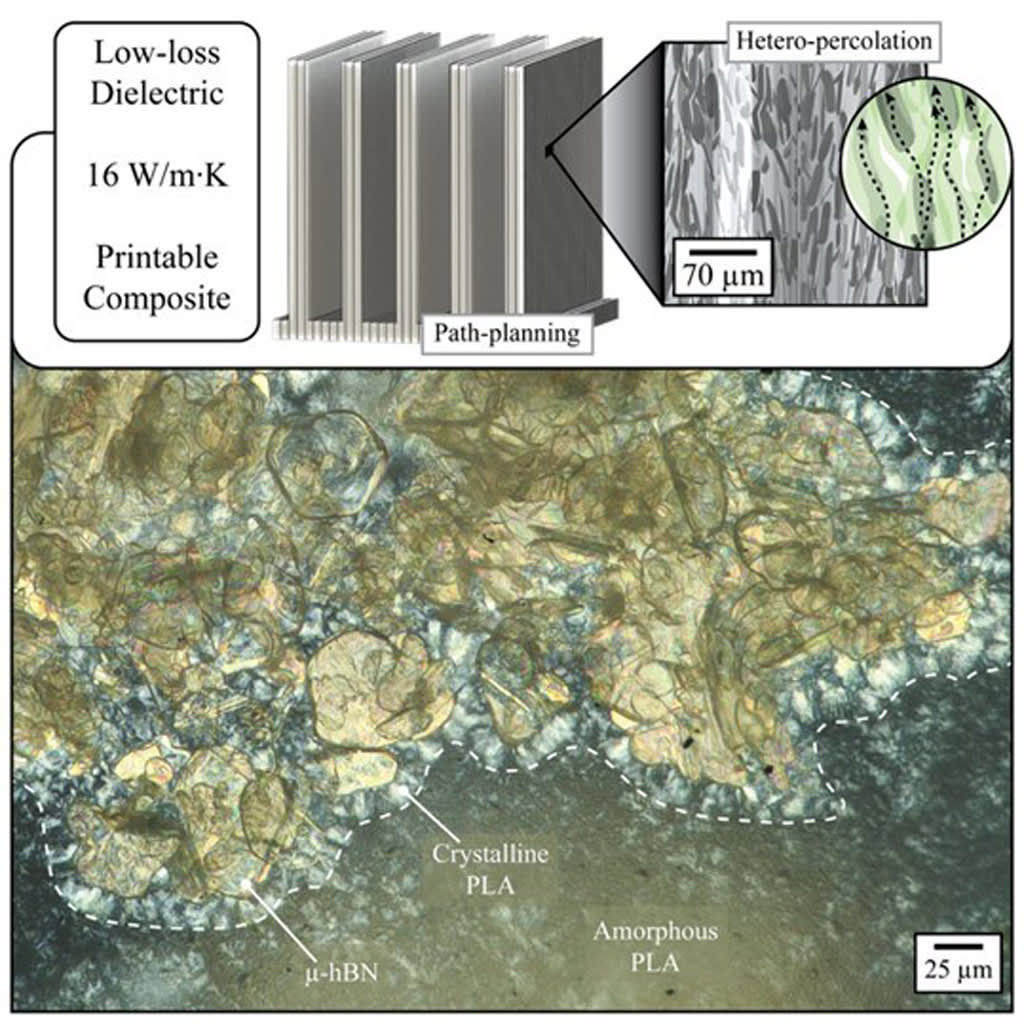
“This advanced material is a significant step forward for packaging of advanced electronics,” said Dr. Eric Wetzel, Mechanical Engineer at DEVCOM ARL and the paper’s co-author. “Its ability to efficiently manage heat while maintaining RF transparency, while also being 3D printable, enables new possibilities for military and industry applications.”
Published in Advanced Materials , the research uses a nanocomposite material comprising inorganic, hexagonal boron nitride (hBN) fillers embedded in a thermoplastic polymer. By carefully combining additives, surface treatments and thermal post-processing, the team created a crystalline polymer structure that bridges the highly conductive fillers, significantly enhancing thermal conductivity.
The nanocomposite is first formed into continuous filament, which can then be fed into a desktop 3D printer to create complex structures such as heat sinks, thermal spreaders, mounting plates or panel covers. The 3D printing process further aligns the fillers, boosting the material’s performance. Unlike metal packaging, this hBN nanocomposite is both RF transparent and electrically insulating, so it can be placed in close proximity to high-current and high-voltage electronics without blocking RF signals — critical to communications or radar systems — or risking an electrical short.

The material is also lightweight, about 40 percent less dense than aluminum and 80 percent less dense than copper, two of the most widely used materials for advanced thermal management of electronics.
This material could enable the development of lighter, more compact and more efficient electronic assemblies for use in harsh environments, which could lead to improved Soldier survivability and mobility.
“We are looking for industry partners to transition this technology,” Wetzel said. “In additional to military applications, we see a wide range of commercial applications for this material, including personal electronics such as mobile phones, telecommunications equipment, data centers and electric vehicles.”
More From SAE Media Group

Tech Briefs
3D Printing Stronger Carbon Nanotubes

Tech Briefs
Strong, Stretchy, 3D-Printed Metamaterials
Medical Design Briefs
New Products and Services
Tech Briefs
Testing the Thermal Limits of BNNTs
Medical Design Briefs
New Products & Services

Aerospace & Defense Tech Briefs
Unlocking the Potential of 3D-Printed Polymers in Aerospace and Defense
Electronics & Sensors INSIDER
MIT Team Takes a Major Step Toward Fully 3D-Printed Active Electronics

Sensor Technology
3D Printable Sensors Disposed of Without Contaminating the Environment
Tech Briefs
Products of Tomorrow
Electronics & Sensors INSIDER
3D Printing of Organic Electronics

Tech Briefs
New on the Market

Medical Design Briefs
Winter 2022 Resource Guide

Aerospace & Defense Tech Briefs
Carbon Nanotube Thermal Interfaces Enhanced with Sprayed-On Nanoscale Polymer Coatings

Tech Briefs
Conductive Carbon Fiber Polymer Composite


Aerospace Manufacturing and Machining INSIDER
Supernova to 3D Print Military Grade Energetic Materials
Medical Design Briefs
New Products and Services

Aerospace & Defense Tech Briefs
Aitiip Integrates Freeform Injection Molding to Lower Weight and Reduce Production Costs
Medical Design Briefs
3D Printable Polymer Nanocomposite Ink
Power Electronics INSIDER
Substrate Engineering to Improve Power Electronics
Top Stories
INSIDERRF & Microwave Electronics
 FAA to Replace Aging Network of Ground-Based Radars
PodcastsDefense
 A New Additive Manufacturing Accelerator for the U.S. Navy in Guam
NewsSoftware
 Rewriting the Engineer’s Playbook: What OEMs Must Do to Spin the AI Flywheel
Road ReadyPower
 2026 Toyota RAV4 Review: All Hybrid, All the Time
INSIDERDefense
 F-22 Pilot Controls Drone With Tablet
INSIDERRF & Microwave Electronics
 L3Harris Starts Low Rate Production Of New F-16 Viper Shield
Webcasts
Energy
 Hydrogen Engines Are Heating Up for Heavy Duty
Energy
 SAE Automotive Podcast: Solid-State Batteries
Power
 SAE Automotive Engineering Podcast: Additive Manufacturing
Aerospace
 A New Approach to Manufacturing Machine Connectivity for the Air Force
Software
 Optimizing Production Processes with the Virtual Twin
