




New AI Tool Predicts Lithium Metal Anode Failures from Just Two Early Cycles
Researchers identify early “fingerprints” in battery data to foresee failure issues, offering a game-changing approach to battery development.
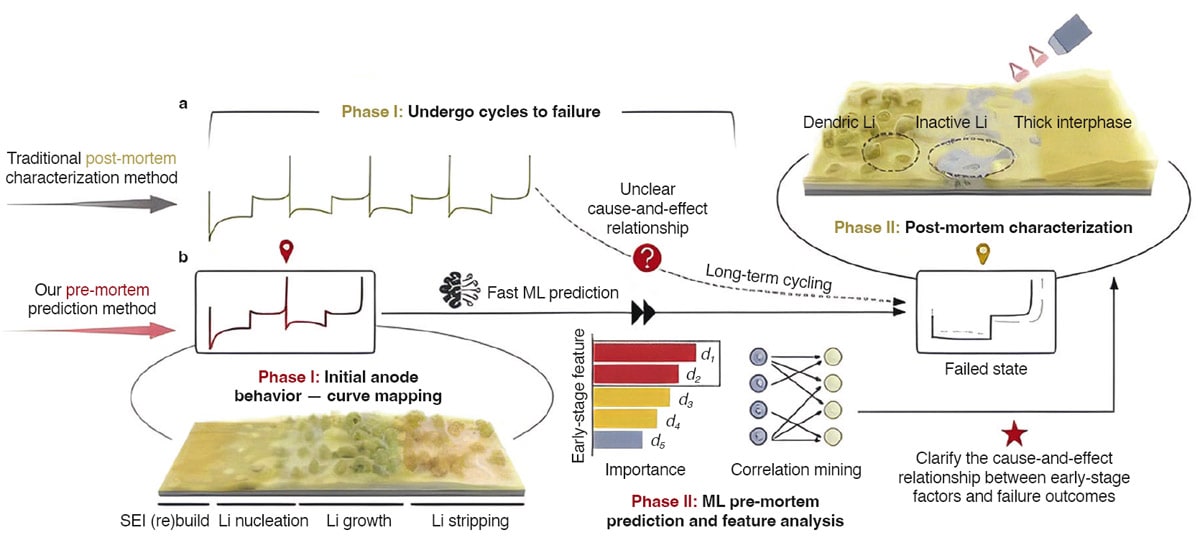
Lithium metal batteries (LMBs) are a promising technology for next-generation energy storage, offering higher energy density than traditional lithium-ion batteries. However, challenges related to the anode’s behavior — specifically issues related to its kinetics and reversibility — have hindered their widespread adoption. Researchers have long struggled with understanding the underlying causes of battery failure, often relying on post-mortem analysis that only reveals outcomes but fails to capture the dynamic processes leading to failure.
In a groundbreaking study, researchers at Tsinghua Shenzhen International Graduate School and the Shenzhen Institute of Advanced Technology, Chinese Academy of Sciences, have developed a predictive model that uses electrochemical data from the initial cycles of LMBs to forecast potential failures. This model identifies early indicators that correlate with different types of anode failure. The research demonstrates that failure signatures in the initial cycles serve as “electrochemical fingerprints” — providing key insights into the failure mechanisms of lithium metal anodes.
“We discovered that early-stage lithium plating and stripping behaviors during the first two cycles are highly indicative of the battery’s eventual failure mode,” said first author Zhihong Piao. “This breakthrough model not only predicts the failure type accurately but also reduces the time and resources needed for testing.”
By leveraging machine learning algorithms and extensive datasets, the team developed a high-accuracy classification model that distinguishes between three main failure types: kinetics degradation failure, reversibility degradation failure, and co-degradation failure. It also demonstrates generalizability, accurately classifying failures in cells using a wide range of published electrolyte formulations — including low- and high-concentration systems based on carbonates, ethers, and siloxanes.
Instead of waiting weeks or even months for a battery to degrade, engineers and researchers can now forecast its future in a matter of days. This offers a major advantage in both speed and cost, especially when developing and testing new electrolyte formulas or battery designs. What makes this approach even more powerful is that it doesn’t require any disassembly or special instruments — it works using cycling data that the battery produces. This makes it highly practical and easy to adopt in both academic labs and commercial production lines. This opens up new possibilities for designing more robust batteries, optimizing electrolytes, and accelerating the development of LMB technologies.
Notably, the research offers more than just a predictive tool — it provides scientific insights into failure mechanisms. The research reveals the importance of the solid electrolyte interphase (SEI) and the lithium deposit microstructure in determining battery performance. The team validated this with experiments and simulations, linking observed electrochemical behaviors to specific SEI properties and lithium morphology. These two features influence the formation of ineffective interphase regions (lacking intimate contact with the lithium metal) and inactive lithium at the lithium metal anode, which in turn lengthen charge carrier (lithium-ion and electron) transport paths, leading to poorer kinetics and reversibility.
For more information, contact Zhihong Piao at tsinghua.edu.cn.
More From SAE Media Group
Battery & Electrification Technology
Crafting Safe, Long-Cyclable Lithium Metal Batteries for High Temperatures
Battery & Electrification Technology
Enhancing the Performance of All-Solid-State Batteries

Battery & Electrification Technology
Developing High-Energy, Stable All-Solid-State Lithium Batteries Using Aluminum-Based Anodes and High-Nickel Cathodes

Tech Briefs
A New Design for Lithium-Sulfur Batteries
Battery Technology
Hybrid Membrane Doubles the Lifetime of Rechargeable Batteries
Battery & Electrification Technology
Thick Electrodes’ Chemistry Matters More Than Structure for Battery Performance
Battery & Electrification Technology
New Priming Method for Improving Battery Lifecycle

Battery & Electrification Technology
Improving and Increasing Energy Density of Batteries
Power Electronics INSIDER
World’s Strongest Battery Paves Way for Light, Energy-Efficient Vehicles

Battery & Electrification Technology
Researchers Discover a Surprising Way to Jump-Start Battery Performance

Battery Technology
Doubling Battery Performance with Lithium Metal

Medical Design Briefs
Flexible High-Energy Textile Lithium Battery Designed for Wearables
Tech Briefs
Long-Life Lithium-Metal Battery
Tech Briefs
First-Ever 3D-Printed Battery
Tech Briefs
Lithium Metal Battery Allows Cold Charging
Battery & Electrification Technology
New Material Offers Promise for Solid-State Batteries
Battery & Electrification Technology
Designing Safer, Higher-Performance Lithium Batteries

Battery Technology
Nanostructured Alloy for Battery Anodes
Tech Briefs
A Better-Performing Sodium-Ion Cathode
Power Management INSIDER
Researchers Determine Optimum Pressure to Improve the Performance of Lithium Metal Batteries
Battery & Electrification Technology
New Cathode Material for Sodium-Ion Batteries
Battery & Electrification Technology
Niobium: Magic Metal for Battery Anodes?
Battery & Electrification Technology
Designing Sodium-Ion Batteries with Extended Longevity
Top Stories
NewsSensors/Data Acquisition
 Microvision Aquires Luminar, Plans Relationship Restoration, Multi-industry Push
INSIDERRF & Microwave Electronics
 A Next Generation Helmet System for Navy Pilots
INSIDERWeapons Systems
 New Raytheon and Lockheed Martin Agreements Expand Missile Defense Production
NewsAutomotive
 Ford Announces 48-Volt Architecture for Future Electric Truck
INSIDERAerospace
 Active Strake System Cuts Cruise Drag, Boosts Flight Efficiency
ArticlesTransportation

Webcasts
Aerospace
 Cooling a New Generation of Aerospace and Defense Embedded...
Energy
 Battery Abuse Testing: Pushing to Failure
Power
 A FREE Two-Day Event Dedicated to Connected Mobility
Automotive
 Quiet, Please: NVH Improvement Opportunities in the Early Design Cycle
Electronics & Computers
 Advantages of Smart Power Distribution Unit Design for Automotive &...
Unmanned Systems
 Sesame Solar's Nanogrid Tech Promises Major Gains in Drone Endurance