




Battery & Electrification Technology - July/August 2025
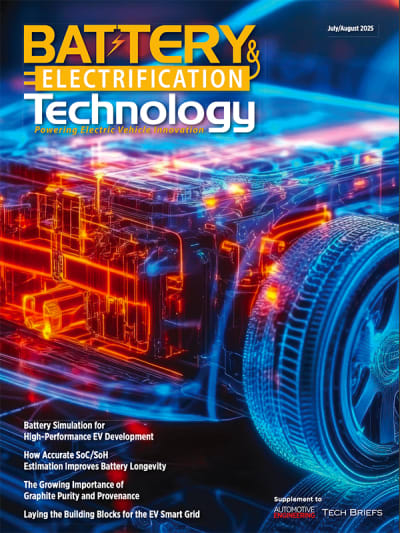
Inside this issue
Overview
The July/August 2025 issue of "Battery & Electrification Technology" delves into critical advancements in electric vehicle (EV) technology, battery safety, and the evolving landscape of energy management systems. This issue highlights the importance of load management in the successful implementation of EV fleets, the safety challenges associated with lithium-ion batteries, and innovative methodologies for designing next-generation solid-state batteries.
Laying the Building Blocks for the EV Smart Grid
The issue opens with an article discussing the pivotal role of load management in the transition to electric vehicles. As fleets, including school districts and commercial delivery services, increasingly adopt EVs, the challenge of managing concentrated charging loads becomes apparent. The article emphasizes that without sophisticated load management systems, the electrical infrastructure may struggle to support the growing demand, leading to costly upgrades and delays.
A hybrid local-plus-cloud charge management architecture is introduced as a solution to optimize charging across multiple sites while minimizing the impact on the distribution grid. This system allows fleet operators to maximize the use of existing utility services, thereby facilitating a smoother transition to electric mobility.
Fundamentals of Reliable EV Load Management
The reliability of charge management systems (CMS) is crucial for ensuring safe and efficient EV charging. The article outlines the need for robust systems that can handle complex load management tasks while maintaining safety protocols. It discusses the importance of local control devices that minimize latency and enhance optimization, as well as the necessity for fallback mechanisms to prevent hazards like arc flashes or fires.
The CMS serves as the nerve center of an integrated charging system, relying on strong communication standards such as the Open Charge Point Protocol (OCPP) and Modbus. These standards ensure effective communication between charging stations and energy management systems, which is essential for achieving reliable load management.
Battery Safety in Logistics and Storage
Another significant focus of this issue is battery safety, particularly during the logistics and storage phases. A webinar led by Emily Klein addresses the often-overlooked risks associated with lithium-ion batteries, including thermal events during warehousing, mislabeling during shipping, and improper state-of-charge management during transit. The discussion underscores the need for dedicated logistics teams to mitigate these risks and ensure safe handling of batteries throughout their lifecycle.
Building a Sustainable and Carbon-Neutral Future
The magazine also explores the broader context of sustainability in the energy sector. It highlights the critical role of analytical tools like Isotope Ratio Mass Spectrometry (IRMS) and Laboratory Information Management Systems (LIMS) in ensuring the quality and traceability of materials used in battery production. As the industry strives for a carbon-neutral future, these tools are essential for maintaining high standards in battery manufacturing and supporting the clean energy movement.
The article emphasizes the importance of collaboration across sectors to keep pace with advancements in energy solutions. By embracing new technologies and methodologies, businesses can lead the transition to sustainable energy and develop high-performance batteries that comply with evolving regulations.
Advancements in Solid-State Battery Design
The issue concludes with a discussion on the design and optimization of next-generation solid-state batteries. Researchers are exploring innovative frameworks that enable accurate predictions of candidate structures without relying solely on experimental inputs. This transformative approach aims to enhance the efficiency of solid-state battery design, contributing significantly to sustainable energy solutions.
The potential application of generative AI tools is also highlighted, as these technologies may improve the predictive capacity of battery design platforms by exploring ion migration pathways and reaction mechanisms. This advancement could lead to more efficient and effective battery technologies in the future.
Conclusion
Overall, the July/August 2025 issue of "Battery & Electrification Technology" provides a comprehensive overview of the current state of battery technology and energy management systems. It addresses the challenges and opportunities presented by the growing adoption of electric vehicles, the critical importance of safety in battery logistics, and the ongoing efforts to develop sustainable energy solutions. As the industry continues to evolve, the insights shared in this issue will be invaluable for stakeholders looking to navigate the complexities of the electrification landscape and contribute to a cleaner, more sustainable future.
Briefs
-
17 Spray Drying Tech Used in Instant Coffee Applied to High-Capacity Battery Production
18 How Can We Optimize Solid-State Batteries? Try Asking AI
Features
-
Articles
2 How Battery Simulation Is Taking High-Performance EV Development to New Heights
6 Why Accurate SoC and SoH Estimation Is Critical for Battery Longevity and Business Success
10 From Mine to Battery: The Growing Importance of Graphite Purity and Provenance
Products
-
21 New Products
Top Stories
INSIDERDefense
 New Raytheon and Lockheed Martin Agreements Expand Missile Defense Production
NewsAutomotive
 Ford Announces 48-Volt Architecture for Future Electric Truck
INSIDERManufacturing & Prototyping
 Active Strake System Cuts Cruise Drag, Boosts Flight Efficiency
ArticlesTransportation
 Accelerating Down the Road to Autonomy
INSIDERMaterials
 How Airbus is Using w-DED to 3D Print Larger Titanium Airplane Parts
Road ReadyTransportation

Webcasts
Electronics & Computers
 Cooling a New Generation of Aerospace and Defense Embedded...
Power
 Battery Abuse Testing: Pushing to Failure
Connectivity
 A FREE Two-Day Event Dedicated to Connected Mobility
Automotive
 Quiet, Please: NVH Improvement Opportunities in the Early Design Cycle
Transportation
 Advantages of Smart Power Distribution Unit Design for Automotive &...
Aerospace
 Sesame Solar's Nanogrid Tech Promises Major Gains in Drone Endurance