




Off-Highway Vehicle Electrification Surges Ahead
Deutronic’s DVCHx3 DC/DC converter streamlines the electrification of off-highway machines.
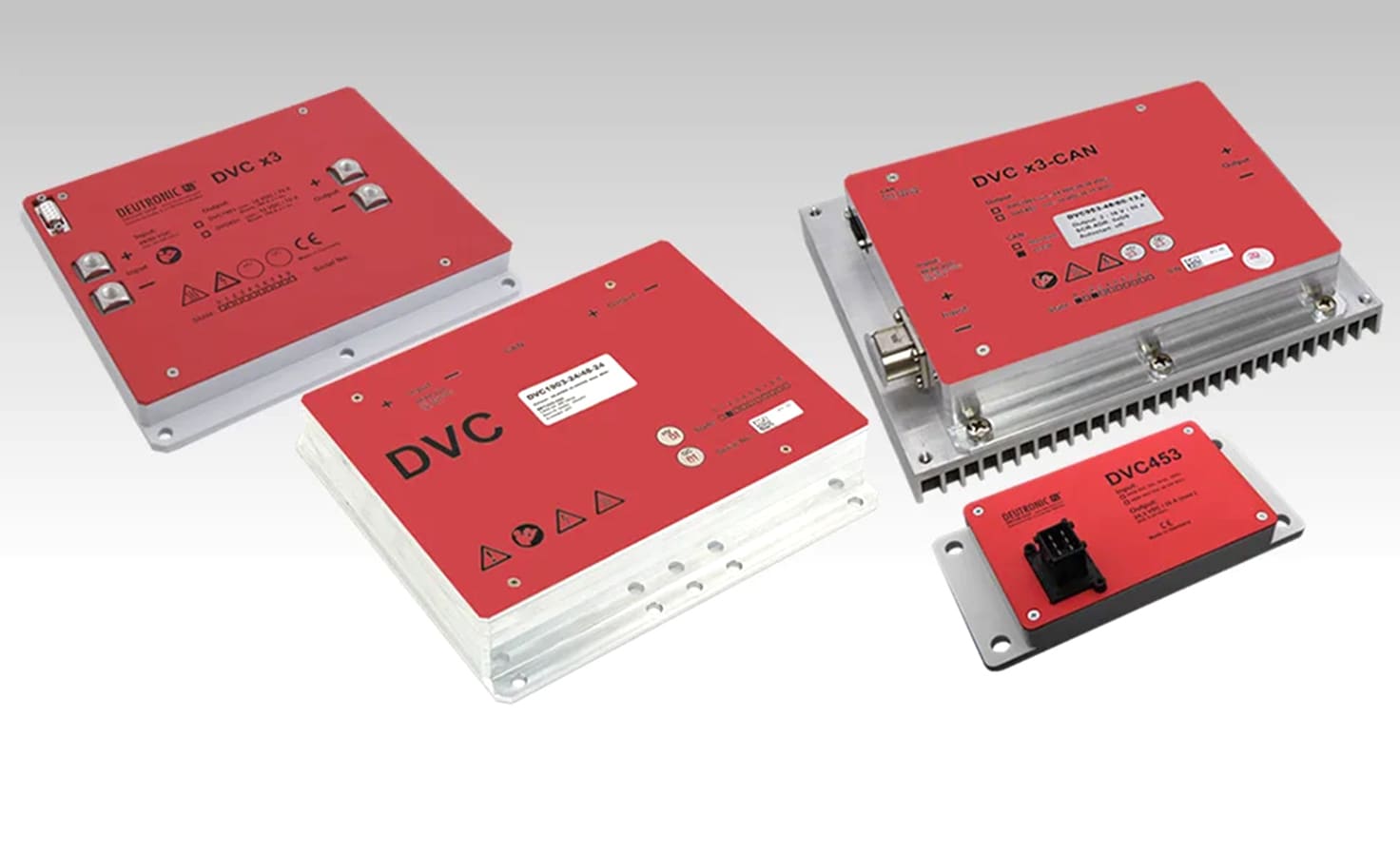
Thanks to the continued growth of electrified machines in the off-highway segment, DC/DC converters are rapidly becoming a crucial component in the supply chain for numerous OEMs for a wide array of applications.

Deutronic recently unveiled a new line of DC/DC converters intended for the mass electrification needs of today’s off-highway commercial vehicles. The converter’s design is said to be durable and compact with high power density that also offers protection from environmental factors such as vibration, shock, and high temperatures. Deutronic’s DVCHx3 converter also provides an interlock function, as well as short-circuit, overtemperature and no-load/self-protection features.
A notable feature of the unit is its contact surface cooling. Unlike liquid-cooled systems, the contact cooling system is extremely flexible in terms of packaging and mounting and also simplifies overall system integration. SAE Media spoke with Tobias Wanzke, Deutronic’s head of business development, at IVT Expo on the significance of the DVCHx3’s contact cooling package as well as the potential for growth in the high-voltage component market.
What were your main goals for this converter and what were you trying to bring to market with it?
We have the same housing across the lineup but with a lot of different input and output voltages because there’s some specific applications that need 48 volts. We’re very focused on simple and clean implementation in the vehicle, especially for construction vehicles. We’re also focusing on contact cooled systems because they’re very easy to mount on the chassis. A liquid cooled system is very expensive and harder to service. The contact cooling system is very flexible because we can offer a cold plate system or also heatsink.
What are the pros and cons of the contact cooling versus liquid cooling in terms of packaging?
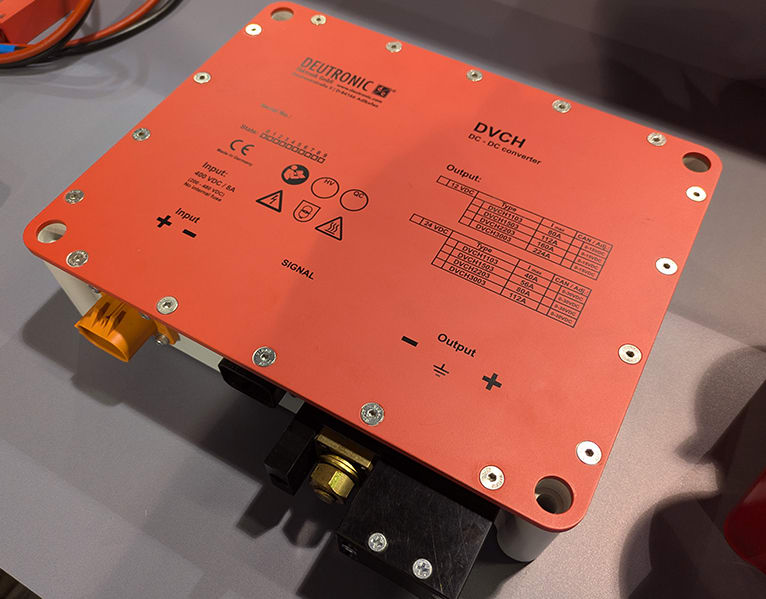
Contact cooling is cheaper because you don’t need an entire electric cooling system. So contact cooling is more compact and easier to implement. You can just screw our unit onto the chassis or wherever you have place for the converter. One downside about contact cooling is some customers want to have a very regulated cooling system. If you have an application that runs in very high temperatures, for example, a cold plate may not be the best solution for you if you want to keep the system in a very specific temperature range.
What are your airflow requirements for this type of cooling or with a heatsink? Is it something that just an electronic fan can meet, or do you need additional cooling beyond that?
It depends on the application. We have two different heatsinks for horizontal and vertical mounting. We have had customers ask us if there’s enough cooling capacity for their application with no airflow with those components. So, it’s a discussion with the customer. But more often than not, we are able to meet their needs with no additional cooling.
What are the main applications you’re seeing for these products right now?

Most customers are naturally from the off-highway sector, like construction equipment and other specialized machines. A lot of customers use these converters to have more power output. Some customers also have different voltages on the same chassis. For example, they have a 12- and a 24-volt system powering various aspects of the machine. This is why we wanted a design with very flexible housing. You may have a customer whose first application or the first vehicle needs a three-kilowatt unit but the next one needs a six-kilowatt one.
What is the state of the high voltage architecture market and where do you see that going over the next 10 to 15 years?
At the moment, it’s only about five to 10 percent. But we see that new components are coming for electrified vehicles that are based on 48-volt architectures because you need less wiring, so the diameter is less so it’s cheaper. It’s also easier to have high power applications like a bigger fan, for example, or air conditioning. I think in five years’ time, 48-volt will be about 25 percent of the market.
So you think it’s going to grow that much that quickly?
I hope so. We’re seeing applications where customers have a 24-volt and a small 48-volt system on the same chassis. This is a very expensive way to do this for the customer. We would like to try to have more of our clients exclusively on a 48-volt system where it makes sense to do so.
What were some of the other notable design considerations of this unit?
It uses the same housing as the first-generation unit, but that had a two-stage power supply inside. This is only a single stage. We focused a lot on flexibility within the same housing for this unit. We tried to have a standard housing but be very flexible in terms of the electronics inside.
More From SAE Media Group
Automotive Engineering
From Emissions Tech to EV Electronics
Off-Highway Engineering
Solving the Challenges of Megawatt Chargers
Automotive Engineering
WCX 2025: Vicor’s New Power Modules Arrive with 48V
Aerospace & Defense Tech Briefs
Simplifying Power Design with Modular Architectures
Automotive Engineering
Defrosting Tech Saves EV Battery Energy
Off-Highway Engineering
Thermal Management for Off-Highway Vehicles
Automotive Engineering
EV Energy-Management Powers-Up
Automotive Engineering
A Resonant Solution for Fast, Flexible EV Charging
Automotive Engineering
48V Is Coming, and Not Just for EVs
Automotive Engineering
Keeping Your Silicon Cool
Off-Highway Engineering
Modine Targets Off-Highway EVs with ‘Plug-And-Play’ BTMS

Off-Highway Engineering
Webasto Delivers Battery System for Zeus EV Chassis
Automotive Engineering
Moving Targets: How Improvements to SiC, GaN Power Electronics Will Redefine EV
Autonomous Vehicle Engineering
Creating Safe, Reliable Circuits for Next-Gen EVs
Aerospace & Defense Tech Briefs
Designing VME Power Systems With Standard Modules
Sensor Technology
Direct-Current Detector for Emergency Responder Safety
Off-Highway Engineering
Lightning EMotors Adapts to Changing Electrification Market
Automotive Engineering
How 3D Printing Could Add Efficiency to EV Power Electronics
Off-Highway Engineering
Catering to Off-Highway EVs’ Unique Thermal Need

Green Design & Manufacturing
Power Conversion for Reduced Cost, Volume, and Weight - and Increased Efficiency
Automotive Engineering
Valeo Moves to Support the Progression to Electrified Vehicles
Tech Briefs
Maximizing Safety in Advanced Battery Systems

Off-Highway Engineering
Battery Innovation Key for Commercial and Off-Highway EVs
Off-Highway Engineering
BEV Truck Manufacturers Charge Ahead at 2022 NTEA Show
Medical Design Briefs
Product Focus: Power Supplies
Power Electronics INSIDER
Medium-Voltage Circuit Breaker Unlocks Electricity Abundance, Savings
Top Stories
INSIDERRF & Microwave Electronics
 FAA to Replace Aging Network of Ground-Based Radars
PodcastsDefense
 A New Additive Manufacturing Accelerator for the U.S. Navy in Guam
NewsSoftware
 Rewriting the Engineer’s Playbook: What OEMs Must Do to Spin the AI Flywheel
Road ReadyPower
 2026 Toyota RAV4 Review: All Hybrid, All the Time
INSIDERDefense
 F-22 Pilot Controls Drone With Tablet
INSIDERRF & Microwave Electronics
 L3Harris Starts Low Rate Production Of New F-16 Viper Shield
Webcasts
Energy
 Hydrogen Engines Are Heating Up for Heavy Duty
Energy
 SAE Automotive Podcast: Solid-State Batteries
Power
 SAE Automotive Engineering Podcast: Additive Manufacturing
Aerospace
 A New Approach to Manufacturing Machine Connectivity for the Air Force
Software
 Optimizing Production Processes with the Virtual Twin
