




Reclaiming Readiness: Advancing US Defense Through Scalable Additive Manufacturing

The nature of defense readiness is being reformed and redefined. Not only are our weapon systems being made increasingly advanced and sophisticated, but the resilience of our defense manufacturing base is becoming the key deterrent factor. In a world that is facing geopolitical uncertainty, escalated regional and global conflicts and tensions, as well as fractured supply chains, the capability to produce critical defense components rapidly, locally, and securely has become a significant strategic advantage.
Why Additive Manufacturing Is Moving from Niche to Necessity
In the past decade, additive manufacturing (AM) has been seen as a technological advancement for prototyping, or a tool to reduce development time for producing highly specialized, complex, lightweight parts. But recently, its perception and role in core manufacturing, especially in defense and aerospace industries, has shifted dramatically.
The pandemic experience, current geopolitical conflicts, and raw material access and shortages have exposed the fragility of global supply chains. Lead times stretched from weeks to months, and sometimes years. In addition, the dependency on overseas suppliers – sometimes from adversarial countries – became a clear vulnerability for the U.S. defense industrial base. Metal AM offers a path to localized, decentralized supply chains as well as on-demand production. It provides flexibility to make critical parts whenever and wherever they are needed, without relying on international shipping lanes or navigating unpredictable trade barriers. The ability to produce necessary components domestically and under controlled conditions helps safeguard intellectual property and strengthens national security.
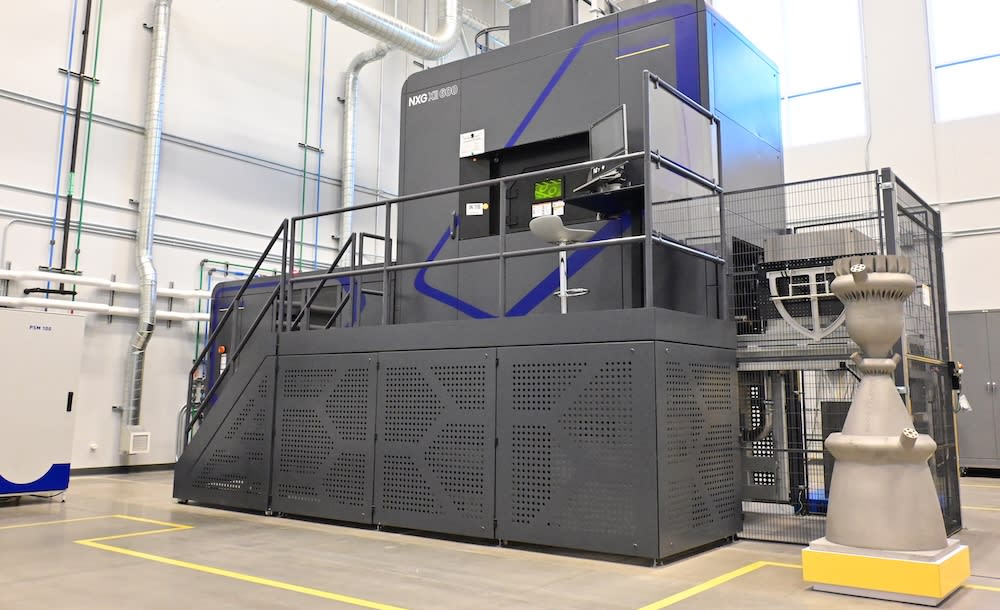
Traditional metal AM Laser Powder Bed Fusion (L-PBF) systems were limited by small build chambers, restricting AM to smaller, intricate parts. Today’s industry-leading large-format L-PBF systems dramatically expand production capabilities, making it possible to manufacture sizable, structurally critical components such as missile structures, unmanned vehicles’ fuselages, aerospace brackets, satellite housings, artillery’s large components, submarine and ship critical parts, or even portions of aircraft frames. These large components (~2X2X5 ft) often have the highest performance requirements and the most severe supply chain constraints, especially in casting and forging. These AM technology advancements are game changing. Ultra-large format, high productivity L-PBF machines such as multi-laser systems (e.g., 12 laser platforms such as Nikon SLM Solutions NXG XII 600) remove the production speed barrier that had previously limited AM to prototyping or low-volume applications. These platforms significantly reduce build times while maintaining quality, making AM a viable option for serial production rather than only one-off parts. For defense programs, this shift is crucial. It brings AM out of the lab and into the factory floor, aligning with the United States’ defense industrial base productivity expectations.
Scaling for Impact: Materials, Repeatability, and Qualification
While the promise of AM is clear, the path to expansion of defense industries adoption hinges on one key factor: trust. In the AM context, trust is translated to machine repeatability, materials performance and qualification, generating data sets, technical data packages, rigorous process qualification and certification, and successfully influencing and adjusting the perception of our engineers and technical decision makers. The Human Factor!
A recent compelling example of materials data generation is the partnership of Nikon Advanced Manufacturing (Nikon AM) with America Makes to build data sets and qualify Aheadd® CP1 aluminum alloy using a large format high productivity AM platform (Nikon SLM Solutions NXG XII 600). CP1 aluminum components are essential across defense platforms, from aircraft structures to multi-functional thermal management components and heat exchangers. However, introducing new AM material into critical systems requires more than technical feasibility. It necessitates validated processes, standardized quality metrics, and clear pathways for qualification. This initiative supported by the Department of Defense reflects a broader trend: AM is maturing beyond research labs and pilot programs. The focus is shifting to industrial-grade reliability and ensuring that every part, whether produced in a centralized facility in the U.S. or a forward-deployed base, meets the operations’ requirements. Without this emphasis on data, repeatability and qualification, AM will be limited to prototypes and non-critical parts. Therefore, strategic, forward-thinking government investments to build and develop critical materials data sets, combined with successful demonstration of repeatable and reliable AM platforms, and component qualification, are making AM technology a true production solution for mission-critical components.
Strategic Value: Risk Mitigation and Supply Chain Control
Lead time and manufacturing speed are often considered AM’s main advantages when it comes to rapid prototyping, but its strategic value extends far beyond that. In the defense industrial base, AM offers an avenue to de-risk logistics particularly in environments where traditional supply chains are not functional, including forward-operating bases, naval vessels at sea, or remote aerospace maintenance hubs. In these scenarios, waiting weeks for a replacement bracket, heat exchanger, or engine component shipped from a distant supplier is not only inconvenient but also can jeopardize operational readiness.
AM has the potential to fundamentally change this dynamic. Localized, on-demand AM production reduces supply chain dependence, accelerates delivery, lowers trade-related risks, and enhances operational agility and readiness. In addition to part production and manufacturing capacity, we need to also consider materials and critical materials availability especially. Critical materials’ availability has long been a vulnerability in defense manufacturing, but AM offers a pathway to reduce that dependency and use materials more efficiently. Traditional manufacturing processes often involve significant material waste, which amplifies the strain on supply chains for scarce or strategic materials like Titanium, Nickel, and Scandium. AM enables near net shape production with substantially reduced material waste, optimizing utilization efficiency for critical alloys and metals. This heightened efficiency is invaluable for defense applications where materials like titanium and rare earth elements are not only expensive but increasingly difficult to source reliably.
What’s Needed Next
As the technical capabilities of AM continue to advance, policy and regulatory frameworks must evolve in parallel. Currently, significant gaps remain in areas such as standardization, intellectual property protection, and export compliance. If left unaddressed, these gaps could negatively impact the substantial benefits AM offers to the defense industrial base. Simplifying and streamlining defense contracting processes is essential. Establishing a unified, standardized supplier checklist and clear qualification metrics will accelerate supplier approval and promote consistency across the AM supply chain.
To fully unlock the potential of AM in defense, greater collaboration across the entire ecosystem is needed. This requires small, medium, and large businesses, government agencies, national labs, and the defense community to work together to develop practical policies, standards, and regulatory frameworks that enable faster adoption of AM technologies while maintaining the vital levels of quality and security. The convergence of clear policy, simplified technology, availability of data packages, and coordinated industry efforts is essential to making additive manufacturing a routine, dependable component of defense production, one that strengthens readiness, resilience, and supply chain security.
This article was written by Behrang Poorganji, Vice President of Technology, Nikon Advanced Manufacturing (Long Beach, CA). Look out for the full version in the August 2025 edition of Aerospace & Defense Technology . For more information, visit ngpd.nikon.com.
More From SAE Media Group
Aerospace & Defense Tech Briefs
Reclaiming Readiness: Advancing US Defense Through Scalable Additive Manufacturing


Aerospace Manufacturing and Machining INSIDER
US Navy Taps Hunt Valve for First 3D-Printed Submarine Assemblies
Aerospace INSIDER
Can Neutrons Improve 3D-Printing of Aluminum Aerospace Components?

Aerospace & Defense Tech Briefs
SAE International Issues First Technical Standards for Aerospace Additive Manufacturing
Aerospace Manufacturing and Machining INSIDER
How Airbus is Using w-DED to 3D Print Larger Titanium Airplane Parts
Aerospace Manufacturing and Machining INSIDER
3D Printing in Combat Zones: A Paradigm Shift for Marine Corps Logistics

Aerospace & Defense Tech Briefs
3D Printing Metal Parts on a Ship
Aerospace & Defense Tech Briefs
Additive Manufacturing Adoption Up, Growing Rapidly in Aerospace

Aerospace Manufacturing and Machining INSIDER
Machine Learning Makes Light Work of AM Aerospace Alloys

Aerospace Manufacturing and Machining INSIDER
Army Seeks to Expand 3D Printing to the Tactical Edge
Aerospace & Defense Tech Briefs
Using Advanced Computational Engineering Software to Meet Aerospace & Defense Industry Challenges
Aerospace INSIDER
Air Force Wind Tunnel Team Takes 3D Printing Program to Next Dimension
Aerospace Manufacturing and Machining INSIDER
Meeting the Demands of Defense Production and Sustainment Through Additive Manufacturing


NASA Spinoff
3D Printed Engines Propel Next Industrial Revolution
Aerospace & Defense Tech Briefs
Scientists Fuse Simulations and Machine Learning to Accelerate Novel Additively Manufactured Materials
Aerospace INSIDER
A New Approach to 3D Printing Tool Recycling for Aerospace Manufacturers
Aerospace & Defense Tech Briefs
Aitiip Integrates Freeform Injection Molding to Lower Weight and Reduce Production Costs

Aerospace Manufacturing and Machining
How Additive Manufacturing is Changing the Aerospace Industry
Aerospace & Defense Tech Briefs
Next Generation Carbon Fiber Composites 3D Printer for Hypersonic Research
Tech Briefs INSIDER
The 3D Printing Landscape: Then and Now
Top Stories
NewsAutomotive
 Microvision Aquires Luminar, Plans Relationship Restoration, Multi-industry Push
INSIDERDesign
 A Next Generation Helmet System for Navy Pilots
INSIDERWeapons Systems
 New Raytheon and Lockheed Martin Agreements Expand Missile Defense Production
NewsPower
 Ford Announces 48-Volt Architecture for Future Electric Truck
INSIDERAerospace
 Active Strake System Cuts Cruise Drag, Boosts Flight Efficiency
ArticlesTransportation

Webcasts
Aerospace
 Cooling a New Generation of Aerospace and Defense Embedded...
Test & Measurement
 Battery Abuse Testing: Pushing to Failure
Internet of Things
 A FREE Two-Day Event Dedicated to Connected Mobility
Transportation
 Quiet, Please: NVH Improvement Opportunities in the Early Design Cycle
Electronics & Computers
 Advantages of Smart Power Distribution Unit Design for Automotive &...
Aerospace
 Sesame Solar's Nanogrid Tech Promises Major Gains in Drone Endurance