




Measurement of Transient Heat Flux and Surface Temperature Using Embedded Temperature Sensors
A report describes approximate solutions for surface temperature and heat flux for two embedded temperature sensors. The solutions were verified and the range of validity was established using several methods including comparisons with an exact analytical solution for a linear problem and a numerical calculation for a non-linear problem.
The solutions place no restrictions on the boundary or initial conditions and rely only on current values of temperature and its rate of change. The temperature dependence of transport properties is accounted for in an approximate way. The method requires minimal computation and is suitable for implementation in a real-time sensor.
The method measures surface temperature and heat flux based on two temperature sensors embedded in the wall of a chamber. The method does not require surface junction thermocouples, which are prone to failure and produce noisy signals in rocket engine flows, and is well suited for studies of the effects of surface features on heat transfer enhancement.
The method requires only current values of temperature and its rate of change and the boundary and initial conditions are arbitrary. The algorithm can be represented as a low pass filter, and the gain and phase behavior have been characterized. The placement of the sensors affects the frequency cutoff and the noise response and optimum values for the relative positions of the sensors have been obtained. The method utilizes time derivatives of temperature data, which can be efficiently calculated using a polynomial smoothing filter.
This work was done by Edward Coy of the Air Force Research Laboratory. AFRL-0112
This Brief includes a Technical Support Package (TSP).
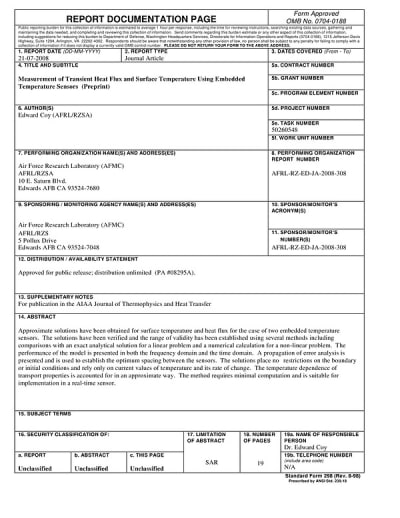
Measurement of Transient Heat Flux and Surface Temperature Using Embedded Temperature Sensors
(reference AFRL-0112) is currently available for download from the TSP library.
Don't have an account?
More From SAE Media Group


Tech Briefs
Steady-State Thermal Test Methodology

Aerospace & Defense Tech Briefs
A New Look at Ignition: Refining Our Understanding of Combustion Dynamics in Gun Chambers

Tech Briefs
Thermogravimetric Analysis With Laser Heating
Tech Briefs
Built-in "Health Check" for Pressure Transducers
Aerospace & Defense Tech Briefs
Manifold-Based Image Understanding
Aerospace & Defense Tech Briefs
Target Detection and Classification Using Seismic and PIR Sensors

Aerospace & Defense Tech Briefs
Evaluating a Data Clustering Approach for Lifecycle Facility Control

Tech Briefs
Thin Film Sensor for Ultra High-Temp Measurement


Aerospace & Defense Tech Briefs
Robust Quantum Sensors Program

Motion Design
Flexible Conductive Skin Gives Robots the Human Touch
Tech Briefs
An Automated Flying-Insect Detection System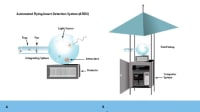
Tech Briefs
Thin-Film Resistance Heat-Flux Sensors
Tech Briefs
When Mushrooms Control Robots
Tech Briefs
The Lewis Number Under Supercritical Conditions


Tech Briefs
A Color-Based Sensor Emulates Skin’s Sensitivity
Overview
The document presents a study on measuring transient heat flux and surface temperature using embedded temperature sensors, conducted by Edward Coy at the Air Force Research Laboratory. The research addresses the challenges associated with traditional surface junction thermocouples, which are prone to failure and produce noisy signals, particularly in dynamic environments like rocket engine flows.
The proposed method utilizes two temperature sensors embedded within the wall of a chamber, allowing for accurate measurements without the drawbacks of surface-mounted sensors. The approach employs a polynomial extrapolation technique that matches temperature readings and their second derivatives at the measurement points, enabling the calculation of heat flux and surface temperature. This method is computationally efficient, requiring approximately 100 multiply and add operations per measurement.
Key findings indicate that the solution behaves like a low-pass filter, with gain characteristics that vary based on the ratio of the distances between the sensors. The study characterizes the gain and phase behavior of the system, revealing that the phase angle begins to lag at higher angular frequencies, except in specific cases where the ratio of distances is optimal.
The document also includes experimental data from a sub-scale rocket combustion chamber, where Type K thermocouples were embedded in a copper block. The experiments were conducted with gaseous hydrogen and oxygen as reactants, under high pressure and flow conditions. The results demonstrate the effectiveness of the proposed method in measuring surface temperature and heat flux, with a focus on the uncertainties that arise during rapid temperature changes.
Overall, the research provides a robust framework for measuring heat transfer in high-performance environments, contributing to the understanding of heat transfer enhancement due to surface features. The findings are expected to have significant implications for future studies and applications in aerospace engineering and related fields, where precise thermal measurements are critical for performance optimization and safety.
Top Stories
INSIDERManufacturing & Prototyping
 How Airbus is Using w-DED to 3D Print Larger Titanium Airplane Parts
INSIDERManned Systems
 FAA to Replace Aging Network of Ground-Based Radars
NewsTransportation
 CES 2026: Bosch is Ready to Bring AI to Your (Likely ICE-powered) Vehicle
NewsSoftware
 Accelerating Down the Road to Autonomy
EditorialDesign
 DarkSky One Wants to Make the World a Darker Place
INSIDERMaterials
 Can This Self-Healing Composite Make Airplane and Spacecraft Components Last...
Webcasts
Defense
 How Sift's Unified Observability Platform Accelerates Drone Innovation
Automotive
 E/E Architecture Redefined: Building Smarter, Safer, and Scalable...
Power
 Hydrogen Engines Are Heating Up for Heavy Duty
Electronics & Computers
 Advantages of Smart Power Distribution Unit Design for Automotive...
Unmanned Systems
 Quiet, Please: NVH Improvement Opportunities in the Early Design...
