




Balancing the Scales in Dakar
Here’s how M-Sport engineers removed some weight – and added some elsewhere – to produce a podium-winning vehicle.
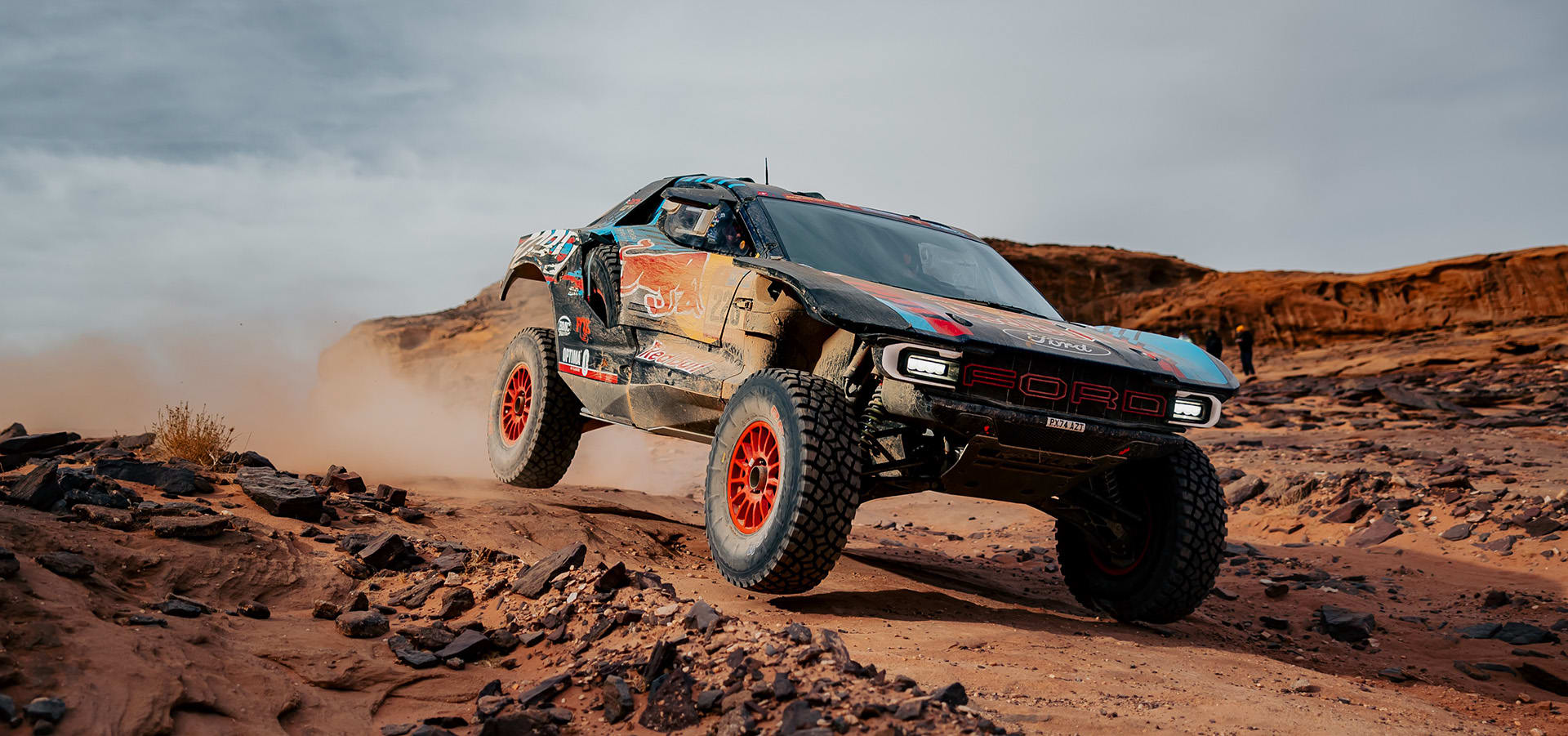
In most kinds of racing, the mantra is simple: simplify and add lightness. Sure, Colin Chapman of Lotus fame was on to something when the route is smooth, but what happens when the racecourse is Mother Nature herself, with all the bumps, rocks and dunes she can dish out?

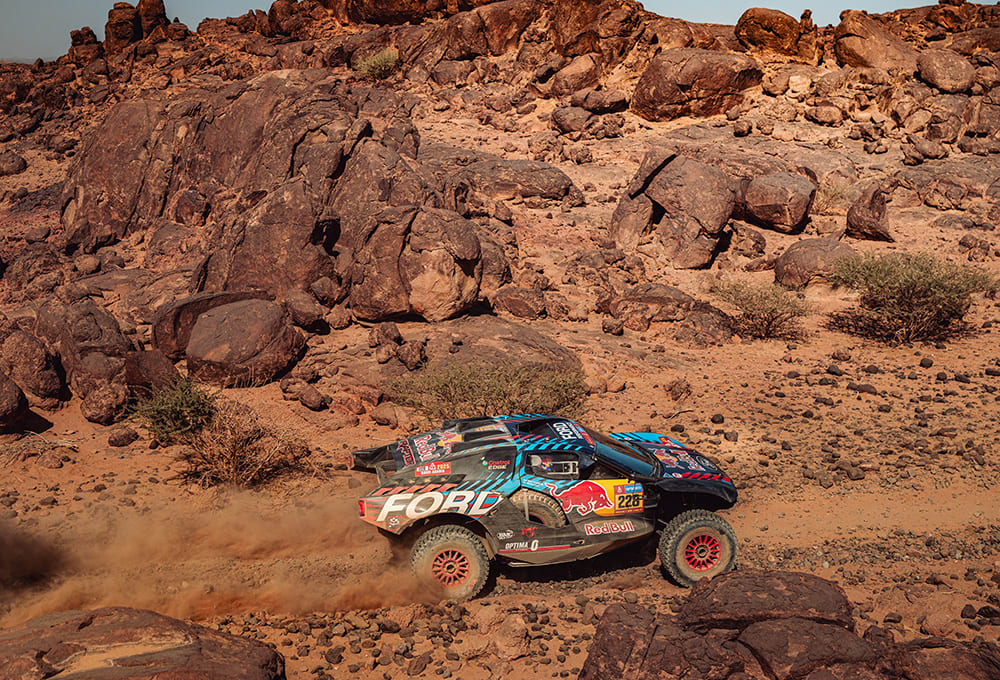
At this year’s Dakar Rally, Ford campaigned four T1+ Raptors. The long-standing Dakar Rally currently takes place over 12 ridiculously tough stages through the desert of Saudi Arabia that take driver and machine to the limit, if not right over the edge. The T1+ vehicles are the top dogs of the rally, purpose-built but still using production-derived engines.
Ford partnered with UK-based rally experts M-Sport to build these V8 monsters. Along the way, the team had to find the right balance between off-road durability and weight. It was not an easy task.
M-Sport’s off-road program manager, Mike Norton, told SAE Media that the T1+ vehicles in the Dakar Rally actually have a minimum weight of 2,010 kilograms (4,431 lbs), so teams can’t go too extreme when cutting weight. He added that in a desert rally, it’s not much of a problem to have sprung weight or a few extra pounds down low. Heavy steel skid plates keep the center of gravity low, after all. What the team didn’t want was something hanging over the front or rear of the vehicle or excess weight on the roof.
Lightweighting gone wrong
As is common with road racing, Ford and most other competitors at this year’s rally used carbon fiber for body panels since it’s strong and lightweight. It turns out, the desert can easily make a fool out of anyone.

“[The upper bodywork] doesn’t often get stuck by rocks, so you don’t need Kevlar in those areas,” Norton said. “We were all somewhat surprised when we went through the sections near Bisha this year. The first few days we were going through trees and bushes. Somebody flew out from the UK with bodywork spares and I know Dacia did the same, simply because we all ran out. We went through 11 windscreens. We collected every old spare we had and brought it out. In the first four days, we almost ran out of all our bodywork spares.”
It got to the point where the mechanics had to fabricate a fender out of aluminum for one of the cars. Luckily, there are no body homologation rules in the Dakar, but the team might have been better served by adding a bit of Kevlar for strength. It would add a bit of weight, but isn’t that better than flying in body parts?
Lose the turbos, lose some weight
Under a T1+ Raptor’s hood in Dakar, you’ll find a 5.0-L Coyote engine. Per the Dakar rules, the engine can produce a maximum 355 hp (265 kW), so why employ a big ol’ V8 if you can’t use all the power?
“The V8 is straightforward and has no turbos, no intercoolers, no charge pipe work,” Norton said. “It is a much simpler system to manage with less opportunity for issues when you’re in the race.”Heat management is paramount when it comes to making power in the desert, and the V8 excels over turbocharged powerplants.
“If you have a turbocharged engine, you have to manage the complexity that comes with the turbos,” Norton said. “Turbos require additional thermal management measures and more challenging cooling systems that can fail in severe environments. Similarly, in off-road racing, you want to have a broad power band with a robust low-end torque curve. A naturally aspirated V8 is able to achieve this without turbos, wastegates and charge coolers.”
In a twist, the V8 also contributes to better fuel economy over a turbo mill and thus lowers the overall weight.
“Depending on the duty cycle and boost pressures, a turbocharged engine may consume more fuel than a naturally aspirated one,” he said. “If you use more fuel, you have to carry more fuel. We have the ability to carry over 500 liters, or 390 kg (860 lb), of fuel. If you can start running fewer kilograms of fuel, then you’re carrying less weight.”
Further, the V8 ended up being lighter overall once all the elements needed for a turbocharged engine are considered, including manifolds and brackets.
“We simply have exhaust headers that come out of a V8 and that’s it,” Norton said. “Straight down the car and out the back.”
18 extra kg
There was one element of the car where M-Sport was willing to add weight, and that was in the dampers. All other competitors in the class run aluminum-body shocks from Reiger in the form of two coilovers on each corner. However, Ford has a long-standing relationship with Fox, well-known for its Baja race packages on everything from the top-tier Trophy Trucks to the humble Class 11 stock Volkswagen Beetle. The suspension company worked its magic on the T1+ as well.

“When we started doing some back-to-back testing with Fox, we very quickly realized that the vertical support that Fox offered at high speed is sublime,” Norton said.
The Fox shocks can keep a vehicle moving in a straight line at 150 mph (241 km/h) while offering 3 ft (0.9 m) of travel in the whoops. The Raptor T1+ doesn’t employ quite so much travel, but Fox has the experience to tune vehicles for racing in the rough.
The only fly in the shock oil? A single three-way adjustable coilover and four-way adjustable bypass shock added 4.5 kg (10 lb) at each corner because of their steel bodies.
Still, it was worth it to Norton. “We took the hit of the 18 kilograms because we knew that Fox could do more for us than lightweighting.”
While seeing the Raptor T1+ up close and personal at the Dakar Rally for a few days was impressive, the real thrills came a few weeks later in Johnson Valley, California. Ford threw me in the right seat with driver Mitch Guthrie for a five-minute joy ride that won’t be forgotten.
I’ve got plenty of desert racing experience, but I’m more of a small-car person. I’ve campaigned air-cooled Volkswagens and I wrote about my lifted Miata in the June 2024 issue of Automotive Engineering. A V8 Dakar rig is something else completely.
First off, there’s the sound. Even though it's detuned to meet the Dakar regulations, it still unleashes a note so deep that my heart hurt – to say nothing of my eardrums. Taking off in the soft sand, the full-time four-wheel-drive Raptor T1+ with 37-inch BFGoodrich KDR3 tires dug deep ruts, leaving me feeling sorry for the next poor soul who had to drive this particular route.
We cut across the desert in the soft sand to an actual trail, full of whoops and rocks. Guthrie couldn’t go flat-out, but we were fast enough for me to tense up as we plunged nose-first into a deep hole, only to realize that the Fox shocks soaked up the hit with aplomb. Yeah, I’d say the 18 kg are worth it.
Of course, the real question is whether any of these Raptor T1+ components will ever make it to a production Raptor. Norton says the team is doing some lightweighting exercises on the engine components, but they will likely be too expensive to put into production. However, he did allude to unique parts inside the Fox shocks that might find their way into production in some fashion. He was understandably a bit mum on details, so we’ll have to stay tuned to see just how much better the road-going Raptor gets.
More From SAE Media Group
Automotive Engineering
2019 Dodge Challenger: Deceased Demon Seeds Stronger and Wider Muscle-Car Lineup
Automotive Engineering
NAIAS 2022: Seventh-Generation of Ford Mustang Is Highest Performer Yet
Automotive Engineering
With 2019 Sierra, GMC Puts Brand Differentiation Behind It—literally
Automotive Engineering
Ford’s Max Mustang Brings ‘World Class’ into the Sports Coupe Conversation
Automotive Engineering
All-New 2019 Ram 1500 Launches with a Bed-Load of Innovations
Automotive Engineering
2020 Subaru Legacy Moving to New Global Platform
Automotive Engineering
Toyota Tacoma TRD Pro
Automotive Engineering
2018 Los Angeles Auto Show: Hyundai Unveils the 2020 Palisade Midsize SUV as Its Flagship
Automotive Engineering
What We’re Driving: 2020 BMW X1 XDrive28i
Automotive Engineering
Bentley's Technology Future: Stone Trim, Smaller SUV and EVs
Automotive Engineering
After a 30-Year Hiatus, Jeep Remakes the Wagoneer
Automotive Engineering
Volkswagen T-Cross
Automotive Engineering
GM Adopts Advanced Cylinder Deactivation for 2019 Chevy Silverado V8s

Automotive Engineering
2018 Porsche 718 Boxster
Automotive Engineering
Making over the World’s Leading Hybrid
Automotive Engineering
What We’re Driving: 2018 Jeep Grand Cherokee Trackhawk
Automotive Engineering
Sunset for the American V8
Automotive Engineering
A Brief History of Chevrolet Corvette Concepts
Automotive Engineering
Lightweighting Tour-De-Force: 2021 Ducati Superleggera V4
Off-Highway Engineering
Engineering the World’s Fastest Tractor
Automotive Engineering
NAIAS 2019: Shelby GT500 Most Powerful and Advanced Mustang in Ford History
Automotive Engineering
Ford’s Latest Mustang Improves the Breed
Off-Highway Engineering
John Deere Power Systems Expands Lineup, Introduces New 13.6- and 18-Liter Engines
Automotive Engineering
2018 Jeep Wrangler Unlimited Rubicon
Automotive Engineering
Raptor 4-Door-Only for 2021; R Version Coming Next Year
Automotive Engineering
Chevrolet Unveils 2024 Corvette E-Ray Hybrid
Automotive Engineering
Formulating a Winning Motor Oil
Automotive Engineering
BMW 440i
Automotive Engineering
Truck Tech War!
Top Stories
INSIDERRF & Microwave Electronics
 FAA to Replace Aging Network of Ground-Based Radars
PodcastsDefense
 A New Additive Manufacturing Accelerator for the U.S. Navy in Guam
NewsSoftware
 Rewriting the Engineer’s Playbook: What OEMs Must Do to Spin the AI Flywheel
Road ReadyPower
 2026 Toyota RAV4 Review: All Hybrid, All the Time
INSIDERDefense
 F-22 Pilot Controls Drone With Tablet
INSIDERRF & Microwave Electronics
 L3Harris Starts Low Rate Production Of New F-16 Viper Shield
Webcasts
Energy
 Hydrogen Engines Are Heating Up for Heavy Duty
Energy
 SAE Automotive Podcast: Solid-State Batteries
Power
 SAE Automotive Engineering Podcast: Additive Manufacturing
Aerospace
 A New Approach to Manufacturing Machine Connectivity for the Air Force
Software
 Optimizing Production Processes with the Virtual Twin
