




Marelli Says New BMS Offers Deeper Insight into State of EV Battery Cells
The system uses electrochemical impedance spectroscopy to monitor changes in state of charge, state of health and internal temperature.
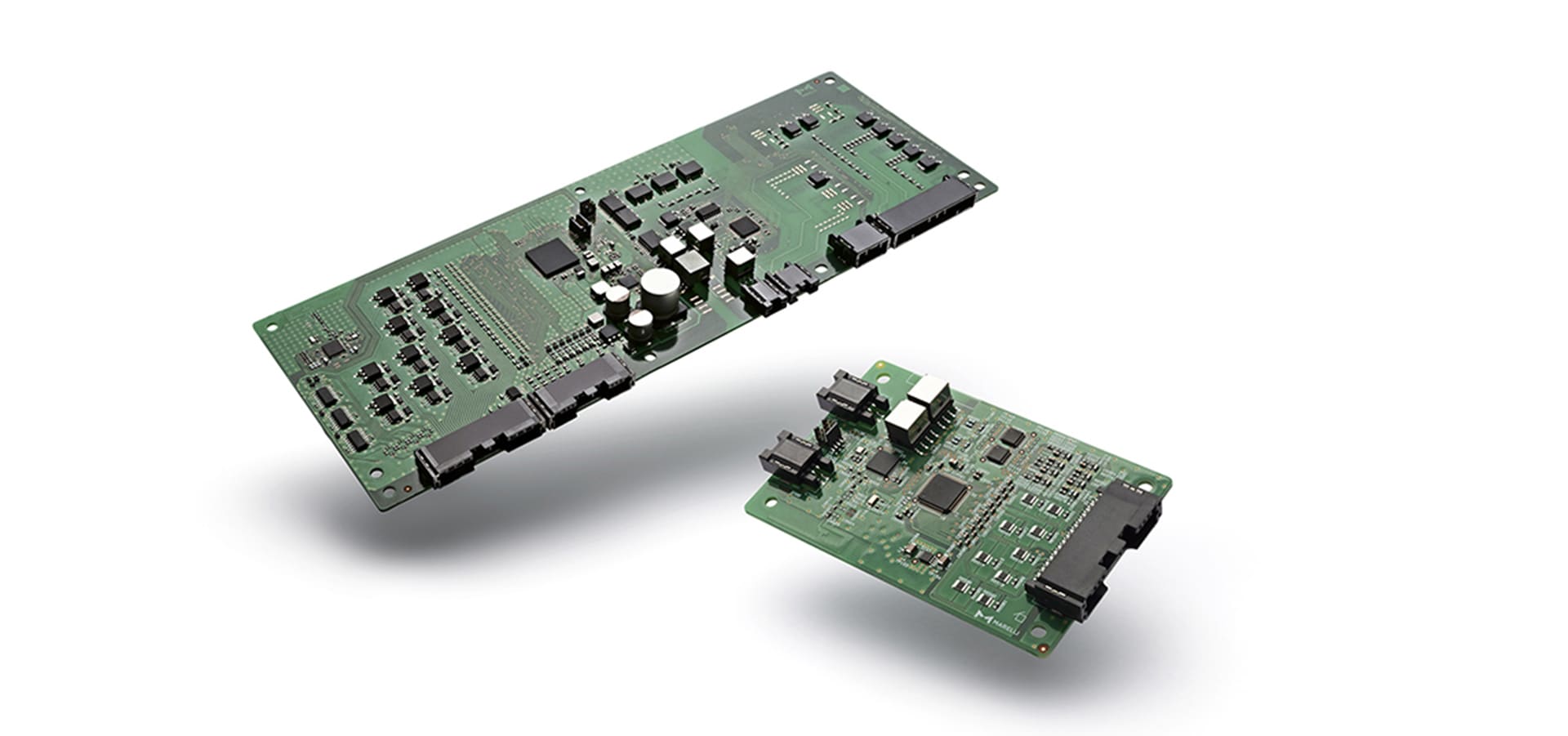
Battery cell management is a never-ending quest for deeper and faster insight into a cell’s energy production and health. Supplier Marelli says its new battery management system (BMS) will raise the bar for battery efficiency and performance.
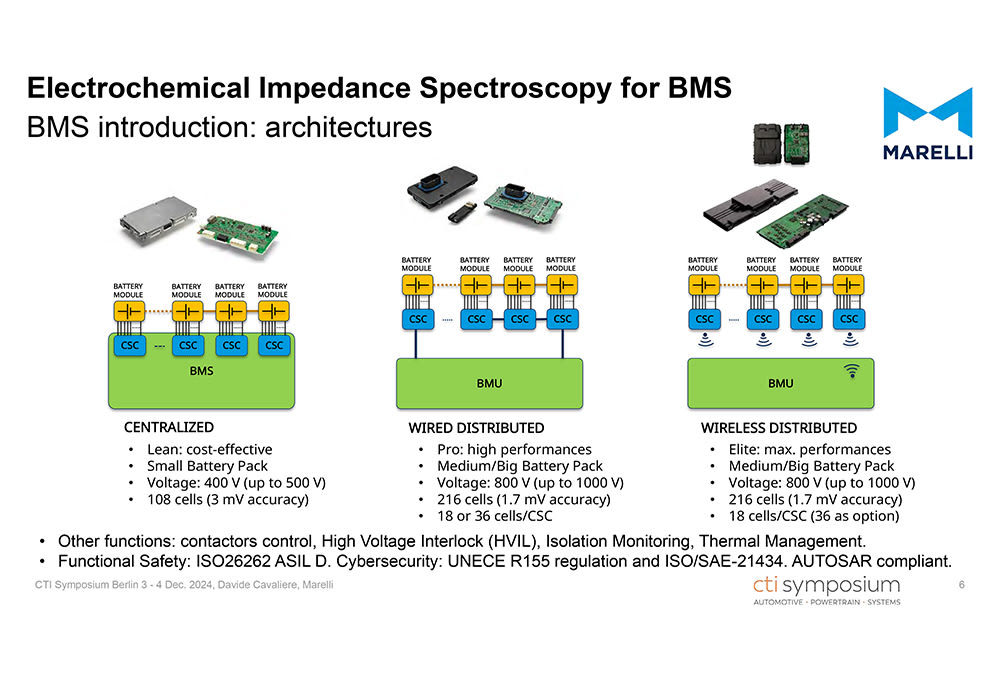
Speaking at a Car Training Institute symposium in Berlin in December, Marelli BMS product manager Davide Cavaliere said the system is based on electrochemical impedance spectroscopy (EIS) and provides real-time insights in lithium-ion batteries’ degradation.
EIS was already popular in labs for its detailed data, but it was too expensive for mass production. In a news release, Marelli said the new solution is cost-effective and scalable for large-scale production.
Giovanni Mastrangelo, CTO of Marelli’s propulsion solutions group, said the new system offers automakers a technological edge. “The adoption of EIS and AI in BMS technology is anticipated to…enhance safety, reliability and performance standards in the management of electric vehicles.”
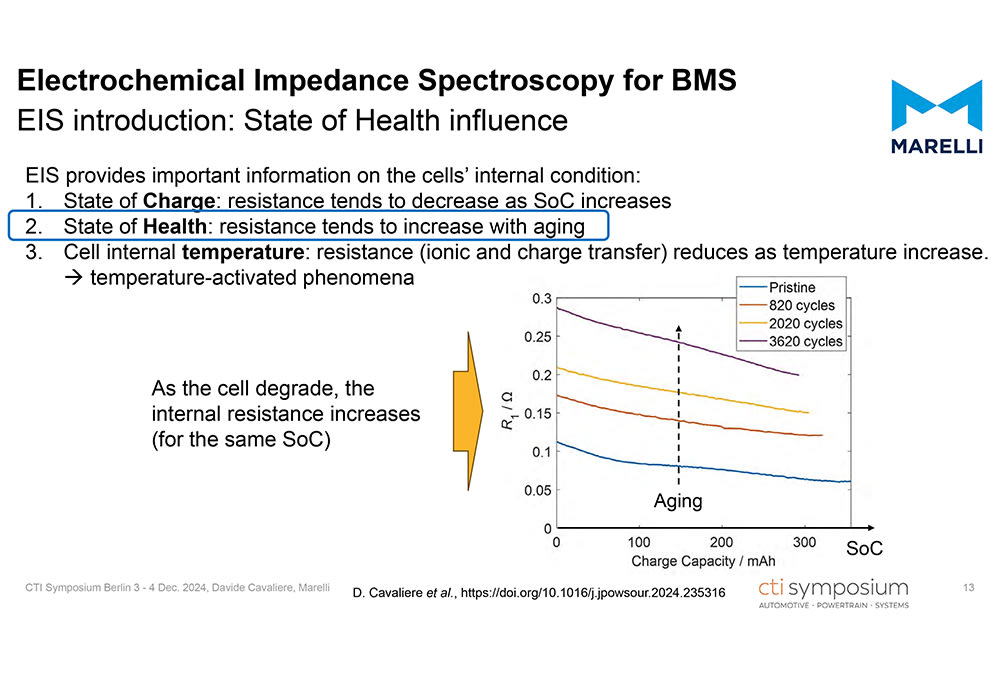
The company calls its current generation of systems “EIS ready.” Its next-gen “Full EIS” BMS will be released later this year and improves real-time estimation of the state of charge, state of power, state of health and internal temperature of cells. Cavaliere said in his presentation that the result is longer battery life and extended range as well as prevention of thermal runaway situations.
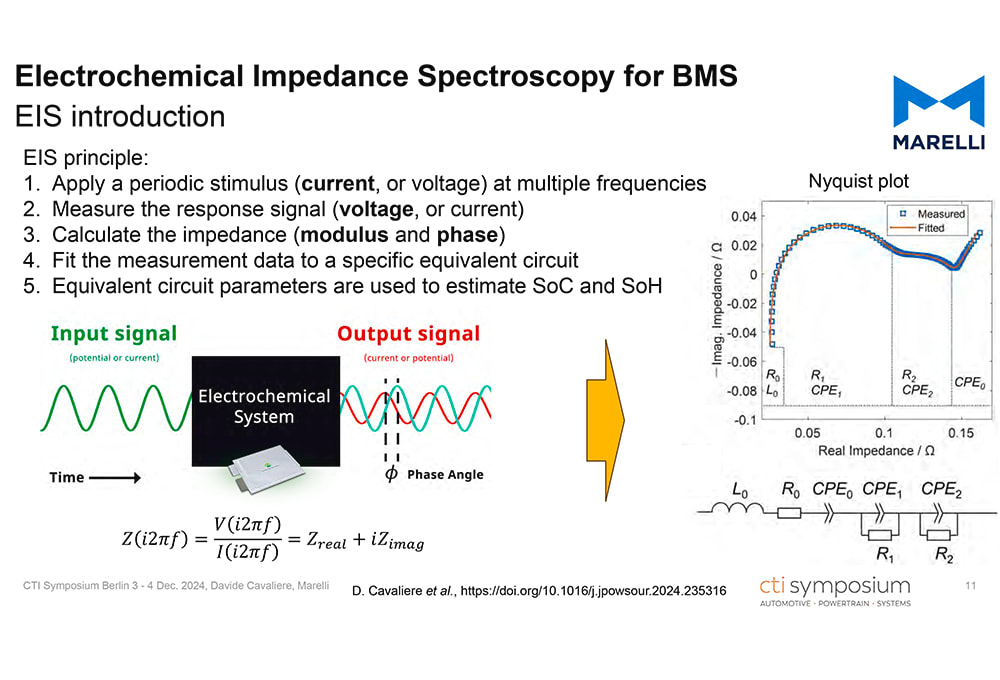
“The EIS principle relies on applying a periodic stimulus to the cell [current] at multiple frequencies,” he said. “We sweep this frequency from high to low and see the voltage response of the cell. Then we can calculate the internal impedance in modulus and phase.” It’s observing the changes in impedance that allows the deep insight into the state of the cells.
The analysis is done by running the results of the sweep through a fast Fourier transform (FFT) algorithm.
Cavaliere said the potential bottleneck is the “speed of the communication protocol between the monitoring IC and the microcontroller.” Still, Marelli’s new BMS can transfer samples once every 10 milliseconds. That means the system can’t reach higher frequencies than 10 Hz.

“We are already working in the next generation of BMS that will push beyond this limit,” he said. “By switching the calculation of the FFT to the monitoring IC, we can increase the frequency to higher than one kilohertz.”
Cavaliere said Marelli now makes three kinds of BMS: A centralized solution in which one board monitors all cells in a pack, a distributed daisy-chain architecture that helps when the number of cells is too cumbersome, and a wireless solution that is projected to be available in 2027.
More From SAE Media Group
Tech Briefs
How to Detect Battery Failures Quicker
Automotive Engineering
Reducing the Weight of EV Batteries with Specialty Thermoplastics
Battery & Electrification Technology
Powering Light Electric Vehicles
Battery & Electrification Technology
Enhancing EV Battery Design with Advanced Testing
Battery & Electrification Technology
How Intelligent Battery Management Drives EV Buyer Confidence
Battery & Electrification Technology
Refining Automotive Battery Management Systems with Lumped-Approach Thermal Modeling
Tech Briefs
New Fluids Coming for EV Thermal Management
Automotive Engineering
Scaling the Solid-State Battery FEST
Off-Highway Engineering
Batteries Go Underground
Automotive Engineering
SAE J-3277 Covers Leak Testing for Every EV Battery

Automotive Engineering
Battery Safety for a Zero-Incident Future
Automotive Engineering
Fully Charged in Six Minutes?
Battery & Electrification Technology
Oxygen-Ion Battery: A Solution for Large Energy Storage Systems
Aerospace & Defense Tech Briefs
Improving Battery Design for eVTOL Aircraft With Simulation
Automotive Engineering
Sensing to Solve EV Thermal Challenges

Automotive Engineering
WCX 2025: Vicor’s New Power Modules Arrive with 48V
Off-Highway Engineering
Solving the Challenges of Megawatt Chargers
Automotive Engineering
GM Picks LMR as Its Future Affordable Battery Technology
Off-Highway Engineering
Yanmar, ELEO Announce Electrification Strategy for Off-Highway Sector
Battery & Electrification Technology
Silicon Forging Ahead for Higher-Performance Battery Anodes
Battery & Electrification Technology
Powering the Future of Electric Vehicles with Safer, Lighter Batteries
Automotive Engineering
Greater Precision for EV Battery Leak Testing
Battery & Electrification Technology
Mistakes to Avoid When Integrating a Battery Test System
Automotive Engineering
Inside GM’s Expanded Electric-Vehicle Battery Lab

Automotive Engineering
Balancing the ‘Dominos’ in EV Thermal Management
Tech Briefs
Factorial’s Solid-State B-Samples Send a Message
Top Stories
NewsRF & Microwave Electronics
 Microvision Aquires Luminar, Plans Relationship Restoration, Multi-industry Push
INSIDERAerospace
 A Next Generation Helmet System for Navy Pilots
INSIDERDesign
 New Raytheon and Lockheed Martin Agreements Expand Missile Defense Production
INSIDERMaterials
 How Airbus is Using w-DED to 3D Print Larger Titanium Airplane Parts
NewsPower
 Ford Announces 48-Volt Architecture for Future Electric Truck
ArticlesAR/AI

Webcasts
Electronics & Computers
 Cooling a New Generation of Aerospace and Defense Embedded...
Automotive
 Battery Abuse Testing: Pushing to Failure
Power
 A FREE Two-Day Event Dedicated to Connected Mobility
Unmanned Systems
 Quiet, Please: NVH Improvement Opportunities in the Early Design Cycle
Automotive
 Advantages of Smart Power Distribution Unit Design for Automotive &...
Energy
 Sesame Solar's Nanogrid Tech Promises Major Gains in Drone Endurance