




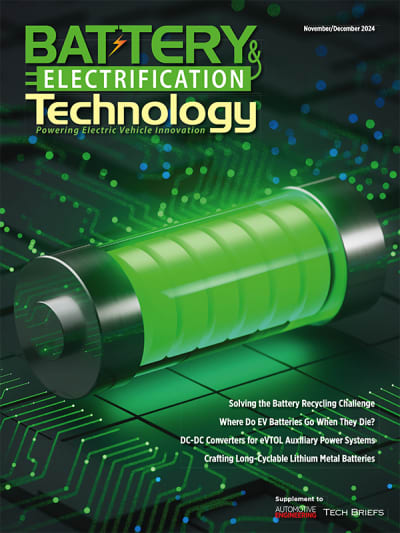
Battery & Electrification Technology - November/December 2024
Inside this issue
Overview
The November/December 2024 issue of Battery & Electrification Technology presents a comprehensive exploration of the current trends, challenges, and innovations in the battery industry, particularly focusing on electric vehicles (EVs) and sustainable practices. This issue is structured around several key features, tech briefs, and sponsored content that highlight the ongoing evolution in battery technology and recycling efforts.
Key Features
-
Solving the Battery Recycling Challenge: The issue opens with a critical examination of the growing problem of battery waste, particularly from lithium-ion batteries, which have seen a doubling in global use over the past four years. The article emphasizes the urgent need for effective recycling methods to manage the hazardous substances contained in spent batteries. Researchers from various Polish institutions have proposed promising solutions, advocating for a shift towards a circular economy model. This model not only addresses responsible disposal but also aims to reduce reliance on volatile raw material supply chains, fostering a more sustainable battery industry.
-
Where Do EV Batteries Go When They Die?: This feature delves into the lifecycle of EV batteries, exploring the various pathways for their disposal and recycling. It discusses the importance of developing infrastructure and technologies that can efficiently handle the increasing volume of battery waste. The article highlights the potential for second-life applications of used batteries, which can be repurposed for energy storage in renewable energy systems, thus extending their usefulness beyond their initial automotive applications.
-
DC-DC Converters for eVTOL Auxiliary Power Systems: The issue also covers advancements in power systems for electric vertical takeoff and landing (eVTOL) aircraft. It discusses the role of DC-DC converters in enhancing the reliability and efficiency of auxiliary power systems in these innovative vehicles. As the eVTOL market grows, the demand for robust and efficient power management solutions becomes critical, and this article outlines the latest technologies being developed to meet these needs.
-
Crafting Long-Cyclable Lithium Metal Batteries: Another significant feature focuses on the development of lithium metal batteries, which promise higher energy densities and longer lifespans compared to traditional lithium-ion batteries. The article discusses the challenges associated with safety and performance at high temperatures, and how researchers are addressing these issues to create safer, more efficient battery technologies.
Tech Briefs
The issue includes several tech briefs that highlight groundbreaking research and innovations in battery technology:
Researchers Discover a Surprising Way to Jump-Start Battery Performance: This brief discusses new findings that could enhance the performance of existing battery technologies, potentially leading to longer-lasting and more efficient batteries.
-
Scalable Graphene Technology: Researchers unveil a new graphene-based technology that could revolutionize battery safety and performance, offering insights into how this material can be integrated into future battery designs.
-
New Battery Cathode Material: A promising new cathode material is introduced, which could significantly impact the EV market and energy storage solutions, enhancing overall battery efficiency.
-
Dormant Capacity Reserve in Lithium-Ion Batteries: This brief reveals the discovery of previously untapped capacity in lithium-ion batteries, suggesting that existing batteries may have more potential than previously understood.
-
Second Life of Lithium-Ion Batteries: The potential for repurposing used lithium-ion batteries for applications in space exploration is explored, highlighting innovative uses for batteries that have reached the end of their automotive life.
-
Folded or Cut Lithium-Sulfur Batteries: Research on lithium-sulfur batteries shows promising results, indicating that these batteries can maintain performance even when physically altered, which could lead to new design possibilities.
Sponsored Content
The issue features profiles of key industry players, such as Aspen Aerogels and COMSOL, Inc., showcasing their contributions to battery technology and electrification. Aspen Aerogels highlights its PyroThin® thermal barriers, which have received accolades for their performance in automotive applications. COMSOL, Inc. emphasizes its role in providing advanced testing technologies that support the development of innovative battery solutions.
Conclusion
Overall, the November/December 2024 issue of Battery & Electrification Technology provides a thorough overview of the current state of battery technology, emphasizing the importance of recycling and sustainable practices in the face of increasing battery waste. The articles and briefs collectively underscore the need for innovation in both battery design and recycling methods to support the growing demand for electrified vehicles and renewable energy solutions. As the industry continues to evolve, the insights presented in this issue will be crucial for stakeholders looking to navigate the challenges and opportunities in the battery sector.
Briefs
-
20 Researchers Discover a Surprising Way to Jump-Start Battery Performance
21 Researchers Unveil Scalable Graphene Technology to Revolutionize Battery Safety and Performance
22 New Battery Cathode Material Could Revolutionize EV Market and Energy Storage
23 Dormant Capacity Reserve in Lithium-Ion Batteries Detected
24 Second Life of Lithium-Ion Batteries Could Take Us to Space
Features
-
Articles
4 DC-DC Converters for High Reliability eVTOL Auxiliary Power Systems
8 Solving the Battery Recycling Challenge
14 Where Do EV Batteries Go When They Die?
18 Crafting Safe, Long-Cyclable Lithium Metal Batteries for High Temperatures
Products
Top Stories
INSIDERDefense
 New Raytheon and Lockheed Martin Agreements Expand Missile Defense Production
NewsAutomotive
 Ford Announces 48-Volt Architecture for Future Electric Truck
INSIDERManufacturing & Prototyping
 Active Strake System Cuts Cruise Drag, Boosts Flight Efficiency
ArticlesTransportation
 Accelerating Down the Road to Autonomy
INSIDERMaterials
 How Airbus is Using w-DED to 3D Print Larger Titanium Airplane Parts
Road ReadyTransportation

Webcasts
Electronics & Computers
 Cooling a New Generation of Aerospace and Defense Embedded...
Power
 Battery Abuse Testing: Pushing to Failure
Connectivity
 A FREE Two-Day Event Dedicated to Connected Mobility
Automotive
 Quiet, Please: NVH Improvement Opportunities in the Early Design Cycle
Transportation
 Advantages of Smart Power Distribution Unit Design for Automotive &...
Aerospace
 Sesame Solar's Nanogrid Tech Promises Major Gains in Drone Endurance