




Folded or Cut, This Lithium-Sulfur Battery Keeps Going
A lithium-sulfur battery features an improved iron sulfide cathode. One prototype remains highly stable over 300 charge-discharge cycles, and another provides power even after being folded or cut.
Most rechargeable batteries that power portable devices, such as toys, handheld vacuums, and e-bikes, use lithium-ion technology. But these batteries can have short lifetimes and may catch fire when damaged. To address stability and safety issues, researchers reporting in ACS Energy Letters have designed a lithium-sulfur (Li-S) battery that features an improved iron sulfide cathode. One prototype remains highly stable over 300 charge-discharge cycles, and another provides power even after being folded or cut.
Sulfur has been suggested as a material for lithium-ion batteries because of its low cost and potential to hold more energy than lithium-metal oxides and other materials used in traditional ion-based versions. To make Li-S batteries stable at high temperatures, researchers have previously proposed using a carbonate-based electrolyte to separate the two electrodes (an iron sulfide cathode and a lithium metal-containing anode). However, as the sulfide in the cathode dissolves into the electrolyte, it forms an impenetrable precipitate, causing the cell to quickly lose capacity. Liping Wang and colleagues wondered if they could add a layer between the cathode and electrolyte to reduce this corrosion without reducing functionality and rechargeability.
The team coated iron sulfide cathodes in different polymers and found in initial electrochemical performance tests that polyacrylic acid (PAA) performed best, retaining the electrode’s discharge capacity after 300 charge-discharge cycles. Next, the researchers incorporated a PAA-coated iron sulfide cathode into a prototype battery design, which also included a carbonate-based electrolyte, a lithium metal foil as an ion source, and a graphite-based anode. They produced and then tested both pouch cell and coin cell battery prototypes.
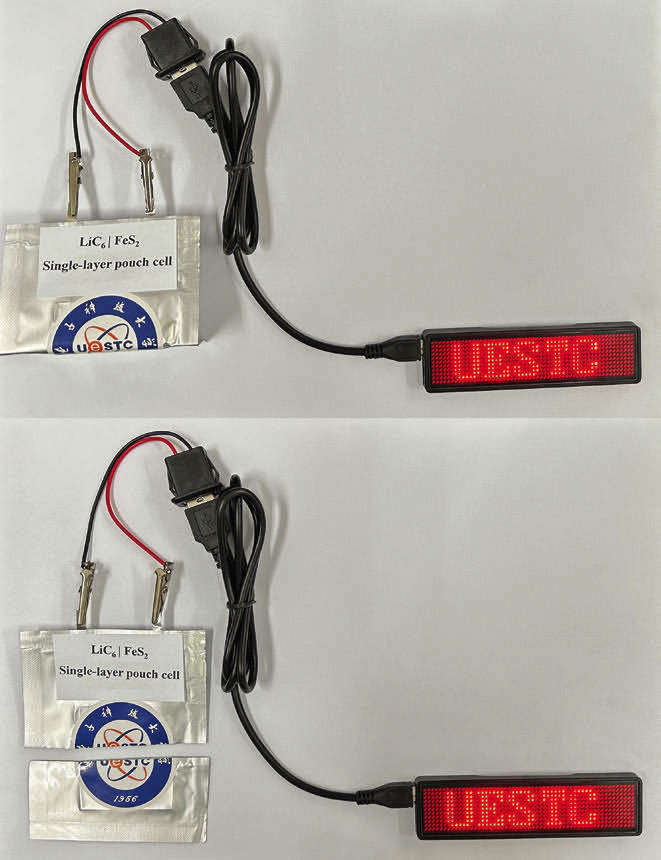
After more than 100 charge-discharge cycles, Wang and colleagues observed no substantial capacity decay in the pouch cell. Additional experiments showed that the pouch cell still worked after being folded and cut in half. The coin cell retained 72 percent of its capacity after 300 charge-discharge cycles. They next applied the polymer coating to cathodes made from other metals, creating lithium-molybdenum and lithium-vanadium batteries. These cells also had stable capacity over 300 charge-discharge cycles. Overall, the results indicate that coated cathodes could produce not only safer Li-S batteries with long lifespans, but also efficient batteries with other metal sulfides, according to Wang’s team.
For more information, contact
More From SAE Media Group
Tech Briefs
A New, Low-Cost Aluminum-Sulfur Battery
Battery & Electrification Technology
Building Temperature-Resilient Batteries
Tech Briefs
Building Temperature-Resilient Batteries
Battery & Electrification Technology
Iron Could Be Key to Less Expensive, Greener Lithium-Ion Batteries
Battery & Electrification Technology
Anode-Free Lithium Batteries with Maximized Energy Density
Power Electronics INSIDER
World’s Strongest Battery Paves Way for Light, Energy-Efficient Vehicles
Tech Briefs
A New Design for Lithium-Sulfur Batteries
Battery & Electrification Technology
A Breakthrough in Solid-State Electrolytes for All-Solid-State Batteries
Automotive Engineering
Niobium: Magic Metal for Battery Anodes?
Battery Technology
Flexible, Thin-Film Battery
Battery & Electrification Technology
Using Nano-Engineering Techniques to Develop a Safer Battery
Battery & Electrification Technology
Niobium: Magic Metal for Battery Anodes?
Tech Briefs
Room-Temperature Liquid-Metal Battery
Battery Technology
Hybrid Membrane Doubles the Lifetime of Rechargeable Batteries
Battery & Electrification Technology
Designing Sodium-Ion Batteries with Extended Longevity
Tech Briefs
Dry Manufacturing Process for EV Batteries
Battery & Electrification Technology
Increased Storage Capacity in Water-Based Batteries
Battery & Electrification Technology
New Cathode Material for Sodium-Ion Batteries
Battery & Electrification Technology
Enhancing the Performance of All-Solid-State Batteries
Green Design & Manufacturing
Nickel-Zinc Battery System Technology
Tech Briefs
Flexible, Water-Based Lithium-Ion Batteries
Battery & Electrification Technology
Electrolyte Additive Improves Battery Performance
Battery & Electrification Technology
An Alternative to Lithium-Ion Batteries
Tech Briefs
The Pursuit of an Uninterruptible Power Supply
Automotive Engineering
In Search of Higher-Energy-Content Batteries
Automotive Engineering
EMBATT Technology Could Double the Driving Range of EVs

Top Stories
NewsSensors/Data Acquisition
 Microvision Aquires Luminar, Plans Relationship Restoration, Multi-industry Push
INSIDERRF & Microwave Electronics
 A Next Generation Helmet System for Navy Pilots
INSIDERWeapons Systems
 New Raytheon and Lockheed Martin Agreements Expand Missile Defense Production
NewsAutomotive
 Ford Announces 48-Volt Architecture for Future Electric Truck
INSIDERAerospace
 Active Strake System Cuts Cruise Drag, Boosts Flight Efficiency
ArticlesTransportation

Webcasts
Aerospace
 Cooling a New Generation of Aerospace and Defense Embedded...
Energy
 Battery Abuse Testing: Pushing to Failure
Power
 A FREE Two-Day Event Dedicated to Connected Mobility
Automotive
 Quiet, Please: NVH Improvement Opportunities in the Early Design Cycle
Electronics & Computers
 Advantages of Smart Power Distribution Unit Design for Automotive &...
Unmanned Systems
 Sesame Solar's Nanogrid Tech Promises Major Gains in Drone Endurance