




Setting the Standard
Meggitt CTO Emeritus begins term at helm of SAE International, seeks to encourage cross-sector relations, elevate image of SAE as aerospace industry leader.

Providing leadership for a diverse organization is nothing new to Richard Greaves, Ph.D., SAE International’s President for 2015. Prior to his semi-retirement in 2012, Greaves oversaw all of engineering and technology for Meggitt PLC, which specializes in aerospace equipment and has 11,000 employees operating at more than 40 sites worldwide. Now as Chief Technology Officer (CTO) Emeritus, Greaves oversees new technology for the $2.5 billion engineering business.
Headquartered in the U.K., Meggitt is organized into five operating divisions—Meggitt Aircraft Braking Systems, Meggitt Control Systems, Meggitt Equipment Group, Meggitt Polymers and Composites, and Meggitt Sensing Systems—and generates revenues in excess of $2.5 billion per year. Customers include many of the major aircraft OEMs and engine suppliers, most notably the U.S. Department of Defense, Airbus, Boeing, Bombardier, GE Aviation, Gulfstream, Lockheed Martin, and Rolls-Royce.
Greaves becomes the first SAE President since 2006 to come from the aerospace industry and is the first President ever to live outside of North America, residing in Switzerland.
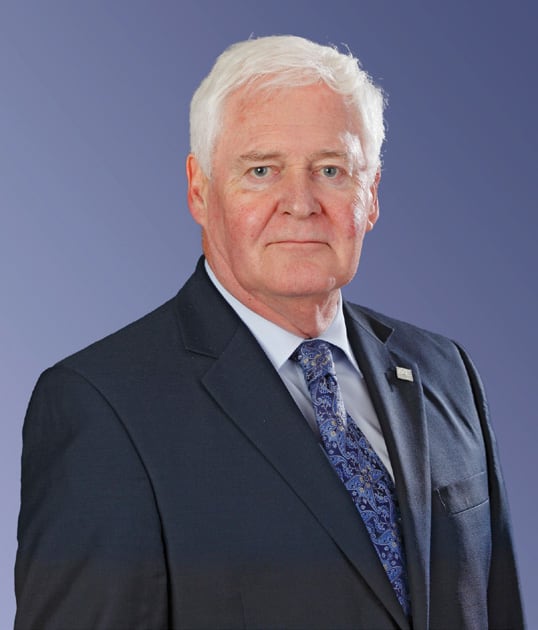
SAE International leadership is also familiar to Greaves, who has served on the SAE Board of Directors since January 2012. While his experience with SAE dates to 1981, it was not until his term on the Board that he came to truly understand the complete range of products, programs, and services that SAE provides.
“I hadn’t realized until I joined the Board what the breadth of activities of SAE is, and so I think that the first year on the Board is very much a learning experience and realizing what all the different divisions of SAE are doing,” Greaves said. “In the second year on the Board, you start to get to know what’s going on and you can participate more, and hopefully you’re contributing on various issues at top level. And near the third year I think you’re fairly effective as a board member. That’s been my experience.”
Greaves first became acquainted with SAE in 1981 while serving as President of U.S. Operations for Vibro-Meter, which specialized in piezo-electric vibration accelerometers. An associate, Bill Peters from General Electric, who chaired the Engine Health Monitoring Committee, recruited Greaves for his knowledge about vibration and attended his first meeting, hosted by Rolls-Royce in Bristol, U.K.
“I went along to the first meeting and I realized here is a group of 30 or 40 people, and there’s so much knowledge about different aspects of the engine that I didn’t know anything about,” Greaves said. “And I thought, there’s an opportunity here for me to be able to learn a lot about engines and monitoring. And I’ve been a loyal member of the committee ever since.”
Greaves now encourages young engineers to follow his lead and get involved with a technical committee related to their area of interest as a way to further their careers.
“When you look at the number of technical committees that SAE has got [240 technical Committees and 450-plus subcommittees and task groups], you can pretty well say SAE has got a committee for it somewhere, whatever the area of specialty may be,” Greaves said. “I think the opportunity of being able to meet other people with a common interest, and yet people who, certainly for me at that time, had a lot more knowledge than I did is valuable.”
Research interests
Greaves’ areas of interest include piezoelectric technology and integrated vehicle health management (IVHM). It was actually an interest in piezoelectrics that first led Greaves to the aerospace industry. Early in his career, while working in the nuclear industry and pursuing a Ph.D. in piezoelectrics, a blind ad in an electronics journal for a piezoelectric engineer piqued his interest and prompted him to apply.
“And that’s how I ended up moving to Switzerland, in 1972” Greaves said. “And then when I got there, it was all industrial and aerospace, principally aerospace. So there was very little activity on the nuclear side at all. But I came from a control and instrumentation background, so it kind of fit in. But it was serendipitous, there was absolutely no thought in my mind of changing from nuclear to aerospace, it just accidentally happened.”
Piezoelectric accelerometers are desirable for aircraft and space applications because of the lack of a need for a power supply for the sensor.
“When building sensors using the piezoelectric effect, there’s a direct and inverse effect. Direct effect, you vibrate and it sends out a directly proportional electrical signal, which happens to be its charge. Then you can use the inverse effect in an actuator, so you can send an electrical signal to the piezoelectric material and it will expand or contract.”
Greaves’ interest in IVHM mirrors that of SAE International, which is seeking to establish itself as the global leader in the technology. Greaves is a member of the board and past chairman (2011-13) of the IVHM Boeing/Cranfield University Centre of Excellence, which works with industry to solve complex issues either through collaborative research projects or direct consultation.
IVHM involves a network of sensors distributed throughout a vehicle, collecting data on the condition of components and subsystems; onboard processors assess health and predict remaining useful life and potential deterioration. The data are then used to manage system health, reduce operating cost, increase competitiveness, and enable companies to assess the efficiency and readiness of fleets.
Although initially used for monitoring the health of aerospace engines, the technology can be extended to many subsystems, including landing gear, avionics, and environmental control, as well as other mobility types such as ships, high-speed trains, and automobiles.
Technology transfer
Encouraging cross-sector initiatives for the common good of industry is one of Greaves’ areas of focus for his term as President.
“[In SAE], we’ve got commercial vehicles, we’ve got automobiles, we’ve got aerospace. There’s not enough cross-fertilization and contact going on between these groups,” Greaves said. “There are many common problems there, whether it be cybersecurity, counterfeit parts avoidance, or health management. There are an awful lot of things which are common across the board and across the SAE business. And I’d like to think that I can help to bring the SAE business together and break down some of the silos.”
At a recent meeting of the HM-1 Integrated Vehicle Health Management Committee, Greaves was pleasantly surprised to find a representative from General Motors R&D who specializes in IVHM. The GM Research Fellow later submitted a proposal for a standard on health-ready components that was accepted by the HM-1 committee and will be applied across industry.
Greaves’ other area of focus for his presidency is related to enhancing the image of SAE International as an aerospace institution. With nearly 40 years of experience working with all the major aircraft OEMs and engine suppliers and an extensive list of contacts, he hopes to educate the aerospace industry on the vital role that SAE plays during his term as president.
“The statistics in a way speak for themselves,” Greaves said. “Upwards of 60% of all of the world’s aerospace standards are SAE standards. You start to look into facts like that, and they are quite convincing. How many people in upper management in the aerospace industry actually know that? Nearly 10,000 people who participate in technical standards boards and technical committees of SAE cover every aspect of the aircraft. How many people in upper management actually know to what extent SAE is a major player in aerospace? Hopefully through different types of meetings, whether they are one-on-one, face-to-face meetings, or small conferences, I hope to be able to underline that.”
Greaves has already delivered presentations on SAE’s aerospace activities in Bangalore, London, and Shanghai, and has many more meetings on his agenda for 2015 where he will deliver his message.
Finding ways to recognize more of SAE’s aerospace members with Fellow grade status is another goal for Greaves, a 2010 Fellow recipient.
“I felt very honored to be made a Fellow by my peers. What is disappointing is that there are so few aerospace people being made Fellows, and we don’t seem to be getting the candidates,” Greaves said. “We’ve got great participation in the technical committees; you end up with several thousand people in aerospace involved with SAE technical committees, and then you only get 2 or 3 candidates for Fellow, or no Fellows on the aerospace side. It’s a bit of a conundrum really.”
Encouraging young people to get involved with engineering is also a passion of his and something he is looking forward to further engaging in as President through SAE’s science, technology, engineering, and math (STEM) outreach programs.
“I’m a firm believer in doing everything we can to encourage the younger generation to get into engineering,” Greaves said. “This is not just simply a problem in the United States. It’s very much a problem in Western Europe as well.”
More From SAE Media Group
Aerospace & Defense Tech Briefs
The Future of Aircraft Electrification
Aerospace Manufacturing and Machining INSIDER
Bell and Rolls-Royce Collaborate on Advanced Propulsion Systems
Aerospace INSIDER
Making Carbon Aircraft Brakes More Environmentally Friendly



Aerospace & Defense Tech Briefs
SAE International Establishes a New AI Standards Committee at Le Bourget
Aerospace & Defense Tech Briefs
SAE International Extends Call for Abstracts, Seeks Submissions for AeroTech Conference
Aerospace INSIDER
How Aerospace Manufacturers are Adjusting to Ongoing Tariff Changes
Aerospace Manufacturing and Machining INSIDER
Collins Aerospace to Modernize B-52 Wheels and Brakes
Aerospace INSIDER
Autonomous Freight Aircraft Achieves Design/Development Milestones
Aerospace & Defense Tech Briefs
SAE International Launches Aerospace Technology Symposium at Japan Aerospace 2018
Aerospace & Defense Tech Briefs
Air Mobility Innovations Take Center Stage at Aerospace Systems and Technology Conference
Aerospace INSIDER
Sikorsky is Designing a New Hybrid Electric Tilt Wing VTOL Demonstrator
Medical Design Briefs
Show Preview: Evolving to MedDev 2021

Motion Design INSIDER
Megawatt Electrical Motor Could Help Electrify Aviation
Tech Briefs
Rising Star Awards 2025 Judges

Aerospace & Defense Tech Briefs
Hybrid Electric EWIS System
Aerospace INSIDER
Quarterhorse Hypersonic Test Aircraft Completes First Flight

NASA Spinoff
Flying (Not Quite) Blind
Tech Briefs
2025 Award Finalists
Aerospace & Defense Tech Briefs
GE Aviation Enhances Digital Thread with Dassault Systèmes’ 3DEXPEREINCE Platform
Aerospace & Defense Tech Briefs
Connected Aircraft Technologies Benefit Manufacturers, Airlines, and Travelers
Aerospace & Defense Tech Briefs
Industry Invited to Participate in AeroTech Aerospace and Defense Technical Program

Top Stories
INSIDERManufacturing & Prototyping
 How Airbus is Using w-DED to 3D Print Larger Titanium Airplane Parts
INSIDERManned Systems
 FAA to Replace Aging Network of Ground-Based Radars
NewsTransportation
 CES 2026: Bosch is Ready to Bring AI to Your (Likely ICE-powered) Vehicle
NewsSoftware
 Accelerating Down the Road to Autonomy
EditorialDesign
 DarkSky One Wants to Make the World a Darker Place
INSIDERMaterials
 Can This Self-Healing Composite Make Airplane and Spacecraft Components Last...
Webcasts
Defense
 How Sift's Unified Observability Platform Accelerates Drone Innovation
Automotive
 E/E Architecture Redefined: Building Smarter, Safer, and Scalable...
Power
 Hydrogen Engines Are Heating Up for Heavy Duty
Electronics & Computers
 Advantages of Smart Power Distribution Unit Design for Automotive...
Unmanned Systems
 Quiet, Please: NVH Improvement Opportunities in the Early Design...
