




Rethinking the HUD
New tech solutions move toward augmented reality to bring greater capability to head-up displays.
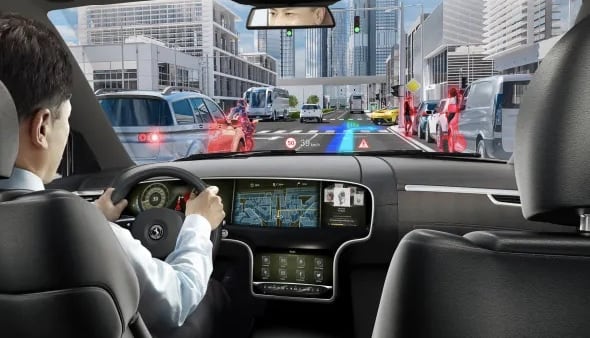
Head-up displays (HUD) debuted in the late 1950s as a means of providing jet fighter pilots critical information while maintaining situational awareness outside the cockpit. Today these systems for projecting data onto the wind-screens of cars and trucks are becoming a vital conduit of information to drivers.
The first production automotive HUD appeared in the 1988 Oldsmobile Cutlass Supreme Indianapolis 500 Pace Car Convertible. That early GM system employed a vacuum fluorescent display tube and mirror to project a virtual speedometer in the pale green hue that would become familiar to drivers of cars so equipped.

Today, HUDs are obviously more sophisticated, and common, as technology advances have made them better and cheaper. Their appeal lies in their ability to convey information “in a simple way that is easy to understand,” explained Stephan Peters, project manager for human-machine interfaces at BMW.

While in-dash display screens might be used for various purposes, such as showing lavish satellite photo image maps and song information complete with cover art, HUD data is more specific. “The focus is on driving-relevant information,” Peters said.
According to research firm Future Market Insights, the global market for HUD devices was $2.9 billion in 2017 and is forecast to grow to $18 billion by 2027. Automotive HUDs accounted for 77.5% of the market in 2017; by 2027 their share is expected to reach 88.4%, or $15.9 billion globally.
“The market is growing faster than we initially thought,” stated Sue Drescher, head of innovation for supplier Continental’s advanced technology product group in North America. “The market is going to grow substantially over the next few years,” she observed.
More info in the driver’s FOV
Today’s typical HUDs employ Thin Film Transistor (TFT) devices, which are becoming increasingly affordable but suffer from limited brightness and field of view, according to John Davis, Ford’s chief engineer for the 2020 Lincoln Aviator.

To overcome those constraints in developing the Aviator’s HUD, Davis’ team turned to Continental for its HUD featuring Digital Micromirror Device (DMD) Digital Light Processing (DLP) technology. It delivers the brightness necessary to overcome the typical HUD incompatibility with drivers’ polarized sunglasses. Lincoln engineers claim the system, which is also used on the brand’s Continental and Navigator models, has the largest field of view (FOV)—10 degrees wide and 2.5 degrees high.
It’s also claimed to be the brightest display, providing “great image clarity and brightness simultaneously,” enthused Davis.
Larger and brighter full-color displays provide the opportunity to move more driver information off the instrument panel and onto the windscreen, where it can be seen more effortlessly by the driver. In addition to the typical digital speed reading, the HUD can convey data about the current speed limit, adaptive cruise control system’s status, indicate turn signal use, and flash collision-avoidance warnings. In manual-transmission-equipped sports cars, HUDs provide upshift lights like those in Formula 1 race cars.

Indeed, “anything on the CAN network, you can bring in to the HUD,” noted Drescher. Improving the image quality boosts the effectiveness of bringing that data to drivers, she said, adding: “The colors are definitely much more saturated so you can get nice contrast against the background so you can provide better alerts.”
This is particularly relevant when driving in snowy environments, she explained, when the bright ambient light tends to wash out conventional HUD images.
The 24-inch Denso-supplied system in the Lexus LS includes pedestrian alerts and front cross-traffic alerts right in the HUD where they can’t be missed.
“By integrating the Front Cross Traffic Alert System into the Head Up Display on LS, you are alerted very easily with the direction of the upcoming vehicle, before you can even see the vehicle in some situations,” noted Chad Deschenes, Technical Training Senior Analyst for Lexus College. This alone helps decrease the reaction time for drivers, saving valuable seconds when every second matters.
As more information moves into the driver’s field of view, there is less need for the proliferation of displays on the dashboard. “Today, when we use our HUD, we reduce the amount of information on the instrument panel, because it is redundant,” Lincoln’s Davis said.
Holographic waveguide tech
And as HUDs grow in display area, they have started pointing the way to the ‘holy grail’ of driver-information conveyance—augmented reality (AR). Next generation HUDs will combine AR information in the HUD image, such as road signs and objects. The aim is to make understanding of driver information more intuitive.
Continental touts the DMD HUD technology it supplies to Lincoln as “a bridge” between head-up displays and augmented-reality solutions. “That is an area of opportunity,” agreed Davis. “But the viewing angles and lights paths are difficulties.”
That’s because the challenge of expanding the HUD to cover the driver’s entire forward FOV is packaging—fitting a display into the upper surface of the IP that’s large enough to cover much of the windshield. Future-gen HUDs with significantly larger image sizes will require new relay optic system technologies to maintain reasonably small HUD package requirements. Indeed, Davis would like to have “something energy-efficient, in a smaller package.”
Continental has developed what its engineers believe is a solution. It’s a holographic waveguide projector technology pioneered by DigiLens Inc., a specialist company in which Continental has invested. And it could be in production vehicles by 2023, advanced-tech leader Drescher said.
Instead of using mirrors to direct and magnify images, waveguide technology diffracts the light, enabling a much flatter physical package. It produces a FOV that is twice as large as that offered by a conventional mirror-based HUD projector, but from a device that consumes one-sixth the volume.
Holographic film embedded in the windshield is another potential solution. Yazaki is currently working with several suppliers to explore this emerging technology, as well as HUDs in general.
By covering much more of the windshield, AR-based systems will be able to do things like draw a box around pedestrians or deer ahead, highlight road signs, and circle objects in the road. They can even project night vision images of threats that are invisible to the eye, finally fulfilling the potential of infrared night vision that has so far gone unrealized in the automotive space.
The AR systems will also focus the data at the distance of the objects being highlighted, so drivers won’t have to change focus between distant objects and the HUD data which is focused at the distance of the front of the car. This is especially relevant to older drivers whose eyes require more time to refocus, Drescher pointed out.
But all drivers will benefit from being able to keep their eyes on the road rather than looking down at the instrument panel periodically, she added. “It does have a potential for great improvement because your off-road glance times are practically eliminated.”
Ideally, moving toward greater degrees of augmentation will help keep drivers safer. And if nothing else, including vehicle speed on the HUD should help us avoid inadvertently speeding and getting ticketed.
“I definitely go the speed limit more when I have a HUD,” Drescher claimed.
More From SAE Media Group
Automotive Engineering
2024 Lexus GX Ready for Off-Road Adventure with New Platform, E-KDSS

Automotive Engineering
2026 Nissan Sentra Review: Putting the Pieces Together
Automotive Engineering
Lights Communicate Hella's Autonomous Vehicle Messages
Automotive Engineering
Toyota Stretches SUV Line-Up with World Debut of Grand Highlander

Automotive Engineering
Gearing Up Drive Axle Innovations
Automotive Engineering
CES 2019: Blueprint for Future Auto Shows?
Autonomous Vehicle Engineering
AV Powers Bring May Flowers

Automotive Engineering
GM Announces SAE Level 3 Autonomy and SDV Technology
Autonomous Vehicle Engineering
Volvo Leads the Shift to ‘Driver Understanding’
Automotive Engineering
2021 Toyota Supra 2.0
Battery & Electrification Technology
Ultracapacitor Solutions to Address Energy-Storage Needs of Vehicles
Automotive Engineering
Suppliers Struggling to Keep Pace with Faster Product Cycles, Says IHS
Off-Highway Engineering
Freightliner’s Medium-Duty Makeover
Automotive Engineering
2023 Cadillac Lyriq Executive Chief Engineer: New EV Her ‘North Star’
Off-Highway Engineering
Yanmar CE Adds to Growing Compact Track Loader Segment
Automotive Engineering
Company Says Tiny Motions Can Predict Big Problem: Impaired Driving
Motion Design INSIDER
Improving Traffic Signal Timing with a Handful of Connected Vehicles
Off-Highway Engineering
Western Star Adds ‘Weight Sensitive’ 47X to Vocational Lineup
Automotive Engineering
Aluminum: Toward 50% Body Content
Automotive Engineering
2019 Subaru Ascent Premium
Automotive Engineering
2019 Chevrolet Silverado 2.7L
Automotive Engineering
AVSC Develops Best Practices for Traceable AV Safety Inspection Protocols
Automotive Engineering
5 More HP for 2026 Kia Sportage: First Drive
Autonomous Vehicle Engineering
We Finally Have Some Data on ADAS!
Tech Briefs
Autonomous Vehicles and the Burden of Testing
Automotive Engineering
Setting Hyundai’s Safety Strategy
Autonomous Vehicle Engineering
Ensuring No Child Left Inside
Top Stories
INSIDERManufacturing & Prototyping
 How Airbus is Using w-DED to 3D Print Larger Titanium Airplane Parts
INSIDERManned Systems
 FAA to Replace Aging Network of Ground-Based Radars
NewsTransportation
 CES 2026: Bosch is Ready to Bring AI to Your (Likely ICE-powered) Vehicle
NewsSoftware
 Accelerating Down the Road to Autonomy
EditorialDesign
 DarkSky One Wants to Make the World a Darker Place
INSIDERMaterials
 Can This Self-Healing Composite Make Airplane and Spacecraft Components Last...
Webcasts
Defense
 How Sift's Unified Observability Platform Accelerates Drone Innovation
Automotive
 E/E Architecture Redefined: Building Smarter, Safer, and Scalable...
Power
 Hydrogen Engines Are Heating Up for Heavy Duty
Electronics & Computers
 Advantages of Smart Power Distribution Unit Design for Automotive...
Unmanned Systems
 Quiet, Please: NVH Improvement Opportunities in the Early Design...
