




Digital-Image Data Acquisition System for Turbulent Mixing and Combustion
This system enables visualization of subsonic and supersonic high-speed flows.
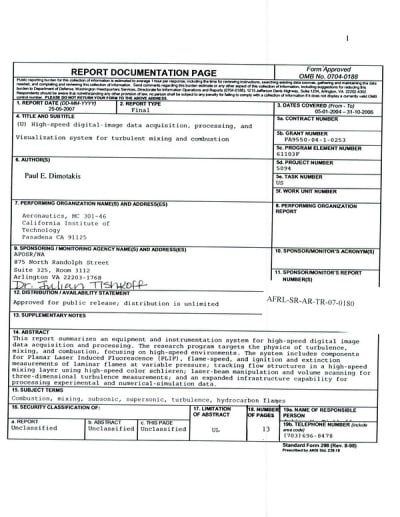
An equipment and instrumentation system for high-speed digital image data acquisition and processing includes components for Planar Laser Induced Fluorescence (PLIF), flame-speed, and ignition and extinction measurements of laminar flames at variable pressure; tracking flow structures in a high-speed mixing layer using high-speed color schlieren; laser-beam manipulation and volume scanning for three-dimensional turbulence measurements; and an expanded infrastructure capability for processing experimental and numerical-simulation data.
Flame measurements rely on an extension of Particle Streak Velocimetry (PSV), using a continuous-wave laser modulated with a Pockels cell. The measurements allow the study of laminar-flame profile details in higher-speed flames, such as encountered in ethylene and other fast fuels. The color Schlieren measurements rely on a high-speed color CMOS camera and associated light source and other support components. These measurements provide details of turbulent mixing in flow geometries for both subsonic (diffusers) and supersonic (SCRAMJET) internal flows. The laser-beam manipulation and volume-scanning capability is provided through a network of mirrors, servo actuators, motion controllers, and an optical scanner.
The system enables resolved three-dimensional measurements of fully developed turbulence as a function of time. The processing and visualization of the data acquired are enhanced through memory, CPU, and tape-backup upgrades to previously available data acquisition and visualization computers.
To perform PSV measurements, a continuous-wave Argon-Ion laser operating at 2.5 W was used. The laser beam was chopped at a 50% duty cycle and at a maximal frequency of 2.4 kHz to illuminate the particles for a specified amount of time. The exposure on the CCD imager then produced streaks that were used to determine the local flow velocity. PSV has the crucial advantage of significantly lower particle-loading requirements in this environment (2-3 orders of magnitude). Low particle loading is critical in archival combustion measurements, where large particle loading may alter flame properties. Therefore, a new particle tracking velocimetry (PTV) technique was developed that keeps the low particle-loading advantage of PSV and features a higher spatio-temporal resolution, thanks to the use of both a new illumination source (Nd:YLF 527-nm diode-pumped Q-switched laser with double-pulse option), a new imaging system (4008 × 2672 pix 2, low-noise), 14-bit dynamic range, and a CCD camera with a maximum framing rate of 5 fps at full resolution.
In order to be able to store data continuously to the disk at the same rate as the maximum framing rate of the camera, a designated Datawulf computer system is used that is equipped with fast raid controller with nine hard drives. A camera interface board was chosen to transfer data quickly from the camera to the computer local RAM memory, and software is used to manage data streaming.
With the PTV technique, investigations of pure ethylene flames and blends of hydrocarbon fuel and hydrogen flames at atmospheric, as well as moderately high pressures, are now possible.
This work was done by Paul E. Dimotakis of the California Institute of Technology for the Air Force Office of Scientific Research.
AFRL-0104
This Brief includes a Technical Support Package (TSP).
Digital-Image Data Acquisition System for Turbulent Mixing and Combustion
(reference AFRL-0104) is currently available for download from the TSP library.
Don't have an account?
More From SAE Media Group
Aerospace & Defense Tech Briefs
System for Imaging Turbulent Combustion Flows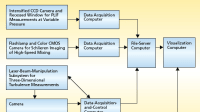
Photonics & Imaging Technology
Researchers Use Inkjet Printing to Make a Portable Multispectral 3D Camera

Photonics & Imaging Technology
New Products
Aerospace & Defense Tech Briefs
This Laser Clock Could Transform Satellite Navigation Accuracy
Photonics Tech Briefs
Target-Tracking Camera for a Metrology System
Tech Briefs
Tunable, Narrow Linewidth, Chip-Scale Lasers
Tech Briefs
Microparticle Flow Sensor
Power Electronics INSIDER
Powerful and Precise Multi-color Lasers Now Fit on a Single Chip
Photonics & Imaging Technology
New Frequency Comb Can Identify Molecules in 20-Nanosecond Snapshots
Photonics & Imaging Technology
New Upgrade Will Supercharge Atomic Vision of the World’s Most Powerful X-Ray Laser
Photonics & Imaging Technology
Ultra-Narrowband Optical Filters Pushing Boundaries from the UV to the LWIR
Aerospace & Defense Tech Briefs
Diode Laser Sensor for Scramjet Inlets
Tech Briefs
Compact Microwave Fourier Spectrum Analyzer
Tech Briefs
Solar-Powered Airplane With Cameras and WLAN
Tech Briefs
Forward-Scattering Particle-Image Velocimetry
Photonics Tech Briefs
Two-Photon-Absorption Scheme for Optical Beam Tracking
Photonics & Imaging Technology
The Latest Advancements in Optics
Photonics Tech Briefs
Shared-Aperture Multiplexed Holographic Scanning Telescopes
Tech Briefs
Levitating Objects with Light
Photonics Tech Briefs
Low-Resolution Raman-Spectroscopy Combustion Thermometry
Aerospace & Defense Tech Briefs
Liquid-Crystal-Particle Thermometry and Velocimetry System
Electronics & Sensors INSIDER
New Tech May Lead to Smaller, More Powerful Wireless Devices
Tech Briefs
Products of Tomorrow
Aerospace & Defense Tech Briefs
A New Look at Ignition: Refining Our Understanding of Combustion Dynamics in Gun Chambers
Aerospace & Defense Tech Briefs
Distributed, Collaborative Human- Robotic Networks for Search, Identify, and Track

Tech Briefs
Optical Pointing Sensor
Overview
The document is a final progress report summarizing a research program focused on high-speed digital image data acquisition, processing, and visualization systems for studying turbulent mixing and combustion. The project, led by Principal Investigator P. E. Dimotakis at the California Institute of Technology, was supported by the Air Force Office of Scientific Research (AFOSR) under Grant FA9550-04-1-0253, covering the period from May 1, 2004, to October 31, 2006.
The report outlines the development and implementation of advanced equipment designed to enhance the understanding of turbulence and combustion phenomena, particularly in high-speed flows. A key innovation in this research is the use of hybrid CCD-CMOS detectors, which significantly improve the signal-to-noise ratio (SNR) of focal plane array (FPA) detectors, allowing for more precise measurements.
The system includes various components for conducting experiments, such as Planar Laser Induced Fluorescence (PLIF) for tracking flow structures, flame-speed measurements, and ignition and extinction assessments of laminar flames under varying pressure conditions. The research aims to provide insights into the three-dimensional structure and dynamics of turbulence, as well as the mixing processes in both incompressible/subsonic and compressible/supersonic flows.
The report emphasizes the educational aspect of the project, highlighting its role in training research students in disciplines relevant to the Department of Defense (DOD) mission. The experiments conducted with the new equipment offer a first look at the large-scale structures of turbulence, contributing to the broader understanding of fluid dynamics and combustion processes.
In addition to the experimental work, the report discusses the expanded infrastructure capabilities for processing both experimental and numerical simulation data, which are crucial for advancing knowledge in the field. The findings from this research are expected to have significant implications for applications in aerospace and other industries where high-speed flows and combustion processes are critical.
Overall, the document serves as a comprehensive overview of the research conducted, the technological advancements achieved, and the educational contributions made through this innovative program.
Top Stories
INSIDERManufacturing & Prototyping
 How Airbus is Using w-DED to 3D Print Larger Titanium Airplane Parts
NewsAutomotive
 Microvision Aquires Luminar, Plans Relationship Restoration, Multi-industry Push
INSIDERAerospace
 A Next Generation Helmet System for Navy Pilots
INSIDERDesign
 New Raytheon and Lockheed Martin Agreements Expand Missile Defense Production
ArticlesAR/AI
 CES 2026: Bosch is Ready to Bring AI to Your (Likely ICE-powered) Vehicle
Road ReadyDesign

Webcasts
Semiconductors & ICs
 Advantages of Smart Power Distribution Unit Design for Automotive...
Unmanned Systems
 Quiet, Please: NVH Improvement Opportunities in the Early Design...
Electronics & Computers
 Cooling a New Generation of Aerospace and Defense Embedded...
Power
 Battery Abuse Testing: Pushing to Failure
AR/AI
 A FREE Two-Day Event Dedicated to Connected Mobility
