




Liquid-Crystal-Particle Thermometry and Velocimetry System
Temperature and flow fields are mapped with the help of TLC particles.
A three-dimensional (3D) defocusing liquid-crystal-particle thermometry and velocimetry (3DDLCPTV) system has been designed and constructed (but not yet operated) for use in measuring the 3D velocity and temperature fields, respectively, in a volume of interest in a possibly turbulent flow. As its name suggests, the system utilizes defocusing digital particle-image velocimetry (DDPIV) for obtaining velocity data and liquid-crystal thermometry for obtaining temperature data.
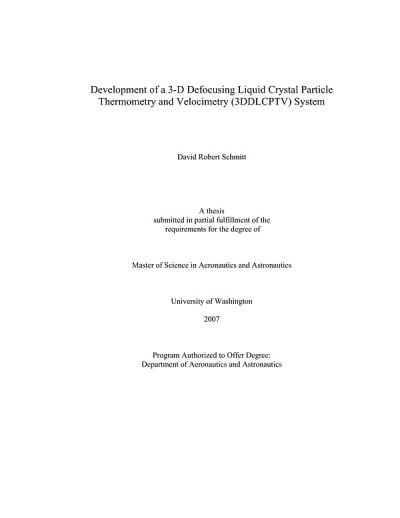
The system includes a total of three monochrome charge-coupled- device (CCD) electronic cameras and one color CCD camera, all aimed at the flow volume of interest (see figure). During operation of the system, the flow would be seeded with thermotropic liquid crystal (TLC) particles, which reflect light predominantly at a wavelength that varies with temperature. The flow would be illuminated by use of a high-intensity xenon flashlamp, and the cameras would acquire sequences of images of the illuminated TLC particles.

The geometric arrangement of the cameras is such that in superposing the four camera images as part of the processing of image data, one would obtain, for each illuminated particle, a composite image that could be readily and uniquely identified as a combination of four blurred spots located at the vertices and center of an equilateral triangle. The 3D velocity of each particle could then be calculated by correlation analysis of the blurred spots at the vertices of the triangle in two consecutive images, while the temperature of the particle would be calculated through analysis of the hue of the central spot. Thus, the system should be capable of resolving the temperatures and velocities of all particles within the volume of interest.
This work was done by David Robert Schmitt of the University of Washington for the Air Force Research Laboratory.
This Brief includes a Technical Support Package (TSP).
Liquid-Crystal-Particle Thermometry and Velocimetry System
(reference AFRL-0038) is currently available for download from the TSP library.
Don't have an account?
More From SAE Media Group
Photonics Tech Briefs
Wide-Field Optic for Autonomous Acquisition of Laser Link
Tech Briefs
Forward-Scattering Particle-Image Velocimetry
Photonics & Imaging Technology
Ultra-Narrowband Optical Filters Pushing Boundaries from the UV to the LWIR
Photonics Tech Briefs
Low-Resolution Raman-Spectroscopy Combustion Thermometry


Photonics & Imaging Technology
The Latest Advancements in Optics

Aerospace & Defense Tech Briefs
System for Imaging Turbulent Combustion Flows
Photonics Tech Briefs
Imaging of γ-Irradiated Regions of a Crystal

Photonics Tech Briefs
Holographic Vortex Coronagraph
Tech Briefs
Levitating Objects with Light
Photonics & Imaging Technology
Researchers Use Inkjet Printing to Make a Portable Multispectral 3D Camera

Photonics Tech Briefs
Control Program and Optical Improvements of Fresnel Microspectrometer
Tech Briefs
System for Thermal Imaging of Hot Moving Objects


Tech Briefs
Portable Multispectral Telescope
Tech Briefs
Alignment Cube With One Diffractive Face
Tech Briefs
Hand-Held Instrument for Imaging Hydrogen Fires
Photonics Tech Briefs
Scanning Miniature Microscopes Without Lenses

Tech Briefs
Automated Window Inspection Device
Tech Briefs
Tunable-Bandwidth Filter System
Overview
The document is a master's thesis titled "Development of a 3-D Defocusing Liquid Crystal Particle Thermometry and Velocimetry (3DDLCPTV) System" authored by David Robert Schmitt at the University of Washington. It was submitted in partial fulfillment of the requirements for a Master of Science degree in Aeronautics and Astronautics.
The thesis presents a novel approach to measuring temperature and velocity in fluid flows using a 3D defocusing technique with liquid crystal particles. This method aims to enhance the accuracy and efficiency of thermometry and velocimetry, which are critical in various applications, including aerodynamics, combustion, and environmental studies.
The document includes a comprehensive introduction that outlines the significance of accurate temperature and velocity measurements in fluid dynamics. It discusses the limitations of existing techniques and the need for improved methodologies that can provide detailed spatial and temporal data.
The background section reviews previous work in the field, highlighting advancements in particle-based measurement techniques and the role of liquid crystals in temperature sensing. The thesis details the principles of defocusing and how it can be leveraged to obtain three-dimensional information from the particle images.
The methodology section describes the experimental setup and the design of the 3DDLCPTV system. It explains the process of calibrating the liquid crystal particles, capturing images, and analyzing the data to extract temperature and velocity fields. The author emphasizes the importance of rigorous testing and validation to ensure the reliability of the measurements.
Results from the experiments are presented, showcasing the system's capabilities in various flow conditions. The findings demonstrate the potential of the 3DDLCPTV system to provide high-resolution measurements that can significantly contribute to the understanding of complex fluid dynamics.
The thesis concludes with a discussion of the implications of the research, potential applications, and suggestions for future work. It emphasizes the importance of continued innovation in measurement techniques to advance the field of aeronautics and related disciplines.
Overall, this thesis represents a significant contribution to the field of fluid dynamics, offering a new tool for researchers and engineers to better understand and analyze fluid behavior in various contexts.
Top Stories
INSIDERManufacturing & Prototyping
 How Airbus is Using w-DED to 3D Print Larger Titanium Airplane Parts
INSIDERManned Systems
 FAA to Replace Aging Network of Ground-Based Radars
NewsTransportation
 CES 2026: Bosch is Ready to Bring AI to Your (Likely ICE-powered) Vehicle
NewsSoftware
 Accelerating Down the Road to Autonomy
EditorialDesign
 DarkSky One Wants to Make the World a Darker Place
INSIDERMaterials
 Can This Self-Healing Composite Make Airplane and Spacecraft Components Last...
Webcasts
Defense
 How Sift's Unified Observability Platform Accelerates Drone Innovation
Automotive
 E/E Architecture Redefined: Building Smarter, Safer, and Scalable...
Power
 Hydrogen Engines Are Heating Up for Heavy Duty
Electronics & Computers
 Advantages of Smart Power Distribution Unit Design for Automotive...
Unmanned Systems
 Quiet, Please: NVH Improvement Opportunities in the Early Design...
