




Biaxial and Shear Testing Apparatus With Force Controls
This apparatus is intended especially for measuring strength properties of fabrics.
An apparatus for in-plane biaxial tension/compression and in-plane shear testing of fabrics, other flexible sheet materials, or relatively rigid thin plate materials has been invented. The apparatus is capable of applying, to a sheet material specimen, a controlled tensile or compressive force along each of two directions in the plane of the specimen. The force along each direction can differ from the force along the other direction. The directions of the applied forces can be orthogonal or can be set at an oblique angle, depending on the combination of stresses required to be applied to the specimen. Thus, depending on the angle between the applied-force directions, the sense (tensile or compressive) of each applied force, and the magnitude of each force, the specimen can be subjected to almost any combination of in-plane shear and biaxial tension/compression loading.

The apparatus (see figure) includes two rhombus four-bar linkages in vertical planes that intersect at a top joint and a bottom joint on a common vertical axis. The top and bottom joints include thrust bearings that enable rotation, about the common vertical axis, of the plane of one linkage relative to the plane of the other linkage so as to obtain the desired angle between the directions of the applied forces. The top and bottom joints are connected to the top crosshead and the bottom crosshead, respectively, of a conventional controlled- displacement tension/ compression testing machine. Located at the lateral joints of each four-bar linkage there are loading-plate assemblies that include loading plates connected to piston actuators. The specimen is clamped to the loading plates of either or both four-bar linkage(s), depending on the nature of the required test load. The conventional tension/ compression testing machine serves mainly as an adjustment mechanism: By raising or lowering the top joint, the horizontal distance between the lateral joints in each four-bar linkage is set to the value required to obtain the proper fit to the specimen to be clamped to the loading plates.
The piston actuators are energized by a pressurized fluid (a hydraulic liquid or a compressed gas) from a pump or other pressure source. The piston actuators are connected via tubes to controllers that, in turn, are connected via tubes to the pressure source and to a reservoir. The controllers contain shut-off valves and adjustable check valves. The settings of these valves determine the pressures supplied to the opposing faces of the pistons in the piston actuators and thereby determine the senses (tensile or compressive) and the magnitudes of the forces applied by the piston actuators. Because the pressures are regulated, the forces applied by the actuators remain substantially constant even as the specimens creep and/or become elastically deformed under the applied loads.
The apparatus can accommodate a variety of instrumentation: The loading plates can be instrumented with strain gauges for measurement of the applied forces. A wire displacement transducer can be installed between the loading plates in each four-bar linkage to measure the deformation of the specimen under the applied load. A camera aimed downward at the specimen can be mounted on the bottom of the top joint.
This work was done by Paul V. Cavallaro of the Naval Undersea Warfare Center.
NUWC-0005
More From SAE Media Group
Motion Design
Conical, Floating-Piston Isolation Valve

Motion Design
Multi-Axis Motion Controller Accelerates Gear Testing
Tech Briefs
Soft Components for Soft Robotics
Motion Design
New Piston Design Features Soft, Flexible Materials
Motion Design
Valves for Pneumatic Cylinders and Actuators
Motion Design
Calculating the Estimated Fatigue Life of a Disc Spring
Motion Design
Popcorn-Driven Robotic Actuators
Aerospace & Defense Tech Briefs
Thermostatic Solutions for Temperature Control Applications


Tech Briefs
Alignment Stage for a Cryogenic Dilatometer
Aerospace & Defense Tech Briefs
Limiting Creep in Aerospace Materials
Tech Briefs
Extrans Permeation Measurement System
Tech Briefs
Hydraulic Pressure Distribution System
Tech Briefs
Chemically Driven Wheels “Morph” Into Gears
Aerospace & Defense Tech Briefs
MEMS Offset-Beam Torsional Electrothermal Actuators
Motion Design
New Hybrid Concept for Actuating Subsea Valves
Tech Briefs
Tension Element Vibration Damping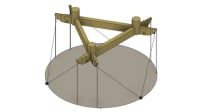
Medical Design Briefs
Microparticles Pave Way for Microfluidic Devices
Tech Briefs
Process Enables Machines to Thermally “Breathe”
Tech Briefs
Cord Tension Measurement Device
Tech Briefs
Bubble Eliminator Based on Centifugal Flow

Aerospace & Defense Tech Briefs
Encapsulated Ball Bearings for Rotary Micro Machines
Tech Briefs
Color-Changing Dyes Visualize Stress in Plastics

Aerospace & Defense Tech Briefs
SAE International Extends Call for Abstracts, Seeks Submissions for AeroTech Conference
Top Stories
INSIDERManufacturing & Prototyping
 How Airbus is Using w-DED to 3D Print Larger Titanium Airplane Parts
INSIDERManned Systems
 FAA to Replace Aging Network of Ground-Based Radars
NewsTransportation
 CES 2026: Bosch is Ready to Bring AI to Your (Likely ICE-powered) Vehicle
NewsSoftware
 Accelerating Down the Road to Autonomy
EditorialDesign
 DarkSky One Wants to Make the World a Darker Place
INSIDERMaterials
 Can This Self-Healing Composite Make Airplane and Spacecraft Components Last...
Webcasts
Defense
 How Sift's Unified Observability Platform Accelerates Drone Innovation
Automotive
 E/E Architecture Redefined: Building Smarter, Safer, and Scalable...
Power
 Hydrogen Engines Are Heating Up for Heavy Duty
Electronics & Computers
 Advantages of Smart Power Distribution Unit Design for Automotive...
Unmanned Systems
 Quiet, Please: NVH Improvement Opportunities in the Early Design...
