




3D-printed Radar Rises Toward Production
Lunewave’s unique Luneburg-lens technology aims to simplify vehicle radar arrays — and deliver better ADAS and AV performance.

The past 14 months have been particularly tough for new-tech innovators who were in the process of breaking into the crowded automated/autonomous vehicle space before COVID-19 struck. As investors’ clocks ticked with each passing locked-down week, many automotive OEMs adjusted their development, testing and validation focus toward advanced driver-assist systems (ADAS), shifting the longer-term AV (SAE Level 4 and 5) programs to the back burner.
“There was definitely uncertainty in Q2 and Q3 of last year,” noted John Xin, the CEO and co-founder of radar-technology startup Lunewave. “Some of the advanced engineering and production programs were impacted — not just related to our company, but across the board.” Luckily for Lunewave, its most strategic-minded OEM and Tier-1 supplier partners saw the situation as “an opportunity to accelerate their development activities.”
Without in-person meetings, Xin’s small team, which includes his brother and co-founder Hao (Lunewave’s CTO), pivoted to shipping prototypes and conducting virtual demonstrations and program reviews on Zoom. “In some ways, it was actually easier to schedule meetings,” Xin said. “Overall, our schedule was adjusted slightly, but now [spring 2021] we’re very much back on track regarding our progress.” There is strong OEM interest in the advanced ADAS space that’s been unofficially dubbed Level 2+, he explained.
Series production in 2024

Much has been accomplished by the small Tucson, Arizona-based company that specializes in a unique 3D-printed Luneburg-lens antenna and radar since Autonomous Vehicle Engineering last spoke with Xin a year ago [https://www.sae.org/news/2020/03/ lunewave-radar]. Last December, Lunewave closed a $7 million funding round led by FM Capital and on-boarded several new investors that include Proeza Ventures, part of the Mexico-based Tier 1 supplier Proeza Group.
“From a financial standpoint, we’re in a great position,” he stated. “And in product development we’ve executed about a dozen product-trial agreements with OEMs and Tier-1 suppliers who continue to evaluate our third-generation high-imaging radar.” That has included much on-vehicle testing in different scenarios and edge cases, comparing the Luneburg-based system to other radar sensors and to lidars. Feedback has been positive, related to the technology’s potential to help them simplify their existing radar architectures for both ADAS today and self-driving AVs of the future, Xin noted.
The 3D-printed Luneburg lens, the shape and size of a golf ball, now is in its third version in three years. Designed to deliver broad bandwidth, high-gain object detection at ranges over 300 meters (984 ft), the Lunewave radar is claimed to have five times better angular resolution than existing automotive radars. It has the potential to significantly simplify a vehicle’s sensor array, replacing up to 20 traditional radars with two to four sensors, depending on vehicle size and OEM requirements.
The current portfolio includes three radars. The “standard” unit’s field of view [FoV] in the azimuth — the angle of the radar beam in respect to north — is 120° at an 0.5° angle of resolution with 20° vertical FoV. It is targeted to replace existing radars mounted in the grill, front bumper, rear bumper and potentially in the side of the vehicle. A second Lunewave radar has a 180° FoV and 20° vertical, also with 0.5° of angular resolution — “best on the market,” Xin claimed. A third product features 180° FoV in azimuth and 90° vertical FoV that will address an existing gap in the sensor market, Xin said. Future product features include 270° and 360° in azimuth FoV.

According to Xin, Lunewave is close to announcing a strategic partnership with at least one global Tier-1 supplier that currently manufactures automotive radar. “As a startup, we must find the right partner to commercialize our product,” he said. “I do not expect to have any exclusivity at this stage of our company, because our solution is to be ‘Tier-1 agnostic.’ We are working with a short list of Tier 1 suppliers to design a Luneburg-lens-based radar sensor that is very robust and can be mass-produced in millions and millions of units. We’ve gone through an extensive in-depth review of our technology solution, while learning about their capabilities.”
Lunewave is targeting series production in 2024 for an ADAS application. For L3/L4 use cases, “we’ll be releasing our B-sample in 2022,” Xin reported.
3D printing at high volume
Some manufacturing experts reckon that Lunewave’s process for producing of its Luneburg antennae, each with 6,500 uniquely shaped internal chambers, may be the most advanced use of additive manufacturing/3D printing in the ADAS and AV space. Can it be done at automotive scale when, for example, Ford’s F-150 program would need four million of the tiny, sophisticated “golf balls” per year?
“The beauty of 3D printing is not to produce ‘unsophisticated widgets’ that traditional processes can do very quickly and cheaply,” Xin explained. “Instead, it’s about producing something like a Luneburg antenna that’s complex and frankly impossible to do with existing processes.” He said the antenna currently is produced in batches using a commercial-grade 3D printer, of which Lunewave owns “several.” One printer can manufacture 1,000 antennae per day. The annual yield of a single machine printer is about 350,000 antennae, Xin noted.
“The reality is that when we purchase ten 3D printers, we’ll be capable of 3.5 million antennae per year,” he said. “The scaling for this product is linear; there is no magic about it. Our lens is easily within the capability of a 3D printer.”
The high performance potential of Luneburg antennas has been accepted for decades. But the cost and complexity of manufacture has limited their application to relatively niche high-value but low-volume use cases, observed Dr. Tom Jellicoe, head of autonomous technology at TTP, an independent technology company in Cambridge, England.
“What is really exciting about Lunewave is their combination of innovative manufacture with wide field-of-view sensors to make extremely high performance, 360-degree automotive systems at a competitive cost point.”
The weight of the antenna, about 10 grams [.35 oz] makes it amenable for mass-production batches. Lunewave has had “very in-depth” discussions with its Tier 1 partner and with OEMs to ensure quality and quantity of the product and process,” Xin noted.
More From SAE Media Group
Autonomous Vehicle Engineering
Lunewave Promises Low-Cost Radar with High-Performance 360-Degree View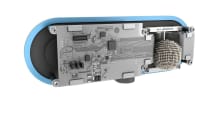
Automotive Engineering
Single-chip digital imaging radar heads for 2022 production

Tech Briefs
A Hack to Trick Automotive Radar
Autonomous Vehicle Engineering
Imaging Radar Is the Next Big Thing

Automotive Engineering
Osram and Vergence Automation Develop New Lidar and 4D Camera for Autonomous Vehicles
Sensor Technology
RTK and Sensor Fusion for Autonomous Vehicle Navigation & Guidance
Autonomous Vehicle Engineering
ADAS Over the Horizon
Defense INSIDER
New 3D-Printed Antenna Designs Reduce Cost, Weight and Size

Autonomous Vehicle Engineering
GM Announces Door-To-Door Ultra Cruise ADAS
Automotive Engineering
Honda to Reveal Autonomous Work Vehicle at CONEXPO

Tech Briefs
Over-the-Air Radar-in-the-Loop Simulation

Tech Briefs
Compact 3D LiDAR Imaging System
Autonomous Vehicle Engineering
Opsys Tech Demos Cost-Effective Solid-State Lidar-Module Prototypes
Automotive Engineering
Lumotive’s New LCM Underpins Next-Gen Lidar
Automotive Engineering
Valeo Debuts New Lidars, EV Tech at CES 2022
Automotive Engineering
Expanding ADAS Roles for Radar and Cameras
Autonomous Vehicle Engineering
Ensuring No Child Left Inside
Automotive Engineering
Growing Lidar for North America

Tech Briefs
New on the Market
Automotive Engineering
DSpace Launches Simphera AV Development Simulator
Photonics & Imaging Technology
Add LiDAR to ADAS for Pedestrian Safety
Autonomous Vehicle Engineering
New Automotive Radars Take Tech from a Blip to a Boom
Top Stories
INSIDERMaterials
 How Airbus is Using w-DED to 3D Print Larger Titanium Airplane Parts
INSIDERAerospace
 FAA to Replace Aging Network of Ground-Based Radars
NewsUnmanned Systems
 CES 2026: Bosch is Ready to Bring AI to Your (Likely ICE-powered) Vehicle
NewsSoftware
 Rewriting the Engineer’s Playbook: What OEMs Must Do to Spin the AI Flywheel
Road ReadyTransportation
 2026 Toyota RAV4 Review: All Hybrid, All the Time
NewsSoftware

Webcasts
Automotive
 E/E Architecture Redefined: Building Smarter, Safer, and Scalable...
Transportation
 Hydrogen Engines Are Heating Up for Heavy Duty
Automotive
 Advantages of Smart Power Distribution Unit Design for Automotive...
Automotive
 Quiet, Please: NVH Improvement Opportunities in the Early Design...
Power
 A FREE Two-Day Event Dedicated to Connected Mobility
Power
 Powering America’s EV Future: Connect, Collaborate, Innovate