




NO-Generating Coats for Subcutaneous Glucose Sensors
These implantable sensors can be used for monitoring diabetes patients.
In a research program now in progress, polymeric materials that catalyze the generation of nitric oxide (NO) at low concentrations are being developed and tested for utility as coatings on surgically implantable amperometric glucose sensors. Heretofore, efforts to develop subcutaneous sensors for real-time clinical monitoring of glucose concentrations in diabetic patients have been stymied by inflammatory/foreign-body responses to implantation of sensors. The present research program follows from an observation, made in a related prior research program, that local generation of NO at low concentrations enhances the biocompatibility of implanted sensors by reducing inflammatory responses.

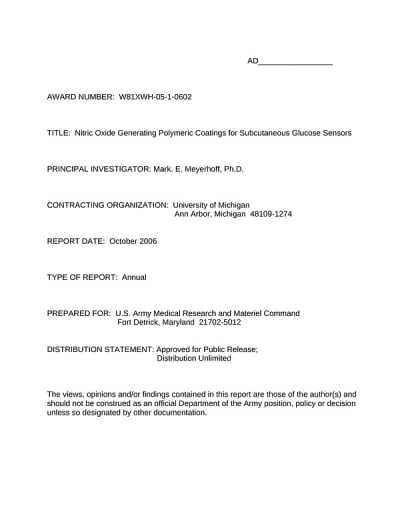
The focus of this research program is, more specifically, to develop new biomedical hydrogel and polyurethane coating materials containing immobilized copper(II) ions or other chemical species (e.g., organoselenium) that act as catalysts for in situ conversion of endogenous nitrosothiol compounds (e.g., nitrosoglutathione and nitrosocysteine) to NO, thereby enabling sustained local generation of NO at the surfaces of the implanted sensors. One of the accomplishments thus far has been the synthesis and characterization of a new material that includes a Cu(II)- cyclen compound covalently attached to a cross-linked poly (2-hydroxy- ethyl methacrylate). This material has been found to generate NO from endogenous nitrosothiols in solution at physiological pH. In preliminary in vivo studies using a lipophilic Cu(II)- cyclen compound blended into a biomedical-grade polyurethane coating material on sham subcutaneous devices implanted in rats, an apparent reduction in inflammatory response was demonstrated (see figure). However, proof that NO is the agent causing the observed improvement has yet to be obtained.
Needle-type subcutaneous glucose sensors that are to be coated with various NO-generating materials are undergoing development. At the time of reporting the information for this article, it was planned to use these sensors in experiments to determine (1) whether the NO-generating chemistry is compatible with the glucose-sensing chemistry and (2) whether the sensing function is compromised by coating with the NO-generating materials.
This work was done by Mark. E. Meyerhoff of the University of Michigan for the Army Research Laboratory.
This Brief includes a Technical Support Package (TSP).
NO-Generating Coats for Subcutaneous Glucose Sensors
(reference ARL-0037) is currently available for download from the TSP library.
Don't have an account?
More From SAE Media Group
Medical Design Briefs
Tubing Coated with Light-Powered Catalysts Aids Drug Manufacturing
Aerospace & Defense Tech Briefs
Implantable Electrochemical Sensors for Metabolic Monitoring
Medical Design Briefs
Gold Nanoparticles Enable Long-Term Implantable Sensor ‘Tattoo’
Medical Design Briefs
Skin Sensors Monitor Health
Medical Design Briefs
Flexible Sweat Sensor Based on Photonic Cellulose Nanocrystal
Aerospace & Defense Tech Briefs
Update on Implantable Sensors for Metabolic Monitoring
Medical Design Briefs
Wearable Gas Sensor Enhances Sensitivity
Medical Design Briefs
Hybrid Material Enables Next-Gen E-Skin
Medical Design Briefs
Low-Cost Plastic Sensors Could Monitor a Range of Health Conditions
Medical Design Briefs
New Plasma Process for Surface Treatment of Implants
Medical Design Briefs
Building Better Gas-Phase Biosensors for Fight Against Diseases
Medical Design Briefs
Medical Implants: Zwitterions Coating Could Prevent Blood Clotting
Medical Design Briefs
Reliable Protection for the Latest Advances in Diabetes Management Technologies
Medical Design Briefs
Self-Powered Diaper Sensors Monitor Urine Sugar Levels
Tech Briefs
Products of Tomorrow
Photonics & Imaging Technology
Scientists Discover New Way to Label Chemical Compounds for Medical Imaging
Medical Design Briefs
Spikes of Graphene Kill Bacteria on Medical Implants
Tech Briefs
Surgical Tape Detaches on Demand
Medical Design Briefs
Lead-Free Piezoelectric Materials
Medical Design Briefs
Scientists 3D Print All-Liquid ‘Lab on a Chip’
Medical Design Briefs
Electrical and Antibacterial Hydrogel Developed for Brain Implants
Medical Design Briefs
Sensors Measure Uric Acid Levels
Medical Design Briefs
Sweat Sensor Wristwatch for Real-Time Monitoring
Medical Design Briefs
Metal-Ion Breakthrough Leads to New Biomaterials
Medical Design Briefs
Super-Strong Surgical Tape Detaches on Demand
Medical Design Briefs
Understanding Titanium’s Biocompatibility
Medical Design Briefs
Implantable Sensor Could Measure Bodily Functions and Safely Biodegrade

Overview
The document is an annual report detailing research on "Nitric Oxide Generating Polymeric Coatings for Subcutaneous Glucose Sensors," led by Dr. Mark E. Meyerhoff at the University of Michigan. The research aims to address the challenges faced in developing implantable glucose sensors for real-time monitoring in diabetic patients, particularly issues related to biocompatibility and inflammatory responses caused by sensor implantation.
The report highlights that previous efforts to create reliable implantable chemical sensors have been hindered by the inflammatory response of surrounding tissues, which can lead to unreliable analytical results. The primary goal of this research program is to optimize the chemistries involved in fabricating amperometric glucose sensors that feature outer polymeric coatings capable of generating low levels of nitric oxide (NO). The local generation of NO is expected to enhance the biocompatibility of these sensors by reducing inflammation and promoting angiogenesis and wound healing at the implantation site.
Key findings from the research include the successful demonstration that NO-generating polymer coatings, based on a lipophilic Cu(II)-cyclen complex embedded in medical-grade polyurethane, can modestly reduce the inflammatory response in tissue surrounding implanted devices in rat models over a seven-day period. Additionally, the report discusses the fabrication of enzyme-based needle-type glucose sensors that exhibit a linear response to glucose concentrations ranging from 0 to 30 mM.
The report also outlines the development of new polymeric coatings, including biomedical hydrogels and polyurethanes, which contain immobilized copper ion sites. These sites serve as catalytic surfaces for the in situ conversion of endogenous nitrosothiol species (RSNO) to NO, providing a sustained local generation of NO at the sensor surface. Preliminary experiments indicate that RSNO levels in the subcutaneous fluid of rats are sufficient to generate local NO, thereby reducing the inflammatory response at the implantation site.
The report concludes with a summary of conference presentations and reportable outcomes, emphasizing the potential of NO-generating materials in creating thromboresistive polymers and improving the performance of glucose sensors. Overall, the research represents a significant step toward enhancing the biocompatibility and functionality of implantable glucose monitoring devices for diabetic patients.
Top Stories
NewsRF & Microwave Electronics
 Microvision Aquires Luminar, Plans Relationship Restoration, Multi-industry Push
INSIDERAerospace
 A Next Generation Helmet System for Navy Pilots
INSIDERDesign
 New Raytheon and Lockheed Martin Agreements Expand Missile Defense Production
INSIDERMaterials
 How Airbus is Using w-DED to 3D Print Larger Titanium Airplane Parts
NewsPower
 Ford Announces 48-Volt Architecture for Future Electric Truck
ArticlesAR/AI

Webcasts
Electronics & Computers
 Cooling a New Generation of Aerospace and Defense Embedded...
Automotive
 Battery Abuse Testing: Pushing to Failure
Power
 A FREE Two-Day Event Dedicated to Connected Mobility
Unmanned Systems
 Quiet, Please: NVH Improvement Opportunities in the Early Design Cycle
Automotive
 Advantages of Smart Power Distribution Unit Design for Automotive &...
Energy
 Sesame Solar's Nanogrid Tech Promises Major Gains in Drone Endurance