




Implantable Electrochemical Sensors for Metabolic Monitoring
Electrochemical-transducer compounds are encapsulated in biocompatible hydrogel structures.
Arrays of electrochemical sensors that include specially coated (as described below) gold electrodes on flexible polyimide sheets have been fabricated and tested in a continuing effort to develop biocompatible, surgically implantable electrochemical-sensor arrays for continuous measurement of concentrations of analytes that play major roles in human and animal metabolism. The effort thus far has been oriented particularly toward developing sensors for monitoring one analyte — glucose — to enable improved treatment of diabetic patients. It is planned to extend this effort to the fabrication and testing of sensors for monitoring lactate and pyruvate and, eventually, to implement the concept of a single array that contains sensors for monitoring glucose, lactate, and pyruvate.
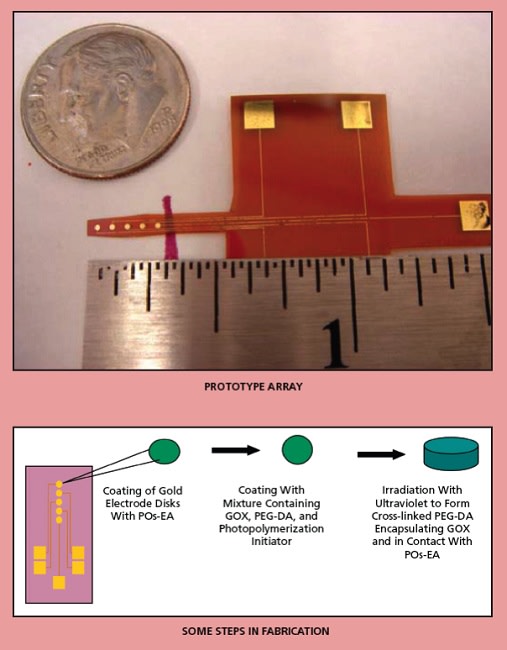
Implantable sensors for monitoring glucose have been under investigation for nearly three decades, with mixed and promising results. In the electrochemical- monitoring approach followed in the present development, cyclic voltammetry, amperometry, square-wave voltammetry, or a combination of these techniques is used to measure the rate of catalytic oxidation of glucose by the enzyme glucose oxidase (GOX) in a reaction mediated by poly[vinyl pyridine Os(bipyridine)2Cl] co ethylamine (POs EA), which is an osmium-based polycationic redox polymer. To ensure biocompatibility, the GOX is entrapped in a poly(ethylene glycol) diacrylate (PEG-DA) hydrogel that has previously been demonstrated to be biocompatible.
The upper part of the figure depicts a typical sensor array; the lower part of the figure depicts some essential features of the fabrication of the array. Fabrication begins with the formation of microdisk electrodes and associated conductors in gold film on a flexible polyimide sheet by use of established deposition and photolithography techniques. The microdisk electrodes are functionalized with a monolayer of 11 mercaptoundecanoic acid (MUA) then coated with POs-EA, which adheres by strong electrostatic attraction to the MUA. The POS-EA layer is further coated with a mixture comprising PEG-DA, a solution containing GOX, and a photopolymerization initiator. Exposure to ultraviolet light causes cross-linking of the PEG-DA to form the PEG-DA hydrogel that encapsulates GOX.
In tests of a five-element array of individually electrically addressable sensors like the one shown in the figure, no cross-talk between adjacent electrodes was observed. It was found that when sampled together, the electrodes behaved as one large electrode with peak current equivalent to the sum of the currents of the individual electrodes — a characteristic that is especially important for diagnosis of failure of one of the sensors in an array. In other tests, an array was shown to exhibit the desired linear sensitivity to the concentration of glucose in the range of biological interest.
This work was done by Michael V. Pishko of Pennsylvania State University for the Army Research Laboratory. For more information, download the Technical Support Package (free white paper) at www.defensetechbriefs.com/tsp under the Bio-Medical category. ARL-0017
This Brief includes a Technical Support Package (TSP).

Implantable Electrochemical Sensors for Metabolic Monitoring
(reference ARL-0017) is currently available for download from the TSP library.
Don't have an account?
More From SAE Media Group
Aerospace & Defense Tech Briefs
Update on Implantable Sensors for Metabolic Monitoring
Medical Design Briefs
Low-Cost Plastic Sensors Could Monitor a Range of Health Conditions
Medical Design Briefs
Wearable Sensors Printed on Natural Materials Analyze Substances Present in Sweat
Aerospace & Defense Tech Briefs
NO-Generating Coats for Subcutaneous Glucose Sensors

Medical Design Briefs
Skin Sensors Monitor Health
Medical Design Briefs
Wristbands Do Health Check During Workout
Medical Design Briefs
Creating Sensitive Gels for Glucose Testing
Medical Design Briefs
Self-Powered Diaper Sensors Monitor Urine Sugar Levels
Medical Design Briefs
Rapid Sensor Chip for Real-Time THO Monitoring
Medical Design Briefs
Hybrid Material Enables Next-Gen E-Skin
Medical Design Briefs
Sensors Measure Uric Acid Levels
Medical Design Briefs
Simple Method Developed for 3D Biofabrication Based on Bacterial Cellulose
Medical Design Briefs
Sensor Detects Early-Stage Parkinson’s
Medical Design Briefs
Wearable Sensors Printed Directly on Skin with No Heat
Medical Design Briefs
Flexible Sweat Sensor Based on Photonic Cellulose Nanocrystal
Medical Design Briefs
Turning Pollen into 3D Printing Ink for Biomedical Applications
Medical Design Briefs
Super-Strong Surgical Tape Detaches on Demand
Medical Design Briefs
Wearable Gas Sensor Enhances Sensitivity
Tech Briefs
Surgical Tape Detaches on Demand
Medical Design Briefs
Creating Cathodes for Air-Breathing Biobatteries
Medical Design Briefs
Wearable Sensor Measures Lactate Concentration in Real Time
Medical Design Briefs
Hierarchical Surface Restructuring for Electrodes and Microelectrode Arrays
Medical Design Briefs
Implantable Sensor Could Measure Bodily Functions and Safely Biodegrade
Medical Design Briefs
Nanotexturing Creates Bacteria-Killing Spikes on Stainless Steel Surfaces
Medical Design Briefs
3D Printing Method ‘Grows’ Ultra-Strong Materials
Medical Design Briefs
Biodegradable Polymer Is Stronger and Longer Lasting
Overview
The document is an annual report dated September 2006, detailing the progress of a research project titled "Microfabricated Multianalyte Sensor Arrays for Metabolic Monitoring," led by Dr. Michael V. Pishko at Pennsylvania State University. The project is funded by the U.S. Army Medical Research and Materiel Command and focuses on developing implantable continuous monitoring sensors for metabolic parameters, particularly glucose and lactate levels.
The report outlines various aspects of the project, beginning with bench-top work on glucose sensors. The researchers aimed to optimize these sensors using photolithographic methods and PEG-DA (polyethylene glycol diacrylate) as a hydrogel to encapsulate sensing elements. Initially, the plan was to encapsulate both a redox polymer (POs-EA) and the enzyme glucose oxidase (GOX) simultaneously within the hydrogel. However, challenges arose, leading to a modified approach where POs-EA was electrostatically attached to a self-assembled monolayer on gold, followed by the encapsulation of GOX in the PEG-DA hydrogel using photolithography. This revised method yielded successful results for the glucose sensors.
In addition to glucose sensors, the report mentions ongoing work on lactate sensors and the design of the overall sensor system. Animal testing is also a critical component of the research, with a graduate student named Becky receiving training in rat handling and biomethodology to prepare for these studies.
The document includes a table of contents that outlines the structure of the report, which covers key research accomplishments, reportable outcomes, and conclusions drawn from the findings. The research aims to advance the field of metabolic monitoring, potentially benefiting various applications, including military and medical settings.
Overall, the report highlights the innovative approaches taken in sensor development, the challenges faced, and the progress made in creating effective monitoring tools for metabolic parameters. The findings from this research could have significant implications for real-time health monitoring and management, particularly in critical care and military environments.
Top Stories
INSIDERAerospace
 How Airbus is Using w-DED to 3D Print Larger Titanium Airplane Parts
NewsUnmanned Systems
 Microvision Aquires Luminar, Plans Relationship Restoration, Multi-industry Push
INSIDERRF & Microwave Electronics
 A Next Generation Helmet System for Navy Pilots
ArticlesUnmanned Systems
 Accelerating Down the Road to Autonomy
INSIDERDesign
 New Raytheon and Lockheed Martin Agreements Expand Missile Defense Production
ArticlesUnmanned Systems
 CES 2026: Bosch is Ready to Bring AI to Your (Likely ICE-powered) Vehicle
Webcasts
Automotive
 Advantages of Smart Power Distribution Unit Design for Automotive...
Transportation
 Quiet, Please: NVH Improvement Opportunities in the Early Design...
Electronics & Computers
 Cooling a New Generation of Aerospace and Defense Embedded...
Automotive
 Battery Abuse Testing: Pushing to Failure
Connectivity
 A FREE Two-Day Event Dedicated to Connected Mobility
