




Microwave RF Amplifier Boosts Communications Power
When you watch TV or use a cell phone, amplifiers make the signal stronger or the voice clearer. A hybrid, high-powered microwave amplifier from Aria Microwave Systems of Teaneck, NJ enables signals to be stronger while offering potential savings to satellite and cell phone system providers. The amplifier also offers a high-power solid-state solution for high-frequency needs in military, radar, industrial, scientific, and medical applications.
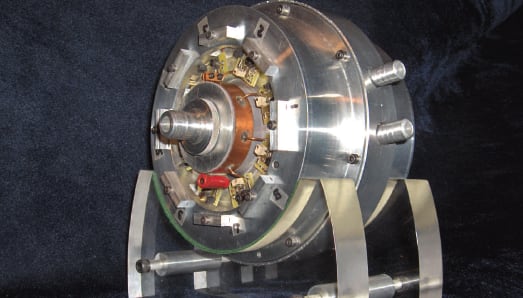
Funded by a Missile Defense Agency (MDA) Small Business Innovation Research (SBIR) Phase II award, Aria's Active Radio Frequency Cavity Amplifier (ARFCA™) provides a unique way of creating a high-power RF amplifier using standard off-the-shelf RF power transistors that are highly reliable and longer-lasting than microwave tubes. By combining the transistors in this way, the ARFCA makes high-power applications like communications far more affordable than current solid-state device-based amplifiers.
Using commercially available amplifier components will allow Aria to manufacture ARFCAs inexpensively and price them to compete with vacuum tube technology minus the short lifespan, and while operating without dangerous high voltages. As a result, applications such as UHF phased-array radar and digital TV transmission can become more practical.
How it Works
Aria's microwave amplifier generates high levels of power through a synchronous reaction of large numbers of RF semiconductor transistors within the device. Because it does not require discrete circuit components, such as capacitors, inductors, and resistors in the RF circuitry, the amplifier also offers greater reliability than not only vacuum-tube-based amplifiers, but commercially available solid-state-based amplifiers, which generally average a six-year lifecycle.
Aria designed the ARFCA to be a simple solution for power amplification — one that flies in the face of the trend to build all modern electronics on printed circuit boards. The design calls for placing a circular disc between cylindrical cavities of an amplifier, onto which are bonded eight or more RF semiconductor transistors. When power reaches the amplifier's output cavity, the transistors begin to react in sync.
The synchronous reaction subsequently generates a high level of power output that is coupled into the device's output cavity and then piped out through standard connectors. This increase in amplitude can be used to boost reliability in telecommunications or satellite operations, or increased output for commercial RF heating.
Several prototypes have been successfully tested for various applications. For cell phone infrastructure, Aria designed an amplifier to operate at 2.1 GHz. This increased power level meets the high peak power required of wide code division multiple access (W-CDMA) and time division multiple access (TDMA) base-station amplifiers. The technology could possibly enable a significant reduction of the number of base stations required to cover a certain area as compared with using high-power, state-of-the-art amplifiers.
An Aria prototype for high-power industrial heating also has shown success in tests. The amplifier operates at 915 MHz, with more than 700 Watts of output power at approximately 1-dB gain compression, which meets the requirements of most industrial applications such as semiconductor manufacturing, plasma processing, and large-scale food processing. Higher power can be attained by using higher-power transistors. Another variant operates at 2.45 GHz and can be used for plasma-fusion lighting. Such lighting, which requires microwave stimulation, is being used to replace conventional high-intensity lights at ballparks, arenas, and factories.
Where it Stands
Aria envisions its patented amplifier technology being used in commercial applications such as cell phone transmission towers, satellite television transmission systems for remote broadcast of events in high definition, and industrial processing units such as RF heaters for chemical processing. The company also is interested in using ARFCAs to enhance output power and reliability of radar as well as other military applications.
More Information
For more information on Aria's microwave RF power amplifier, click here . (Source: MDA TechUpdate, Missile Defense Agency, National Technology Transfer Center Washington Operations)
More From SAE Media Group
Aerospace & Defense Tech Briefs
90° Hybrid Coupled Power Amplifier – Pros and Cons
Aerospace & Defense Tech Briefs
GaN Breaks Barriers
Aerospace & Defense Tech Briefs
Solid-State Microwave Power Module
Aerospace & Defense Tech Briefs
Solving Military Satellite, Radar and 5G Communications Challenges with GaN-on-SiC MMIC Power Amplifiers
Aerospace & Defense Tech Briefs
Ka-Band Front-End Monolithic Microwave Integrated Circuits (MMICs) and Transmit/Receive (T/R) Modules Testing
Aerospace & Defense Tech Briefs
Radar Recording Proves Next-Level System Performance
Aerospace & Defense Tech Briefs
What is Pulse Shaping?
RF & Microwave Technology
A Fundamental Key to Next-Generation Directed-Energy Systems
Aerospace & Defense Tech Briefs
Software-Defined Analog Filters: A Paradigm Shift in Radio Filter Performance and Capability
RF & Microwave Technology
Prognostic Health Management of an RF System Using GPS
Aerospace & Defense Tech Briefs
Improving Transmit/Receive Module Test Accuracy and Throughput
Aerospace & Defense Tech Briefs
Making AESA Radar More Flexible
Aerospace & Defense Tech Briefs
Broadband 1.2- and 2.4-mm Gallium Nitride (GaN) Power Amplifier Designs
Aerospace & Defense Tech Briefs
Making Fully Digital Beamforming for Radar and Electronic Warfare Applications a Reality
Tech Briefs
New Phase Shifter to Reduce Antenna Signal Loss
Aerospace & Defense Tech Briefs
What Today’s Advances in Radar Technology Mean for Testing and Training
Aerospace & Defense Tech Briefs
Advances and Challenges in Developing Radar Applications
Aerospace & Defense Tech Briefs
RF FPGAs for Multi-Function Systems
Aerospace & Defense Tech Briefs
How to Specify and Select RF Filters
Aerospace & Defense Tech Briefs
Bringing RF into the Embedded World: It's Time
Sensor Technology
‘Impossible’ Millimeter Wave Sensor Has Wide Potential
Tech Briefs
Wireless Transceiver Quadruples Speed of 5G
Aerospace & Defense Tech Briefs
Understanding the “Black Art” of RF and Microwave Switching
Tech Briefs
Quantum Sensor Enables Wide Spectral Coverage
Aerospace & Defense Tech Briefs
Hardware Design of a High Dynamic Range Radio Frequency (RF) Harmonic Measurement System
Aerospace & Defense Tech Briefs
To 6G and Beyond: Penn Engineers Unlock the Next Generation of Wireless Communications
Automotive Engineering
Homing in on STEM Innovation
Aerospace & Defense Tech Briefs
Revolutionizing Electronic Warfare: Unleashing the Power of High-Performance Software-Defined Radios
Top Stories
NewsSensors/Data Acquisition
 Microvision Aquires Luminar, Plans Relationship Restoration, Multi-industry Push
INSIDERRF & Microwave Electronics
 A Next Generation Helmet System for Navy Pilots
INSIDERWeapons Systems
 New Raytheon and Lockheed Martin Agreements Expand Missile Defense Production
NewsAutomotive
 Ford Announces 48-Volt Architecture for Future Electric Truck
INSIDERAerospace
 Active Strake System Cuts Cruise Drag, Boosts Flight Efficiency
ArticlesTransportation

Webcasts
Aerospace
 Cooling a New Generation of Aerospace and Defense Embedded...
Energy
 Battery Abuse Testing: Pushing to Failure
Power
 A FREE Two-Day Event Dedicated to Connected Mobility
Automotive
 Quiet, Please: NVH Improvement Opportunities in the Early Design Cycle
Electronics & Computers
 Advantages of Smart Power Distribution Unit Design for Automotive &...
Unmanned Systems
 Sesame Solar's Nanogrid Tech Promises Major Gains in Drone Endurance