




Tethered, Remotely Operated Miniature Submarine
Underwater targets could be visually identified.
A tethered, remotely operated, armed underwater vehicle has been conceived to satisfy a need for an uninhabited vehicle for Navy missions in which positive identification of targets is needed. Examples of such missions include those involving detection of swimmers and neutralization of mines. Unarmed versions of the vehicle might also be useful in civilian applications involving underwater inspections under hazardous conditions.

The vehicle would be equipped with one or more underwater gun(s), either of a type developed specifically for this vehicle, or of any of several previously developed types having a range of about 30 m. The gun(s) could be discharged on command from the console, once the remote control operator had visually identified a target by use of the video camera(s).
In an alternative to the basic design as described above, the video camera(s) and gun(s) could be mounted on a turret so that they could be turned for better aiming. The turret could also be equipped with a lamp to illuminate dark underwater regions.
This work was done by Kyrill V. Korolenko of the Naval Undersea Warfare Center.
NUWC-0002
This Brief includes a Technical Support Package (TSP).
Tethered, Remotely Operated Miniature Submarine
(reference NUWC-0002) is currently available for download from the TSP library.
Don't have an account?
More From SAE Media Group
Aerospace & Defense Tech Briefs
SAE International Extends Call for Abstracts, Seeks Submissions for AeroTech Conference
Aerospace & Defense Tech Briefs
Industry Invited to Participate in AeroTech Aerospace and Defense Technical Program
Aerospace & Defense Tech Briefs
Thrust in Space - The Nuances of Thruster Valve Design

Aerospace & Defense Tech Briefs
Assessing the Effectiveness of a Combat UGV Swarm in Urban Operations
Aerospace & Defense Tech Briefs
3D Data Acquisition Platform for Human Activity Understanding


Sensor Technology
For Power-Efficient Wireless Sensing, Start with Analog Processing
Tech Briefs
New on the Market: January 2022
Tech Briefs
New on the Market
Tech Briefs
Soft Mate Lifting Device
Motion Design
New Hybrid Concept for Actuating Subsea Valves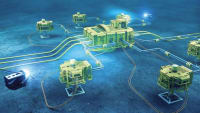
Aerospace & Defense Tech Briefs
Mobile Howitzer
Motion Design
The Fundamentals of Applying Electrohydraulic Valves
Aerospace & Defense Tech Briefs
Hydraulic Thermal Bypass Valve
Motion Design
Torque Limiters 101: Benefits, Types, and Comparisons
Motion Design
Encoder Selection: Finding the Right Fit
Medical Design Briefs
Summer 2022 Resource Guide


Aerospace & Defense Tech Briefs
Underwater Connectors


Aerospace & Defense Tech Briefs
Weapon System Spare Parts

Overview
The document outlines a patent application for an Armed Remotely Operated Vehicle (ROV) designed for underwater missions, particularly focusing on tasks such as swimmer detection and mine neutralization. The invention addresses the critical need for positive target identification, which has been a limitation in prior art devices that lacked the capability to transmit information to a control platform or provide visual confirmation of targets.
The ROV system includes a vehicle equipped with a propulsor and steering mechanisms, allowing for maneuverability in underwater environments. It is connected to a remote operating console via a tether that supports power, sensor, and control signal transmission. This tether can be an all-electrical or fiber optic cable, ensuring reliable communication and power supply to the vehicle.
Key features of the ROV include video and sonar sensors, which enable the operator to view the underwater environment and identify targets before taking action. An underwater gun is mounted on the vehicle, which can be fired in response to control signals from the console. The design also allows for the integration of a turret for aiming the gun, enhancing the vehicle's operational capabilities.
The document emphasizes the importance of remote operation, allowing the vehicle to be deployed from various platforms, including vessels, fixed installations, or shore locations. The ROV can be launched over the side of a vessel or configured for deployment from a conventional launch tube, resembling a torpedo or unmanned underwater vehicle.
The invention is positioned as a significant advancement in underwater vehicle technology, particularly for military applications. It aims to improve the effectiveness and safety of underwater operations by providing operators with the necessary tools to identify and engage targets accurately.
Additionally, the document states that the invention may be utilized by the U.S. Government for governmental purposes without the payment of royalties, indicating its potential strategic importance. Overall, this patent application represents a step forward in the development of advanced underwater systems that enhance operational capabilities while addressing the challenges of target identification in complex underwater environments.
Top Stories
INSIDERManufacturing & Prototyping
 How Airbus is Using w-DED to 3D Print Larger Titanium Airplane Parts
INSIDERManned Systems
 FAA to Replace Aging Network of Ground-Based Radars
NewsTransportation
 CES 2026: Bosch is Ready to Bring AI to Your (Likely ICE-powered) Vehicle
NewsSoftware
 Accelerating Down the Road to Autonomy
EditorialDesign
 DarkSky One Wants to Make the World a Darker Place
INSIDERMaterials
 Can This Self-Healing Composite Make Airplane and Spacecraft Components Last...
Webcasts
Defense
 How Sift's Unified Observability Platform Accelerates Drone Innovation
Automotive
 E/E Architecture Redefined: Building Smarter, Safer, and Scalable...
Power
 Hydrogen Engines Are Heating Up for Heavy Duty
Electronics & Computers
 Advantages of Smart Power Distribution Unit Design for Automotive...
Unmanned Systems
 Quiet, Please: NVH Improvement Opportunities in the Early Design...
