




Network-Enabled Resource Devices
NERDs can control robots, communications/GPS modules, and intruder-detection systems.
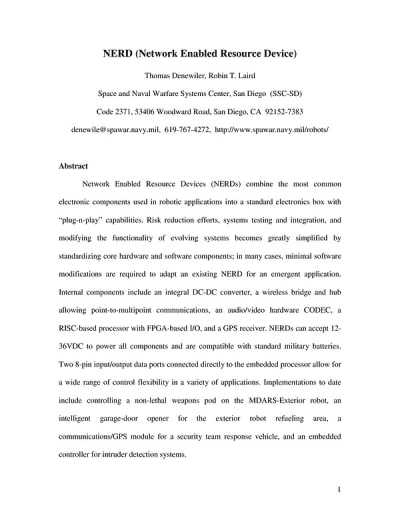
Network Enabled Resource Devices (NERDs) combine the most common electronic components used in robotic applications into a standard electronics box with "plug-n-play" capabilities. Risk reduction efforts, systems testing and integration, and modifying the functionality of evolving systems becomes greatly simplified by standardizing core hardware and software components; in many cases, minimal software modifications are required to adapt an existing NERD for an emergent application.
Internal components include an integral DC-DC converter, a wireless bridge and hub allowing point-to-multipoint communications, an audio/video hardware CODEC, a RISC-based processor with FPGA-based I/O, and a GPS receiver. NERDs can accept 12-36 VDC to power all components and are compatible with standard military batteries.
Two 8-pin input/output data ports connected directly to the embedded processor allow for a range of control flexibility in a variety of applications. Implementations to date include controlling a non-lethal weapons pod on a robot, an intelligent garage-door opener for the exterior robot refueling area, a communications/ GPS module for a security team response vehicle, and an embedded controller for intruder-detection systems.
Benefits of a standard design for an electronics box include:
- Standardized production units. To modify the functionality of a NERD only the firmware needs to be reprogrammed.
- Interchangeability/interoperability. NERDs are self-contained and support "plug-and-play" of payloads, subsystems, and platforms.
- Reduced testing costs. Systems used in risk reduction efforts for large, expensive robots can be tested on small, inexpensive robots using the same interfaces.
The NERDs have two DC-DC converters in them. Both can have 9-36 VDC inputs; one supplies 5 VDC output and the other supplies 12 VDC output. NERDs should be as small as possible; the size of the box is determined mainly by the size of the components that go in it, and to a lesser degree by ease of use and ability to troubleshoot the box. The current box used is 9 × 12 × 4.4".
The NERDs can be swapped out on an as-needed basis. Two NERDs having the same software programmed into them are interchangeable with minimal effort. The wireless bridges in the NERDs have the ability to act as point-to-multipoint repeaters. In this regard, the NERD performs a dual function: when deployed, it provides a robotics capability for the particular application, and it can increase the range of the WLAN by acting as a network repeater. The WLAN components support operation of the Multiple Resource Host Architecture (MRHA). This is very important as the MRHA has the ability to control a variety of the robotics platforms using protocols based on Ethernet UDP/IP and TCP/IP.
This work was done by Thomas Denewiler and Robin T. Laird of the Space and Naval Warfare Systems Center.
SNWSC-0001
This Brief includes a Technical Support Package (TSP).
Network-Enabled Resource Devices
(reference SNWSC-0001) is currently available for download from the TSP library.
Don't have an account?
More From SAE Media Group
Tech Briefs
A Reference Design for a RapidIO End Point
Aerospace & Defense Tech Briefs
How Will TSN Ethernet Impact the Future of Embedded Computing?
Tech Briefs
Processor Power and Energy Efficiency
Aerospace & Defense Tech Briefs
Secure Wireless Command Post
Tech Briefs
Vote for Tech Briefs Product of the Year 2021
Embedded Technology
Designing Software Radio Systems With FPGAs
Autonomous Vehicle Engineering
TCU Testing at the Heart of Vehicle Connectivity
Tech Briefs
Robust Serial Communications


Embedded Technology
Beamforming System Eases Crowded Wireless Spectrum
Tech Briefs
Essential Control and Visualization, Combined
Tech Briefs
Ultra-Wideband Angle-of-Arrival Tracking Systems
Embedded Technology
Understanding Virtex FPGAs
Aerospace INSIDER
TEWS Introduces First VITA 93 QMC Modules
Aerospace & Defense Tech Briefs
The Role of Prototype/Test Systems in Next-Generation C5ISR Development

Aerospace & Defense Tech Briefs
Using High-Performance Computing Clusters to Support Fine-Grained Parallel Applications
Embedded Technology
Small Form Factor Computing in OpenVPX
Battery Technology
Cloud-Connected, Battery-Based IoT Devices Last Years Longer

Embedded Technology
Wireless Embedded Computers for Harsh Environments
Tech Briefs
Simplified Motion Control
Tech Briefs
Product of The Month
Tech Briefs
Easing Industrial-Grade Ethernet Implementation

Tech Briefs
Desktop Computer System Processes Satellite Data
Aerospace & Defense Tech Briefs
Mil-Aero Design Embraces Intelligent Application-Ready ATCA Platforms
Overview
The document discusses the Network Enabled Resource Device (NERD), developed by Thomas Denewiler and Robin T. Laird at the Space and Naval Warfare Systems Center in San Diego. NERDs are designed to streamline robotic applications by integrating common electronic components into a standardized, modular electronics box that supports "plug-n-play" capabilities. This standardization simplifies risk reduction, system testing, and integration, allowing for easy modifications to adapt existing NERDs for new applications with minimal software changes.
Key internal components of a NERD include a DC-DC converter, a wireless communication bridge, an audio/video hardware CODEC, a RISC-based processor with FPGA-based I/O, and a GPS receiver. NERDs can operate on a power supply of 12-36VDC, making them compatible with standard military batteries. They feature two 8-pin input/output data ports connected to the embedded processor, providing flexibility for various control applications.
The document also outlines the SMART software architecture, which is built on concepts from the MRHA (Mobile Robot Hardware Architecture) and the Joint Architecture for Unmanned Ground Systems (JAUGS). This architecture is designed to be efficient, adaptable, and modular, allowing for the integration of functional agents—conceptual entities that perform specific operations such as driving, navigating, and communicating. These agents can operate concurrently on a single computer, forming a logical collection known as a domain.
Dynamic resource discovery is a significant feature of the SMART architecture, enabling systems to self-configure and form networks of cooperating agents without relying on a single coordinating entity. Each agent broadcasts its presence upon startup, allowing for a decentralized approach to system management.
The document highlights practical implementations of NERDs, including their use in controlling non-lethal weapons pods, intelligent garage-door openers, and communication modules for security vehicles. For instance, a NERD is employed to coordinate the actions of an Intruder Detection System (IDS) and a non-lethal weapons pod, ensuring that operators are informed before any response to a suspected intruder is made.
Overall, the document emphasizes the versatility and efficiency of NERDs in enhancing robotic systems and their applications in various military and security contexts.
Top Stories
INSIDERManufacturing & Prototyping
 How Airbus is Using w-DED to 3D Print Larger Titanium Airplane Parts
NewsAutomotive
 Microvision Aquires Luminar, Plans Relationship Restoration, Multi-industry Push
INSIDERAerospace
 A Next Generation Helmet System for Navy Pilots
INSIDERDesign
 New Raytheon and Lockheed Martin Agreements Expand Missile Defense Production
ArticlesAR/AI
 CES 2026: Bosch is Ready to Bring AI to Your (Likely ICE-powered) Vehicle
Road ReadyDesign

Webcasts
Semiconductors & ICs
 Advantages of Smart Power Distribution Unit Design for Automotive...
Unmanned Systems
 Quiet, Please: NVH Improvement Opportunities in the Early Design...
Electronics & Computers
 Cooling a New Generation of Aerospace and Defense Embedded...
Power
 Battery Abuse Testing: Pushing to Failure
AR/AI
 A FREE Two-Day Event Dedicated to Connected Mobility
