




Sustainability Shines in Asahi Kasei Electric Shuttle Concept
Asahi Kasei’s AKXY2 concept showcases the supplier’s innovations in materials and electronics.

Asahi Kasei’s latest concept vehicle is a rolling showcase of the supplier’s materials and electronics innovations, with a strong focus on sustainability. Dubbed the AKXY2, it is “a complete vehicle design – exterior and interior,” Michael Franchy, director of North American Mobility at Asahi Kasei America, told SAE Media in Detroit.
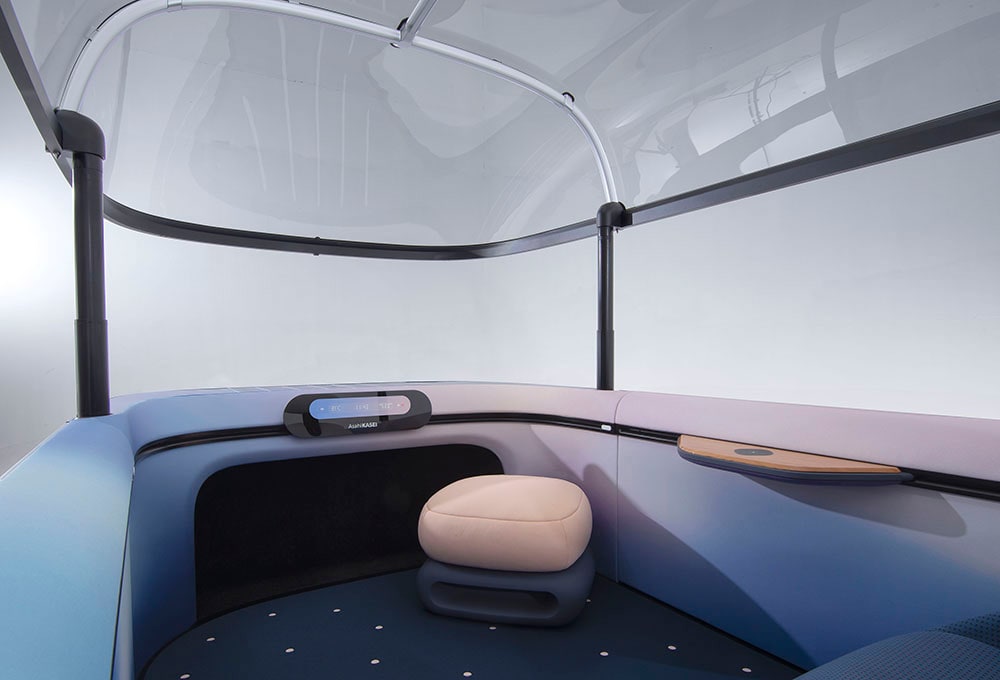
The AKXY2 showcases 18 technologies, including two collaborations with startup companies identified by Asahi Kasei’s corporate venture-capital arm. Fifteen of the Asahi Kasei technologies either are in production or production-ready. “Everything visible, touchable and interactable is made from Asahi Kasei original or collaborative technology,” Franchy said. The concept emphasizes three overlapping themes: sustainability, satisfaction and society.
The vehicle’s seats address aspects of both sustainability and satisfaction. The ‘summer’ seat uses the company’s trademarked Cubit, a 3D honeycomb material that allows for ventilation. This material reduces the amount of polyurethane foam used in a seat without sacrificing comfort. Cubit has front and back surfaces made of polyester fiber (recycled polyester thread, which can be recycled again) and a connecting filament made of PTT (polytrimethylene terephthalate) using 37% plant-derived propanediol.


AKXY2’s ‘winter’ seat uses a flexible electronic circuit from startup Loomia. “It’s a soft, electronic circuit that’s located underneath the seat fabric to provide nearly instantaneous heat to the seat,” Franchy said. The suede-resembling seat fabric (Dinamica Pure) is from Sage Automotive Interiors, an Asahi Kasei company. This microfiber is produced using partially recycled polyester through a water-based process.
Occupants have a sense of inclusion with the outdoors without direct exposure to rain, snow and other weather conditions. “The canopy is a transparent bubble above the body-in-white. And since it is made from polycarbonate that was coated with our water-based hard-coating technology, we were able to design it with a very high curvature that would be impossible with glass,” Franchy said. Asahi Kasei’s coating agent, which is in the final development stage, prevents the polycarbonate from acquiring scratches and UV light discoloration, enabling the canopy to retain clear transparency over time.
The water-based coating also eliminates emission of toxic VOCs (volatile organic compounds). And using polycarbonate in lieu of glass can reduce vehicle body weight, according to the company.
From a functional perspective, the canopy rises upward as the cabin’s access panel drops like a drawbridge for easy entry and exit. “The access panel becomes the vehicle’s interior wall, and this wall has the same fabric underneath as the removable floor mat,” Franchy explained. Operation of the canopy and access to and from the cabin is activated by an exterior touch-sensitive switch from startup UltraSense Systems.

AKXY2’s tires use S-SBR (solution-polymerized styrene-butadiene). The butadiene is derived from plastic waste and biomass. The S-SBR functions at the tire/road contact, providing low rolling resistance and high-performance on slippery roads. Asahi Kasei began producing sustainable S-SBR at its Singapore plant in late 2021.
The concept shuttle’s showcase of technologies is intended as a conversation point for what’s possible today and in the future.
“OEMs and consumers around the world are demanding environmentally friendly mobility and materials,” Franchy said. AKXY2 also depicts how people can travel from place to place in an interior much different from today’s light-duty passenger vehicles. “Cars are becoming a third living space and as autonomous vehicles evolve and become mainstream, they will become extensions of our home,” Franchy said.
More From SAE Media Group
Aerospace & Defense Tech Briefs
Industry Invited to Participate in AeroTech Aerospace and Defense Technical Program
Aerospace & Defense Tech Briefs
SAE International Extends Call for Abstracts, Seeks Submissions for AeroTech Conference
Off-Highway Engineering
ACT Expo 2025: Heavy-Duty EVs, H2 Trucks and Tariff Talk Dominate Day One
Automotive Engineering
WCX 2021: Digitizing That New-Car Smell
Autonomous Vehicle Engineering
Supplier Tech Gets the Germs Out
Autonomous Vehicle Engineering
Budget Airline Car Concept Is the Short-flight Alternative
Off-Highway Engineering
Why Agriculture Will Automate Before On-Highway
Off-Highway Engineering
CNH Introduces Battery-Electric, Autonomous-Ready Tractor
Automotive Engineering
Tata Steel Europe Innovates to Retain the Automotive Materials Lead
Automotive Engineering
A Novel Materials Approach to EV Battery-Box Design
Aerospace & Defense Tech Briefs
SAE International Issues, Revises Technical Reports for Aerospace Engineering
Automotive Engineering
EVs Expand the Testing Envelope
Off-Highway Engineering
Self-Driving Trucks Cut Fuel Consumption by 10%
Off-Highway Engineering
Addressing Electromagnetic Compatibility in the Context of Aircraft Electrification
Automotive Engineering
Continental Tire Rolls Towards a Smart and Connected Future
Automotive Engineering
Engineers Balance Today’s Programs with Tomorrow’s Mobility Future
Automotive Engineering
New SAE Wireless Charging Standard Is EV Game-Changer
Autonomous Vehicle Engineering
New Solutions for Sanitizing Autonomous Vehicles
Off-Highway Engineering
Detailing Kenworth’s Sleek SuperTruck 2
Aerospace & Defense Tech Briefs
SAE International Launches Aerospace Technology Symposium at Japan Aerospace 2018
Off-Highway Engineering
Emissions Reductions Continue to Disrupt CV Industry
Off-Highway Engineering
Paccar Reveals New and Future Tech at CES 2018
Off-Highway Engineering
Volkswagen ID.Buzz All-electric Vans Combine Iconic Styling With Modern Technology
Off-Highway Engineering
Volvo CE’s Road to the Future
Automotive Engineering
The Transformative Power of Large-Format Additive Manufacturing for Automotive
Automotive Engineering
Altair Honors Innovations in Automotive Lightweighting and Sustainability
Automotive Engineering
U.S. States Focus on Taiwan as Trade War Continues
Automotive Engineering
TDK Unveils Power-Generating Wheel Sensor
Automotive Engineering
The Role of Plastic Pallets in the Automotive Supply Chain
Off-Highway Engineering
TE Connectivity Powers down High-Power Systems
Top Stories
INSIDERManufacturing & Prototyping
 How Airbus is Using w-DED to 3D Print Larger Titanium Airplane Parts
INSIDERManned Systems
 FAA to Replace Aging Network of Ground-Based Radars
NewsTransportation
 CES 2026: Bosch is Ready to Bring AI to Your (Likely ICE-powered) Vehicle
NewsSoftware
 Accelerating Down the Road to Autonomy
EditorialDesign
 DarkSky One Wants to Make the World a Darker Place
INSIDERMaterials
 Can This Self-Healing Composite Make Airplane and Spacecraft Components Last...
Webcasts
Defense
 How Sift's Unified Observability Platform Accelerates Drone Innovation
Automotive
 E/E Architecture Redefined: Building Smarter, Safer, and Scalable...
Power
 Hydrogen Engines Are Heating Up for Heavy Duty
Electronics & Computers
 Advantages of Smart Power Distribution Unit Design for Automotive...
Unmanned Systems
 Quiet, Please: NVH Improvement Opportunities in the Early Design...
