




Variable-Data-Rate Speech Encoder
This encoder could supplant older encoders that operate at diverse fixed rates.
Avariable-data-rate (VDR) speech encoder has been designed to be interoperable with, and eventually to supplant, the many different voice encoders now used in military communication systems. Because these older systems were designed to utilize specific radio links with fixed and limited channel capacities, these systems utilize many different voice compression algorithms operating at various fixed rates. The incompatibility of these systems is an obstacle to interoperability. Emerging net-centric communication systems promise to provide connectivity to all military users, but compatible encoding will be necessary for interoperability, and encryption will be necessary for secure communications.
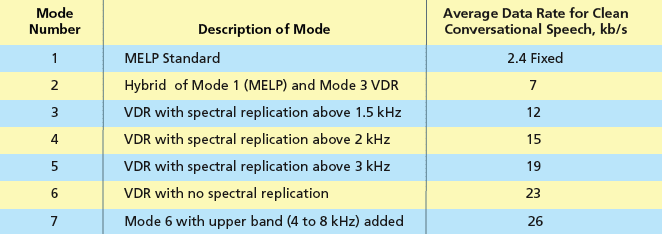
The heart of the VDR voice encoder is a multirate voice processor in which a single voice algorithm generates multiple data streams at rates from 2.4 kb/s to an average rate of about 23 kb/s for input speech at frequencies from 0 to 4 kHz. The algorithm provides for seven different operating modes (see table). Inclusion of a few more kb/s of data from the 4-to-8-kHz audio frequency band makes it possible to encode wide-band speech comparable in quality to that of standard frequency-modulation (FM) broadcasting.
The VDR bit stream has an embedded structure in which higher-rate voice data frames contain successively lower-rate voice data frames as subsets. Deletion of a certain portion of the superset (higherrate frames typically representing higher audio frequencies) makes it possible to reduce the data rate, even in the presence of encryption. Because of this embedded data structure, any of the VDR data rates are interoperable and can be switched, as often as 44 times per second, even when speech is present. Because the speech waveforms of all the VDR rates are synchronous, switching of data rates does not introduce such undesirable sounds such as clicks or warbles.
It must be emphasized that the multirate voice processor in the VDR voice encoder is a single processor running a single algorithm, in contradistinction to both (1) a collection of separate processors operating at different rates and (2) a processor running a multitude of speechcompression algorithms. Prior voice encoders that use multiple compression algorithms do not perform well when algorithms are switched while speech is present. Speech waveforms sometimes become cropped upon switching because different voice algorithms can have different internal delays. Such cropping degrades speech quality and is annoying to listeners.
The VDR speech encoder exploits the variable nature of the speech waveform, utilizing higher or lower data rates as needed (e.g., higher rates for vowels, lower rates for consonants). Unlike some prior speech processors, the speech processor in the VDR speech encoder processor does not eliminate gaps in speech for the sake of efficiency. Elimination of speech gaps that contain ambient sounds could be harmful in military communications because speech gaps often contain sounds that help listeners gauge battlefield conditions at transmitter sites. In the VDR speech encoder, speech gaps are encoded at appropriately low data rates that still provide audible information.
This work was done by Thomas M. Moran, David A. Heide, Yvette and T. Lee of the Naval Research Laboratory and George S. Kang of ITT Industries.
This Brief includes a Technical Support Package (TSP).
Variable-Data-Rate Speech Encoder
(reference NRL-0019) is currently available for download from the TSP library.
Don't have an account?
More From SAE Media Group
Tech Briefs
Downlink Data Multiplexer
Tech Briefs
Loss-Tolerant Speech Codec

Aerospace & Defense Tech Briefs
Advanced Satellite Communications Research
Embedded Technology
Designing Software Radio Systems With FPGAs

Tech Briefs
New Wireless System for Greater 5G Access
Battery Technology
Cloud-Connected, Battery-Based IoT Devices Last Years Longer
Tech Briefs
Wireless Transceiver Quadruples Speed of 5G
Aerospace & Defense Tech Briefs
Software-Defined Analog Filters: A Paradigm Shift in Radio Filter Performance and Capability

Autonomous Vehicle Engineering
TCU Testing at the Heart of Vehicle Connectivity
Sensor Technology
What Will 5G Do for the IoT/IIoT?
Aerospace & Defense Tech Briefs
Software-Defined Radios for Urban and Indoor Navigation
Aerospace & Defense Tech Briefs
Automated Data Acquisition for a Prognostics and Diagnostics Health Monitoring System
Sensor Technology
Always-On Intelligent Sensing at Microwatt Levels
Aerospace & Defense Tech Briefs
Secure Wireless Command Post
Tech Briefs
Wireless, Wearable Transmitter
Aerospace & Defense Tech Briefs
To 6G and Beyond: Penn Engineers Unlock the Next Generation of Wireless Communications
Off-Highway Engineering
Data Connectivity in Heavy-Duty Vehicle Environments
Aerospace & Defense Tech Briefs
Using High-Performance Computing Clusters to Support Fine-Grained Parallel Applications
Aerospace & Defense Tech Briefs
Time Coding of Asynchronously Transmitted Multi-Source Data
Tech Briefs
Architecture of an Autonomous Radio Receiver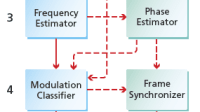
Overview
The document titled "Variable Data Rate Voice Encoder for Narrowband and Wideband Speech" discusses the development and significance of a Variable Data Rate (VDR) voice encoder designed for secure voice communication within the Department of Defense (DoD). The primary objective of the VDR encoder is to enhance interoperability among various secure voice terminals used by the DoD, allowing for efficient communication across different platforms and environments.
The introduction highlights the necessity of a VDR voice processor, emphasizing that it can replace multiple incompatible voice encoders currently in use, thereby streamlining communication for military personnel. The report outlines the challenges faced in tactical communication environments, which often require varying data rates ranging from as low as 2.4 kbps to as high as 64 kbps, depending on the operational context. For instance, noisy environments, such as those encountered in aircraft or naval vessels, necessitate robust encoding methods to ensure clarity and reliability in voice transmission.
The document details the architecture of the VDR encoder, which integrates different encoding techniques to optimize voice quality and data rate based on real-time network conditions. A notable feature is the use of a superposition method in difficult modes, where low-frequency audio is encoded separately from higher frequencies, improving noise tolerance and overall sound quality.
Additionally, the report discusses the future vision for the VDR technology, including the development of the Universal Voice Terminal (UVT) and the Personal Secure Terminal (PST). The UVT aims to unify various secure voice terminals into a single interoperable system, while the PST is envisioned as a compact device for individual soldiers, enhancing their communication capabilities on the battlefield.
The document concludes by underscoring the importance of secure and efficient voice communication for military operations, particularly in critical situations where timely contact with command centers is essential. The VDR encoder represents a significant advancement in achieving these communication goals, ensuring that military personnel can maintain connectivity and operational effectiveness in diverse and challenging environments.
Overall, the report provides a comprehensive overview of the VDR voice encoder's design, functionality, and potential impact on military communication systems, highlighting its role in enhancing the safety and effectiveness of DoD operations.
Top Stories
NewsRF & Microwave Electronics
 Microvision Aquires Luminar, Plans Relationship Restoration, Multi-industry Push
INSIDERAerospace
 A Next Generation Helmet System for Navy Pilots
INSIDERDesign
 New Raytheon and Lockheed Martin Agreements Expand Missile Defense Production
INSIDERMaterials
 How Airbus is Using w-DED to 3D Print Larger Titanium Airplane Parts
NewsPower
 Ford Announces 48-Volt Architecture for Future Electric Truck
ArticlesAR/AI

Webcasts
Electronics & Computers
 Cooling a New Generation of Aerospace and Defense Embedded...
Automotive
 Battery Abuse Testing: Pushing to Failure
Power
 A FREE Two-Day Event Dedicated to Connected Mobility
Unmanned Systems
 Quiet, Please: NVH Improvement Opportunities in the Early Design Cycle
Automotive
 Advantages of Smart Power Distribution Unit Design for Automotive &...
Energy
 Sesame Solar's Nanogrid Tech Promises Major Gains in Drone Endurance