




Automated Data Acquisition for a Prognostics and Diagnostics Health Monitoring System
The system monitors key data test points in a variety of electronic systems.
A highly flexible automated prognostics and diagnostics sensor module (PDSM) prototype is presently under development to be incorporated for data acquisition in a Prognostics and Diagnostics Health Monitoring System (PDHMS). PDHMS acquires, stores, and communicates data gathered from sensors that monitor essential platform components to determine its current diagnostic status. This diagnostic data is used to make reliable prognostications of remaining operational life expectancy based on a platform usage profile.
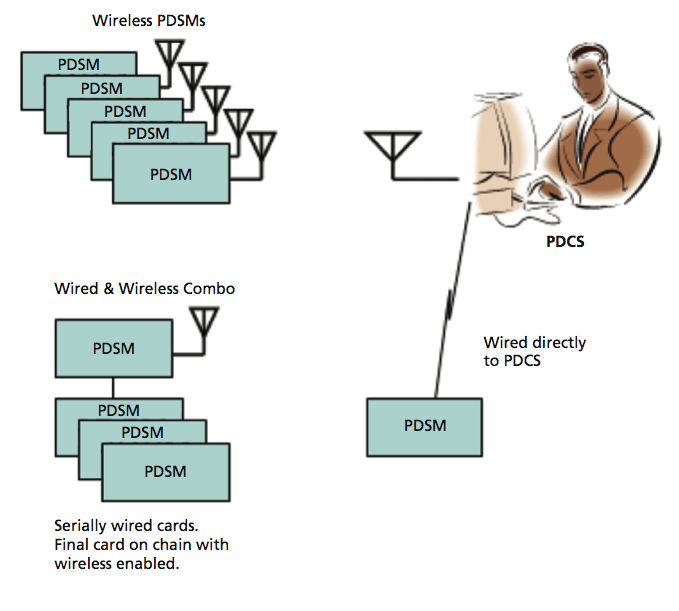
Currently, the prototype PDSM is being developed to monitor fuse temperatures, component surface temperatures, component voltage and current levels, and system vibration and shock behavior. The temperature, current, and voltage sensors will continuously monitor the fuses and surrounding circuitry to collect data on system behavior leading up to the provoked electronic fault. This data will be used to develop monitoring techniques and algorithms to detect and prevent possible fuse failure in other military systems.
The PDHMS is composed of one or more PDSMs designed to independently take measurements on test points of interest and the Prognostics and Diagnostics Control Station (PDCS) (see figure). The PDSM is programmed through the use of the standard JTAG interface, and can be programmed to have its wireless IEEE 802.15.4 hardware enabled or disabled depending on the application.
The PDSM stores data acquired from the test points until it can be transferred to the PDCS. A PDCS running the wireless protocol can remotely request and retrieve all acquired data from the PDSM, and perform a more extensive data analysis. A flexible design means any number of PDSMs can be incorporated into a PDHMS to monitor a system of interest. They can communicate with the PDCS either via wireless communications, or through the I2C hardwired serial interface. The PDSM is fabricated on a custom printed circuit board (PCB) using commercial off-the-shelf components. The heart of the design is the use of the Texas Instruments low-power MSP430 MCU and the CC2420 ZIGBEE low-power transceiver. The PCB dimensions are 2 × 4". The MSP430 can operate from either a 6-MHz clock or a slower 32-KHz clock. Because measurements will be made from multiple sensors, and the aggregate data rates are anticipated to be higher than can be supported by the 32-KHz clock, the 6-MHz clock will be required.
This work was done by Gregory Mitchell, Marvin Conn, Russell Harris, and Andrew Bayba of the Army Research Laboratory. ARL-0060
This Brief includes a Technical Support Package (TSP).
Automated Data Acquisition for a Prognostics and Diagnostics Health Monitoring System
(reference ARL-0060) is currently available for download from the TSP library.
Don't have an account?
More From SAE Media Group
Battery Technology
Cloud-Connected, Battery-Based IoT Devices Last Years Longer
Tech Briefs
Vote for Tech Briefs Product of the Year 2021
Tech Briefs
Distributed Diagnostics and Prognostics
Tech Briefs
Printable IoT Sensor Development Platform
Off-Highway Engineering
Big Data and Next-Gen Prognostics for Heavy-Duty Vehicles


Tech Briefs
Robust Serial Communications
Off-Highway Engineering
Data Connectivity in Heavy-Duty Vehicle Environments
Tech Briefs
Automated Cable-Analyzer System – ACAS

Sensor Technology
Sensors Expo Preview 2019


Tech Briefs
Flexible Silicon-on-Polymer Chip
Tech Briefs
Hyper-Distributed RFID Antenna (HYDRA) System

Tech Briefs
Desktop Computer System Processes Satellite Data
Tech Briefs
New on the Market
Tech Briefs
Wireless, Wearable Transmitter
Aerospace & Defense Tech Briefs
Miniature Data Recorder
Photonics & Imaging Technology
Using CoaXPress-over-Fiber for High-Speed Machine Vision
Aerospace & Defense Tech Briefs
Microelectromechanical System (MEMS) Switch Test
Tech Briefs
“Smart” Sensor Module
Tech Briefs
Essential Control and Visualization, Combined
Overview
The document titled "Automated Data Acquisition for a Prognostics and Diagnostics Health Monitoring System" (ARL-TR-4523) was authored by Gregory Mitchell, Marvin Conn, Russell Harris, and Andrew Bayba and published by the U.S. Army Research Laboratory in July 2008. It addresses the critical need for continuous health monitoring in military systems, focusing on Prognostics and Diagnostics (PD) applications at both mechanical and electronic levels.
The report highlights the military's mandate for a flexible design in health monitoring systems that can be easily adapted for various applications across different military platforms. This flexibility is essential due to the diverse nature of military systems, which require tailored solutions for effective monitoring and maintenance.
A core component of the PD process is data acquisition, which involves collecting valuable information from monitored systems and transmitting it to processing modules for the execution of PD algorithms. The document discusses the design architecture of a PD Sensor Module (PDSM) that serves as a prototype for a Prognostics and Diagnostics Health Monitoring System (PDHMS). This system is intended for use in electronics PD, enabling the identification and analysis of potential faults in military equipment.
The report also details the implementation of the PDSM prototype in provoked electronic fault testing (PEFT) on a specific military platform. This testing is crucial for validating the effectiveness of the PDHMS in real-world scenarios, ensuring that the system can accurately detect and diagnose faults as they occur.
In summary, the document emphasizes the importance of automated data acquisition in enhancing the reliability and efficiency of health monitoring systems within military applications. By providing a robust framework for continuous monitoring and diagnostics, the proposed PDSM aims to improve the operational readiness and longevity of military equipment, ultimately contributing to mission success. The findings and methodologies presented in this report are intended to support the development of advanced health monitoring solutions that can adapt to the evolving needs of military operations. The report is approved for public release, indicating its relevance and potential application beyond military contexts.
Top Stories
INSIDERManufacturing & Prototyping
 How Airbus is Using w-DED to 3D Print Larger Titanium Airplane Parts
INSIDERManned Systems
 FAA to Replace Aging Network of Ground-Based Radars
NewsTransportation
 CES 2026: Bosch is Ready to Bring AI to Your (Likely ICE-powered) Vehicle
NewsSoftware
 Accelerating Down the Road to Autonomy
EditorialDesign
 DarkSky One Wants to Make the World a Darker Place
INSIDERMaterials
 Can This Self-Healing Composite Make Airplane and Spacecraft Components Last...
Webcasts
Defense
 How Sift's Unified Observability Platform Accelerates Drone Innovation
Automotive
 E/E Architecture Redefined: Building Smarter, Safer, and Scalable...
Power
 Hydrogen Engines Are Heating Up for Heavy Duty
Electronics & Computers
 Advantages of Smart Power Distribution Unit Design for Automotive...
Unmanned Systems
 Quiet, Please: NVH Improvement Opportunities in the Early Design...
