




Software-Defined Radios for Urban and Indoor Navigation
A network provides both positioning and communication services.
Software-defined radios (SDRs) are being developed to provide positioning and communication (POSCOMM) services inside buildings and tunnels, under tree canopies, and in other environments in which local radio- communication systems are accessible but Global Positioning System (GPS) signals are not present or are degraded. These SDRs could be especially helpful for teams of first responders (e.g., firefighters), and military personnel operating in urban settings. These SDRs are capable of navigating by use of GPS signals and can switch over to time-of-arrival (TOA) pseudolite navigation when GPS signals become unavailable, provided that signals from suitably placed TOA pseudolite transmitter nodes are available.
The POSCOMM SDR system is based on relatively inexpensive commercial-off-the-shelf (COTS) hardware and software. At the present state of development, each POSCOMM SDR is a test-bed unit that includes both a GPS receiver and a transceiver that operates in a frequency band near 900 MHz. The hardware aspect of the design of the unit features a modular PC/104 configuration to facilitate rapid construction of prototypes and testing of SDR software to support advanced positioning and communication functions. [PC/104 is an industry standard for compact, stackable modules that are fully compatible (in architecture, hardware, and software) with personal-computer data- and power-bus circuitry.] The software is portable and designed for use in real-time flavors of Windows and Linux operating systems.
Signal processing is performed by a field-programmable gate array (FPGA) card and a Pentium-class central processing unit. Received GPS and/or TOA radio signals are converted to digital signals by use of digital antenna elements (DAEs), which are compact and can be easily modified to operate at alternative signal frequencies and sampling rates. Each DAE is responsible for radio-frequency down-conversion and up-conversion as well as high-speed analog-to-digital and digital-to-analog conversion. Each DAE uses a common sample clock and phase-locked reference local oscillator, thereby maintaining a coherent sampling environment for all transmitted and received signals.
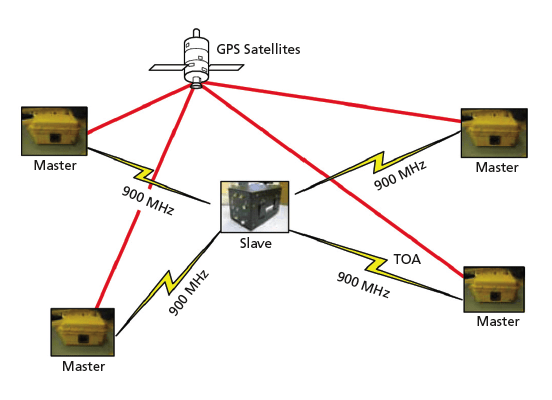
In a test of an early prototype POSCOMM SDR system, four master units were set up around a building, and slave units were operated at various inside and outside positions. Distances between slave positions as determined by TOA and those determined by GPS were found to be no more than about 5 m in most cases.
This work was done by Alison K. Brown, Yan Lu, and Janet Nordlie of NAVSYS Corp.
NAVSYS-0001
This Brief includes a Technical Support Package (TSP).
Software-Defined Radios for Urban and Indoor Navigation
(reference NAVSYS-0001) is currently available for download from the TSP library.
Don't have an account?
More From SAE Media Group
Tech Briefs
Wireless Transceiver Quadruples Speed of 5G
Tech Briefs
Connect Global Positioning System RF Module
Aerospace & Defense Tech Briefs
Software-Defined Analog Filters: A Paradigm Shift in Radio Filter Performance and Capability
Aerospace & Defense Tech Briefs
To 6G and Beyond: Penn Engineers Unlock the Next Generation of Wireless Communications


Sensor Technology
RF Wireless Power Unleashes the Ubiquity of Sensor Networks
Tech Briefs
Wireless, Wearable Transmitter


Tech Briefs
New Wireless System for Greater 5G Access
Tech Briefs
Wideband Agile Digital Microwave Radiometer
Aerospace & Defense Tech Briefs
Development of a 94 GHz Radar System for Dedicated Bird Detection at Airports and Airfields
Tech Briefs
Ultra-Wideband Angle-of-Arrival Tracking Systems
Autonomous Vehicle Engineering
TCU Testing at the Heart of Vehicle Connectivity
Tech Briefs
Hyper-Distributed RFID Antenna (HYDRA) System
Tech Briefs
Miniature EVA Software Defined Radio
Electronics & Sensors INSIDER
New Transmitter Could Make Wireless Devices More Energy-Efficient

Tech Briefs
Customizable Digital Receivers for Radar
Embedded Technology
Designing Software Radio Systems With FPGAs
Tech Briefs
Conformal, Lightweight, Aerogel-Based Antenna
Tech Briefs
Processor Power and Energy Efficiency

Embedded Technology
Software Radio PMC Modules
Embedded Technology
Understanding Virtex FPGAs
Overview
The document presents the design and test results of a Software Defined Radio (SDR) developed by NAVSYS Corporation for indoor navigation. This innovative SDR test-bed integrates Global Positioning System (GPS) capabilities with wireless communications and Time-of-Arrival (TOA) technology, enabling accurate location tracking in environments where GPS signals are weak or unavailable, such as inside buildings, tunnels, or areas with heavy RF interference.
The SDR architecture is flexible, allowing the same hardware to be reconfigured for different functions. It operates as both a GPS receiver and a 900 MHz transceiver within the Industrial, Scientific, and Medical (ISM) band. This dual functionality enables the device to leverage both GPS-derived pseudorange and carrier phase observations, as well as TOA observations from communication channels. The system is designed to operate in a networked architecture, where "Master" units transmit TOA messages to "Slave" units, allowing for precise positioning even in GPS-denied environments.
The document highlights the system's capability to augment GPS signal tracking with TOA aiding, providing a GPS-like quality of service both outdoors and indoors. The SDR's design incorporates a frequency-flexible transceiver, making it adaptable for future enhancements, such as inertial integration and mesh networking capabilities. This adaptability is crucial for leveraging advancements in computing technologies, which can further reduce the size, weight, and power consumption of the device.
The applications of this technology are significant, particularly for military operations in urban terrain and for first responders like firefighters and police officers. The document mentions a partnership with Rex Systems Incorporated to develop a First Responder System that will equip emergency personnel with electronic vests and eyepieces, providing real-time location data, vital signs, and video feeds to their commanders.
In conclusion, the SDR developed by NAVSYS represents a significant advancement in indoor navigation technology, offering robust solutions for challenging environments. Its integration of GPS and TOA technologies, along with its flexible architecture, positions it as a valuable tool for various applications, enhancing operational efficiency and safety for first responders and military personnel alike.
Top Stories
NewsSensors/Data Acquisition
 Microvision Aquires Luminar, Plans Relationship Restoration, Multi-industry Push
INSIDERRF & Microwave Electronics
 A Next Generation Helmet System for Navy Pilots
INSIDERWeapons Systems
 New Raytheon and Lockheed Martin Agreements Expand Missile Defense Production
NewsAutomotive
 Ford Announces 48-Volt Architecture for Future Electric Truck
INSIDERAerospace
 Active Strake System Cuts Cruise Drag, Boosts Flight Efficiency
ArticlesTransportation

Webcasts
Aerospace
 Cooling a New Generation of Aerospace and Defense Embedded...
Energy
 Battery Abuse Testing: Pushing to Failure
Power
 A FREE Two-Day Event Dedicated to Connected Mobility
Automotive
 Quiet, Please: NVH Improvement Opportunities in the Early Design Cycle
Electronics & Computers
 Advantages of Smart Power Distribution Unit Design for Automotive &...
Unmanned Systems
 Sesame Solar's Nanogrid Tech Promises Major Gains in Drone Endurance