




Air Force Propulsion Team Continues Flow Visualization Study
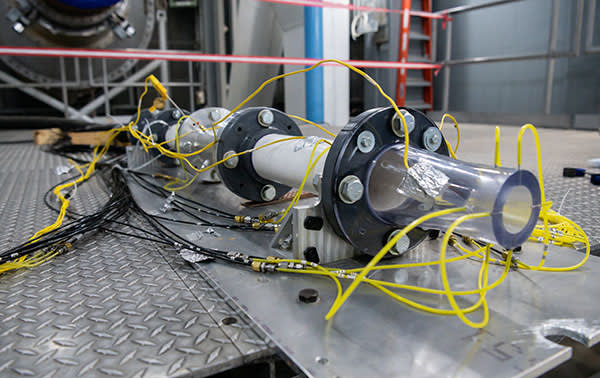
Team members with the 717th Test Squadron, 804th Test Group, Arnold Engineering Development Complex at Arnold Air Force Base are continuing to collect shadowgraph measurements of high sound pressure level nozzle acoustic events to validate computational fluid dynamics (CFD) prediction methods.
To assist with this effort, the team received funding through the AEDC Spark Tank, an event that invited AEDC personnel to submit their innovative ideas that would positively impact the mission of the complex.
Capt. Brian Gatzke, a test engineer, and Steve Arnold, technical adviser for the 717 TS, are heading up the project for the flow visualization and CFD within one of the AEDC engine test facilities at Arnold. Gatzke explained why the studies are important to future engine tests.
“Future configurations may be more complex, so we are trying to determine the possible test cell interactions,” he said. “This non-proprietary data is needed from the exhaust plumes in order to validate the CFD for robust test installations.”
To do this, various nozzles are 3D printed and installed in the test cell. Air is then blown through the nozzles and shadowgraph measurements are collected.
“The data collected from this testing enables us to clearly identify the nozzle acoustics of different nozzle geometries and we utilize the shadowgraph measurements to validate the CFD computational acoustic field,” Arnold said. “This better prepares us when customers with the same or similar engine nozzles come to test with AEDC because we know what we’re looking at and what we need to do to resolve any acoustic disturbances that might be created from the particular nozzle.”
Much of the equipment needed to conduct the nozzle testing was previously installed at the University of Tennessee Space Institute as part of a Small Business Technology Transfer, or STTR, and the air supply hardware was already available in the engine test cell.
“This STTR project was really a part of a combined effort of our AEDC organizations,” Arnold said. “The Test Operations and Sustainment contractor team conducted the testing during an 8-hour test day, and members with Technical Management Advisory Services [contract]-obtained CFD predictions. From there the DOD test analysts compared shadowgraph measurements to CFD predictions using UTSI’s optical support software.”
More From SAE Media Group
Aerospace INSIDER
Engineers Assess Flow Quality in Wind Tunnel Test Facility
Aerospace INSIDER
Air Force Wind Tunnel Team Takes 3D Printing Program to Next Dimension
Aerospace & Defense Tech Briefs
Scientists Fuse Simulations and Machine Learning to Accelerate Novel Additively Manufactured Materials

Medical Design Briefs
Summer 2021 Resource Guide

Defense INSIDER
Air Force Is Developing Mach 18 Wind Tunnel
Aerospace & Defense Tech Briefs
Next Generation Carbon Fiber Composites 3D Printer for Hypersonic Research
Tech Briefs
Executive Roundtable: 3D Printing
Aerospace INSIDER
Breakthroughs in Testing Solid-Fuel Ramjets Advance Research
Aerospace Manufacturing and Machining INSIDER
RAMFIRE Project Develops, Tests 3D-Printed Aluminum Rocket Engine Nozzle
Tech Briefs
Metal 3D Printing for Complex Heat Exchangers

NASA Spinoff
Software Toolkit Steadies Rockets
Aerospace & Defense Tech Briefs
Additive Manufacturing
Medical Design Briefs
Winter 2021 Resource Guide

Tech Briefs
AI and AM: A Powerful Synergy
Motion Control Technology
Computational Fluid Dynamics Aids Aerospace Apps
Aerospace INSIDER
Research Could Lead to Noise Reduction in Aircraft Engines
Aerospace & Defense Tech Briefs
Using Advanced Computational Engineering Software to Meet Aerospace & Defense Industry Challenges
Aerospace & Defense Tech Briefs
Industry Invited to Participate in AeroTech Aerospace and Defense Technical Program
Medical Design Briefs
Winter 2022 Resource Guide
Medical Design Briefs
Summer 2022 Resource Guide
Tech Briefs
Calibration System for Automated Fiber Placement
Aerospace INSIDER
Active Strake System Cuts Cruise Drag, Boosts Flight Efficiency
Tech Briefs
Robust, Optimal Subsonic Airfoil Shapes
Tech Briefs
3D-Printed AUV Aims to Thwart Climate Change
Top Stories
INSIDERDefense
 New Raytheon and Lockheed Martin Agreements Expand Missile Defense Production
NewsAutomotive
 Ford Announces 48-Volt Architecture for Future Electric Truck
INSIDERManufacturing & Prototyping
 Active Strake System Cuts Cruise Drag, Boosts Flight Efficiency
ArticlesTransportation
 Accelerating Down the Road to Autonomy
INSIDERMaterials
 How Airbus is Using w-DED to 3D Print Larger Titanium Airplane Parts
Road ReadyTransportation

Webcasts
Electronics & Computers
 Cooling a New Generation of Aerospace and Defense Embedded...
Power
 Battery Abuse Testing: Pushing to Failure
Connectivity
 A FREE Two-Day Event Dedicated to Connected Mobility
Automotive
 Quiet, Please: NVH Improvement Opportunities in the Early Design Cycle
Transportation
 Advantages of Smart Power Distribution Unit Design for Automotive &...
Aerospace
 Sesame Solar's Nanogrid Tech Promises Major Gains in Drone Endurance