




Multiscale Virtual Design and Testing of Materials
Larger-scale phenomena are computed from smaller-scale phenomena and first principles.
Progress has been made in research on several fronts in an effort to develop computational simulation capabilities for use in virtual design and testing of advanced structural materials. It is envisioned that the capabilities will be embodied in a coherent set of methods, software to implement the methods, and advances in the fundamental understanding of many issues in the thermo-mechanical performance of materials. It is further envisioned that the methods and software will be organized into a hierarchy (see figure) corresponding to a hierarchy of spatial scales from electronic through atomic, mesoscale, micro-structural, and continuum to macrostructural, and that there will be seamless coupling of information from each scale to the next larger scale. A secondary objective of this research and development effort is to provide direct simulation output at each level of the hierarchy for investigating specific phenomena at the corresponding spatial scale. For the purposes of demonstrating the capabilities and providing specific focus for the overall research, it is intended to predict nano-, micro-, and macroscopic degradation of aluminum and titanium alloys under fatigue loading and in a corrosive (oxidative) environment and as a function of temperature.
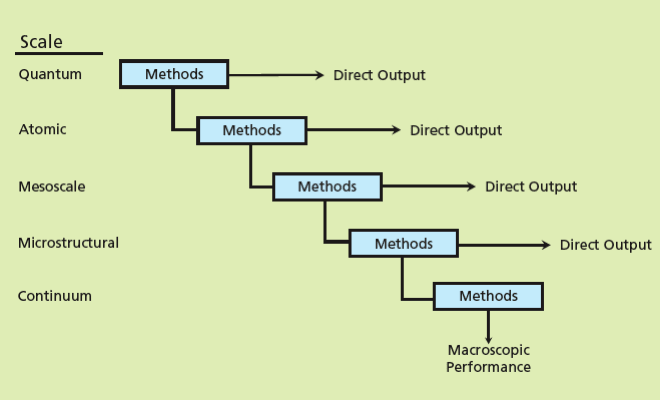
The innovations produced in this effort include the following:
- The first discrete-dislocation model for predicting fatigue-crack-growth behavior with no a priori assumptions about fatigue. The approach taken in developing this model was to directly address the mechanics and other aspects of the applicable physics of plastic deformation at the individual-dislocation level.
- The first method for combining continuum and atomistic descriptions of defects within one conceptual framework. The framework is a model that combines power of the aforementioned discrete-dislocation model with the atomistic resolution of molecular dynamics.
- The first model to couple quantum-mechanical and atomistic submodels for metals. In this model, either standard density-functional theory (DFT) or orbital-free density-functional theory (OF-DFT) is used to embed quantum- mechanical calculations within an atomistic computational submodel that employs semi-empirical atomistic potentials.
- Extension of a static, zero-temperature quasi-continuum model to nonzero finite temperature. The extension was made by considering a formal "coarse graining" of the microscopic partition function of a classical material at finite temperature, then generating an approximate effective coarse-grained potential by making a self-consistent quasi- harmonic approximation for the atoms that were eliminated through the coarse graining process.
- The first quantum/continuum coupling method. This method provides for utilization of first-principles OFDFT calculations in a "local" quasi-continuum model. The energy of strained unit cells of a material is used to compute the deformation of the material in continuum domains that are treated by use of finite elements.
- The first quantum-mechanical determination of decohesion with and without embrittlement by impurities. DFT was used to predict the fundamental cohesive behaviors of metals with and without hydrogen and oxygen atoms as impurities along separating surfaces. The appropriate thermodynamic potential (the so-called grand force potential) was developed for converting the results of computations of decohesion at fixed impurity concentration to those of decohesion at fixed chemical potential. It was shown that the cohesive strength of aluminum drops precipitously, from about 12 GPa to 4 GPa in hydrogen and to between 1 and 2 GPa in oxygen when the chemical potential exceeds a critical value.
- A continuum model of cracking by chemical embrittlement. The results of the above mentioned research on decohesion were used to develop a continuum model for simulation of stress corrosion cracking in steels. An integral part of this development was the renormalization of the decohesion as modelled by first principles, occurring at a length scales of the order of an Angstrom, into an effective cohesion law at a length scale suitable for efficient continuum modeling. The model also includes the stress-dependent diffusion of chemical species (e.g. hydrogen) through the material in the presence of the non-uniform crack-tip field. The model predicts a number of features of crack growth that are observed in experiments.
- The first basic discrete/continuum model for non-steady flow of diffusing chemical species. This is a multiscale diffusion model in which one region of material is treated by use of the full discreteness of the diffusing entities while another, much larger region is treated by use of the continuum diffusion equation. By making the discrete-submodel region small, considerable time is saved in computations, making it possible to perform much longer simulations with no loss in accuracy.
This work was done by W.A. Curtin and A. Needleman of Brown University; M. Ortiz and R. Phillips of California Institute of Technology; E. Kaxiras of Harvard University; G. Cedar of Massachusetts Institute of Technology; E. Carter of the University of California, Los Angeles; R. Miller of Carleton University; C. Woodward of Northwestern University; and D. Farkas of Virginia Polytechnic Institute and State University for the Air Force Research Laboratory. For more information, download the Technical Support Package (free white paper) at www.defensetechbriefs.com/tsp under the Information Sciences category. AFRL-0037
This Brief includes a Technical Support Package (TSP).
Multiscale Virtual Design and Testing of Materials
(reference AFRL-0037) is currently available for download from the TSP library.
Don't have an account?
More From SAE Media Group
Automotive Engineering
Hydrogen Storage Tank Options: Not Everything Need Look like a Sausage
Aerospace & Defense Tech Briefs
Zwick Roell Provides Flexible Materials Testing over a Wide Temperature Range
Aerospace & Defense Tech Briefs
Testing Military-Grade Adhesive in Extreme Loading Conditions
Tech Briefs
Fine-Tuning Alloys for High-Temperature Use
Aerospace & Defense Tech Briefs
‘First of Its Kind’ Composite Material to Help Space Vessels Travel Longer Distances
Off-Highway Engineering
Constructing Lightweight Bus Structures with Stainless Steel


Automotive Engineering
A Cool New Dimension to Automotive Plastics’ Testing
Tech Briefs
Virtual Test Laboratory
Off-Highway Engineering
Moving Metal AM Forward
Aerospace & Defense Tech Briefs
SAE International Extends Call for Abstracts, Seeks Submissions for AeroTech Conference
Aerospace & Defense Tech Briefs
Reduced Order Modeling for Rapid Simulation of Blast Events of a Military Ground Vehicle and its Occupants
Green Design & Manufacturing
Development of a Centrifugal Hydrogen Pipeline Gas Compressor
Electronics & Sensors INSIDER
New Atom-Based Thermometer Measures Temperature More Accurately

Aerospace Manufacturing and Machining
Scaling Low-Cost Carbon Fiber Production with Oxidation Technology
NASA Spinoff
Software Toolkit Steadies Rockets
Aerospace & Defense Tech Briefs
Thermal Simulation and Testing of Expanded Metal Foils for Lightning Protection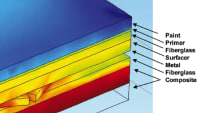
Aerospace & Defense Tech Briefs
Peridynamic Modeling: An Alternative Approach to Analyzing Material Failure


Aerospace & Defense Tech Briefs
Designing for Space and Other Extreme Environments
Tech Briefs
Nanoprecipitates Toughen Structural Alloys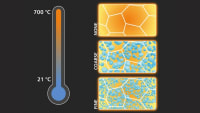
Aerospace & Defense Tech Briefs
Confidence Through Testing: How to Design a Practical Structural Test Program
Aerospace & Defense Tech Briefs
Physicists Measure a Key Aspect of Superconductivity in ‘Magic-Angle’ Graphene
Aerospace & Defense Tech Briefs
Aircraft Maintenance Technicians Seek Simplified, Portable, Fast Aviation Eddy Current Testing
Automotive Engineering
Engineering at the New NVH Frontier
Aerospace & Defense Tech Briefs
Fabrication and Electrical Characterization of Correlated Oxide Field Effect Switching Devices for High Speed Electronics
Overview
The document titled "Virtual Design and Testing of Materials: A Multiscale Approach" is a final technical progress report funded by the Air Force Office of Scientific Research (AFOSR) under Grant # F49620-99-1-0272. It covers the research conducted from May 15, 1998, to June 30, 2006, led by Principal Investigator W. A. Curtin and a team of researchers from various institutions, including Brown University, Caltech, and Harvard.
The primary objective of the research was to develop a virtual testing and design capability for advanced structural materials. This capability aims to facilitate the testing and design of new materials by employing computational methods that can simulate and predict material behavior at multiple scales. The report emphasizes the importance of multiscale approaches in understanding the complex interactions within materials, which is crucial for advancing material science and engineering.
Throughout the report, the authors highlight the theoretical developments achieved during the program, which have garnered interest from various industrial laboratories. These advancements are positioned as beneficial for major industrial users and developers of advanced materials in the United States, particularly in the context of Department of Defense applications. The research is noted for providing a significant portfolio of multiscale research tools that can accelerate the evaluation and testing of advanced materials and systems.
The document also includes a list of publications resulting from the research, showcasing contributions to the fields of computational engineering and materials science. Notable works include studies on orbital-free density functional theory dynamics and the effects of oxidation on nanoscale mechanisms of crack formation in aluminum.
In summary, this report encapsulates a significant body of work aimed at enhancing the design and testing of advanced materials through innovative computational techniques. It underscores the collaborative efforts of a diverse team of researchers and the practical implications of their findings for both academic and industrial applications. The research not only contributes to the scientific community but also addresses the needs of defense agencies by providing tools that can lead to the development of superior materials for various applications.
Top Stories
INSIDERManufacturing & Prototyping
 How Airbus is Using w-DED to 3D Print Larger Titanium Airplane Parts
INSIDERManned Systems
 FAA to Replace Aging Network of Ground-Based Radars
NewsTransportation
 CES 2026: Bosch is Ready to Bring AI to Your (Likely ICE-powered) Vehicle
NewsSoftware
 Accelerating Down the Road to Autonomy
EditorialDesign
 DarkSky One Wants to Make the World a Darker Place
INSIDERMaterials
 Can This Self-Healing Composite Make Airplane and Spacecraft Components Last...
Webcasts
Defense
 How Sift's Unified Observability Platform Accelerates Drone Innovation
Automotive
 E/E Architecture Redefined: Building Smarter, Safer, and Scalable...
Power
 Hydrogen Engines Are Heating Up for Heavy Duty
Electronics & Computers
 Advantages of Smart Power Distribution Unit Design for Automotive...
Unmanned Systems
 Quiet, Please: NVH Improvement Opportunities in the Early Design...
