




New Weapon for Sinking Ships Becomes a Reality
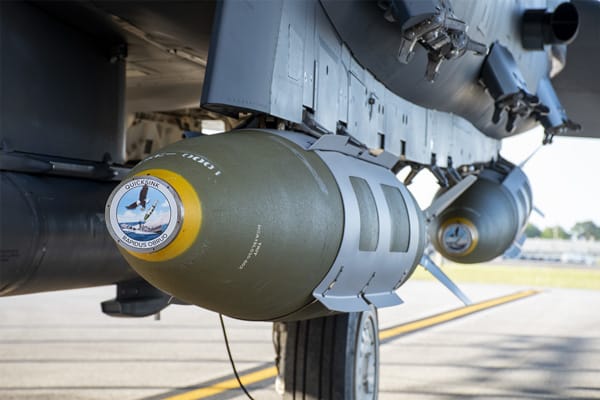
The Air Force Research Laboratory and Eglin’s Integrated Test Team demonstrated a new low-cost, air-delivered capability for defeating maritime threats on April 28, 2022 by successfully destroying a full-scale surface vessel in the Gulf of Mexico. An F-15E Strike Eagle released one modified GBU-31 Joint Direct Attack Munition (JDAM) as part of this test, the second experiment in the QUICKSINK Joint Capability Technology Demonstration (JCTD), funded by the Office of the Under Secretary of Defense for Research and Engineering. The test succeeded through a collaborative effort with AFRL, the 780th Test Squadron of the 96th Test Wing, and the 85th Test and Evaluation Squadron of the 53rd Wing.
AFRL scientists and engineers are developing a weapon open systems architecture, or WOSA, seeker to enable precise placement of the weapon. The implementation of WOSA also lowers costs by providing modularity via the ability to plug-and-play different manufacturers’ seeker components, which can lead to reduced weapon system costs and enhanced performance.
The QUICKSINK program, a partnership with the U.S. Navy, aims to provide options to neutralize surface maritime threats while demonstrating the inherent flexibility of the joint force. This JCTD uses a JDAM to rapidly deliver an immediate effect on stationary or moving maritime targets at minimal costs. While torpedoes predominantly sink enemy ships via submarines, new methods explored through QUICKSINK may achieve anti-ship lethality with air-launched weapons, including modified 2,000-pound JDAM precision-guided bombs.
“Heavyweight torpedoes are effective [at sinking large ships] but are expensive and employed by a small portion of naval assets,” said Maj. Andrew Swanson, 85th TES division chief of Advanced Programs. “With QUICKSINK, we have demonstrated a low-cost and more agile solution that has the potential to be employed by the majority of Air Force combat aircraft, providing combatant commanders and warfighters with more options.”
This latest experiment allowed researchers to assess the scientific and technology challenges associated with the QUICKSINK concept for operational use.
“A Navy submarine has the ability to launch and destroy a ship with a single torpedo at any time, but the QUICKSINK JCTD aims to develop a low-cost method of achieving torpedo-like kills from the air at a much higher rate and over a much larger area,” said Kirk Herzog, AFRL program manager.
As it was released over the Gulf of Mexico, where Eglin operates the 120,000 square mile Eglin Gulf Test and Training Range, stakeholders watched the QUICKSINK demonstration online thanks to multiple camera feeds from aerial platforms.
More From SAE Media Group


Aerospace & Defense Tech Briefs
Navy Lasers, Railgun, and Hypervelocity Projectile: Background and Issues for Congress
Aerospace INSIDER
Air Force Pilots Control XQ-58s from Fighter Jets
Aerospace & Defense Tech Briefs
Electronic Warfare Combat Training Pod
Aerospace & Defense Tech Briefs
Enabling Off-the-Shelf Autonomous Naval Warfare
Defense INSIDER
SDPE’s Rapid Dragon Capability Demonstrated in Norway

Aerospace INSIDER
How the Air Force's B-21 Raider is Advancing Across Test and Production
Aerospace & Defense Tech Briefs
F/A-18 Infrared Search and Rescue System

Defense INSIDER
New Combat Pod System Wakes Up with Software Updates
Defense INSIDER
Australia to Acquire New Class of Nuclear Submarines

Defense INSIDER
Navy Proves Cold-Gas Approach in Hypersonic Launch Test
Aerospace INSIDER
F-35 Proves Nuke Drop Performance in Stockpile Flight Testing

Aerospace INSIDER
EA-37B Compass Call: The US Air Force's New Electronic Attack Aircraft
Defense INSIDER
Navy Deploys Automated Energy Assessment Tools to the Fleet

Aerospace & Defense Tech Briefs
Raytheon Looks to Upgrade Carrier Landing System for Ground Use
Aerospace INSIDER
First F-15Es Equipped With EPAWSS Ready for Flight

Aerospace & Defense Tech Briefs
Advanced Airborne Defensive Laser for Incorporation on Strike Fighter Aircraft
Defense INSIDER
Sandia-Led Team Helps Extend Life of B61 Nuclear Deterrent
Aerospace Manufacturing and Machining INSIDER
Marines Receive First Combat and Control Variant of Amphibious Combat Vehicle
Aerospace INSIDER
Barracuda: Anduril's New Software-Defined Autonomous Air Vehicles

Top Stories
NewsSensors/Data Acquisition
 Microvision Aquires Luminar, Plans Relationship Restoration, Multi-industry Push
INSIDERRF & Microwave Electronics
 A Next Generation Helmet System for Navy Pilots
INSIDERWeapons Systems
 New Raytheon and Lockheed Martin Agreements Expand Missile Defense Production
NewsAutomotive
 Ford Announces 48-Volt Architecture for Future Electric Truck
INSIDERAerospace
 Active Strake System Cuts Cruise Drag, Boosts Flight Efficiency
ArticlesTransportation

Webcasts
Aerospace
 Cooling a New Generation of Aerospace and Defense Embedded...
Energy
 Battery Abuse Testing: Pushing to Failure
Power
 A FREE Two-Day Event Dedicated to Connected Mobility
Automotive
 Quiet, Please: NVH Improvement Opportunities in the Early Design Cycle
Electronics & Computers
 Advantages of Smart Power Distribution Unit Design for Automotive &...
Unmanned Systems
 Sesame Solar's Nanogrid Tech Promises Major Gains in Drone Endurance