




New Material Offers Promise for Solid-State Batteries
A new chlorine-based solid-state electrolyte for lithium-ion batteries could lead to higher safety and increased energy density.
Researchers from the University of Waterloo, Canada, who are members of the Joint Center for Energy Storage Research (JCESR), headquartered at the U.S. Department of Energy's (DOE) Argonne National Laboratory, have discovered a new solid electrolyte that offers several important advantages.
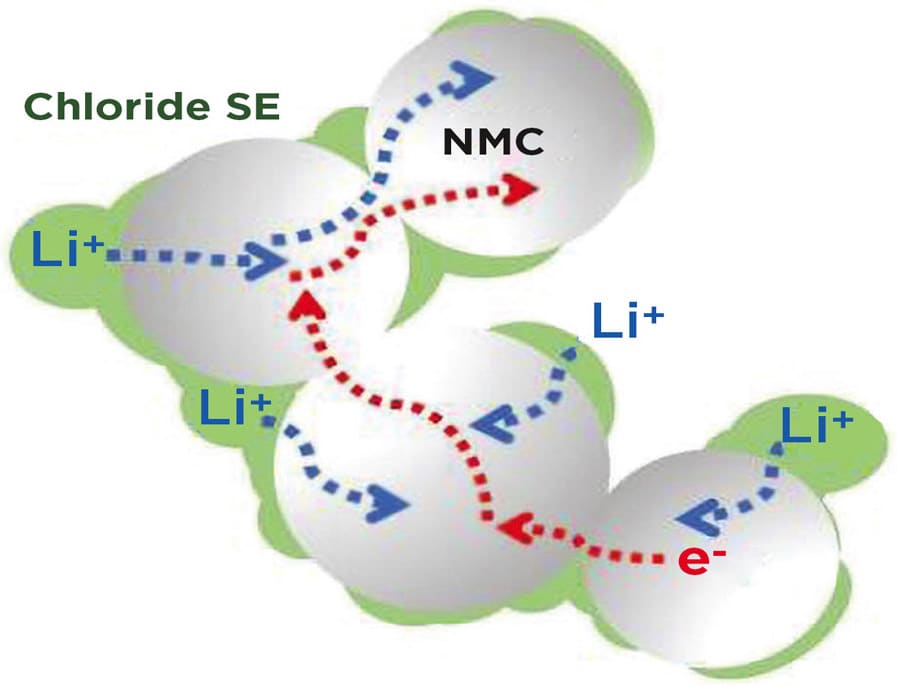
This electrolyte, composed of lithium, scandium, indium, and chlorine, conducts lithium ions well but electrons poorly. This combination is essential to creating an all-solid-state battery that functions without significantly losing capacity for over a hundred cycles at high voltage (above 4 volts) and thousands of cycles at intermediate voltage. The chloride nature of the electrolyte is key to its stability at operating conditions above 4 volts -meaning it is suitable for typical cathode materials that form the mainstay of today's lithium-ion cells.
Current iterations of solid-state electrolytes focus heavily on sulfides, which oxidize and degrade above 2.5 volts. Therefore, they require the incorporation of an insulating coating around the cathode material that operates above 4 volts, which impairs the ability of electrons and lithium ions to move from the electrolyte and into the cathode.
The team wasn't the first to devise a chloride electrolyte, the decision to swap out half of the indium for scandium based on their previous work proved to be a winner in terms of lower electronic and higher ionic conductivity.
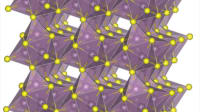
One chemical key to the ionic conductivity lay in the material's crisscrossing 3D structure called a spinel. The researchers had to balance two competing desires – to load the spinel with as many charge carrying ions as possible, but also to leave sites open for the ions to move through.
It is not yet clear why the electronic conductivity is lower than many previously reported chloride electrolytes, but it helps establish a clean interface between the cathode material and solid electrolyte, a fact that is largely responsible for the stable performance even with high amounts of active material in the cathode.
The research was funded by the DOE's Office of Science and Office of Basic Energy Sciences with some support from Canada's National Sciences and Engineering Research Council.
For more information, contact media@ anl.gov; 630-252-5580.
More From SAE Media Group

Battery & Electrification Technology
Material Derived from Trees Could Replace Liquid Electrolytes
Battery & Electrification Technology
Designing Sodium-Ion Batteries with Extended Longevity
Battery Technology
Doubling Battery Performance with Lithium Metal
Battery Technology
Nanostructured Alloy for Battery Anodes
Battery & Electrification Technology
Niobium: Magic Metal for Battery Anodes?
Tech Briefs
Safer, Longer-Lasting, Solid-State Batteries

Battery & Electrification Technology
Enhancing the Performance of All-Solid-State Batteries
Battery & Electrification Technology
Improving and Increasing Energy Density of Batteries
Battery & Electrification Technology
An Alternative to Lithium-Ion Batteries
Battery Technology
Spreadable Way to Stabilize Solid-State Batteries
Tech Briefs
A New Design for Lithium-Sulfur Batteries


Battery & Electrification Technology
New Cathode Material for Sodium-Ion Batteries
Battery Technology
Semi-Liquid Metal Anode

Battery Technology
Electrolyte Design Improves Anode Capacity in Lithium-Ion Batteries


Tech Briefs
Stable, Efficient, Anode-Free Sodium Battery
Tech Briefs
Long-Life Lithium-Metal Battery

Battery & Electrification Technology
Anode-Free Lithium Batteries with Maximized Energy Density
Tech Briefs
Building Temperature-Resilient Batteries
Top Stories
INSIDERDefense
 New Raytheon and Lockheed Martin Agreements Expand Missile Defense Production
NewsAutomotive
 Ford Announces 48-Volt Architecture for Future Electric Truck
INSIDERManufacturing & Prototyping
 Active Strake System Cuts Cruise Drag, Boosts Flight Efficiency
ArticlesTransportation
 Accelerating Down the Road to Autonomy
INSIDERMaterials
 How Airbus is Using w-DED to 3D Print Larger Titanium Airplane Parts
Road ReadyTransportation

Webcasts
Electronics & Computers
 Cooling a New Generation of Aerospace and Defense Embedded...
Power
 Battery Abuse Testing: Pushing to Failure
Connectivity
 A FREE Two-Day Event Dedicated to Connected Mobility
Automotive
 Quiet, Please: NVH Improvement Opportunities in the Early Design Cycle
Transportation
 Advantages of Smart Power Distribution Unit Design for Automotive &...
Aerospace
 Sesame Solar's Nanogrid Tech Promises Major Gains in Drone Endurance