




Micro-Supercapacitors Enable Fast Charging
The supercapacitors are so small that they can fit on the system circuits which control various functions in almost all electronics.
Micro-supercapacitors could revolutionize the way we use batteries by increasing their lifespan and enabling extremely fast charging. Now, researchers at Chalmers University of Technology have developed a method that represents a breakthrough for how such supercapacitors can be produced.
Supercapacitors consist of two electrical conductors separated by an insulating layer. They can store electrical energy and have many positive properties compared to a normal battery, such as much more rapid charging, more efficient energy distribution, and a much greater lifespan without loss of performance, with regards to the charge and discharge cycle. When a supercapacitor is combined with a battery in an electrically powered product, the battery life can be extended many times – up to four times for commercial electric vehicles. And whether for personal electronic devices or industrial technologies, the benefits for the end consumer could be huge.
But in practice, today's supercapacitors are too large for many applications where they could be useful. They need to be about the same size as the battery they are connected to, which is an obstacle to integrating them in mobile phones or electric cars. Therefore, a large part of today's research and development of supercapacitors is about making them smaller.
Agin Vyas, doctoral student at the Department of Microtechnology and Nanoscience at Chalmers University of Technology, and his colleagues have been working with developing ‘micro’ supercapacitors. These are so small that they can fit on the system circuits which control various functions in mobile phones, computers, electric motors, and almost all electronics we use today. This solution is also called 'system-on-a-chip’.
One of the most important challenges is that the minimal units need to be manufactured in such a way that they become compatible with other components in a system circuit and can easily be tailored for different areas of use.
The new paper published by Vyas demonstrates a manufacturing process in which micro-supercapacitors are integrated with the most common way of manufacturing system circuits (known as CMOS).
“We used a method known as spin coating, a cornerstone technique in many manufacturing processes. This allows us to choose different electrode materials. We also use alkylamine chains in reduced graphene oxide, to show how that leads to a higher charging and storage capacity,” said Vyas.
“Our method is scalable and would involve reduced costs for the manufacturing process. It represents a great step forward in production technology and an important step toward the practical application of micro-supercapacitors in both everyday electronics and industrial applications.”
For more information, contact Agin Vyas at
More From SAE Media Group
Automotive Engineering
Clarios to Build Supercapacitor Plant in U.S.
Tech Briefs
Supercapacitor Based on Manganese Oxide
Battery & Electrification Technology
Fast-Charging, Long-Running, Bendable Supercapacitor
Tech Briefs
Supercapacitors for Wearable Devices
Automotive Engineering
Nano-Based Ultracap Tech Boosts EV Power Density
Aerospace & Defense Tech Briefs
Rolls-Royce and Superdielectrics Explore Supercapacitor Technology

Battery Technology
Stretchable Micro-Supercapacitors Self-Power Wearable Devices
Tech Briefs
Maximizing Safety in Advanced Battery Systems

Tech Briefs
Novel, Solid-State Hybrid Ultracapacitor Battery
Medical Design Briefs
Flexible Screen-Printed Rechargeable Battery
Battery Technology
Advancing Battery Technology: THE 2021 BATTERY SHOW Preview

Tech Briefs
Pyroelectric Sandwich Thermal Energy Harvester
Tech Briefs
Ultrahigh-Energy-Density Capacitor

Medical Design Briefs
Powering Wearable Technology with MXene Textile Supercapacitor ‘Patch’
Battery & Electrification Technology
Advancing High-Energy-Density Devices
Automotive Engineering
‘Laxatives’ May Ease Challenge of Lithium-Ion Alternative
Battery & Electrification Technology
Ultracapacitor Solutions to Address Energy-Storage Needs of Vehicles
Green Design & Manufacturing
Fuel-Cell-Powered Vehicle With Hybrid Power Management
Tech Briefs
Coating Extends Lithium Metal Battery Life

Tech Briefs
Nanotransistors Stay Cool at High Voltages
Off-Highway Engineering
Sinonus Carbon-Fiber Structural Batteries Would Reduce Weight While Adding Range
Battery Technology
3D-Printed Biodegradable Battery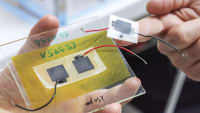



Top Stories
INSIDERManufacturing & Prototyping
 How Airbus is Using w-DED to 3D Print Larger Titanium Airplane Parts
NewsAutomotive
 Microvision Aquires Luminar, Plans Relationship Restoration, Multi-industry Push
INSIDERAerospace
 A Next Generation Helmet System for Navy Pilots
INSIDERDesign
 New Raytheon and Lockheed Martin Agreements Expand Missile Defense Production
ArticlesAR/AI
 CES 2026: Bosch is Ready to Bring AI to Your (Likely ICE-powered) Vehicle
Road ReadyDesign

Webcasts
Semiconductors & ICs
 Advantages of Smart Power Distribution Unit Design for Automotive...
Unmanned Systems
 Quiet, Please: NVH Improvement Opportunities in the Early Design...
Electronics & Computers
 Cooling a New Generation of Aerospace and Defense Embedded...
Power
 Battery Abuse Testing: Pushing to Failure
AR/AI
 A FREE Two-Day Event Dedicated to Connected Mobility
